The Role of Wearables in Race Timing Solution and Participant Experience
Wearable technology has become an integral part of many aspects of daily life, including fitness, healthcare, and sports. In the realm of competitive racing, wearables play a crucial role in optimizing race timing solutions and enhancing the overall participant experience. These technologies offer precise timing, comprehensive performance analytics, and personalized feedback, which are pivotal in modern racing events.
This article explores the technical aspects of wearables in race timing, their impact on participant experience, and the advancements in technology that drive these innovations. We will also examine best practices for integrating wearables into race timing solutions and provide structured insights into their benefits.
The Evolution of Wearables in Racing
Historical Context
Historically, race timing relied on manual methods and rudimentary technology. Early systems included stopwatches and manual record keeping, which were often prone to errors and inefficiencies. The introduction of electronic timing systems marked a significant improvement, but it was the advent of wearable technology that truly revolutionized the field.
Modern Wearable Technologies
Today’s wearables offer advanced features such as GPS tracking, heart rate monitoring, and real-time data analytics. These technologies enable race organizers to provide more accurate and detailed timing solutions, while also enhancing the participant experience through real-time feedback and personalized insights.
Key Technologies in Wearable Race Timing Solutions
GPS Tracking
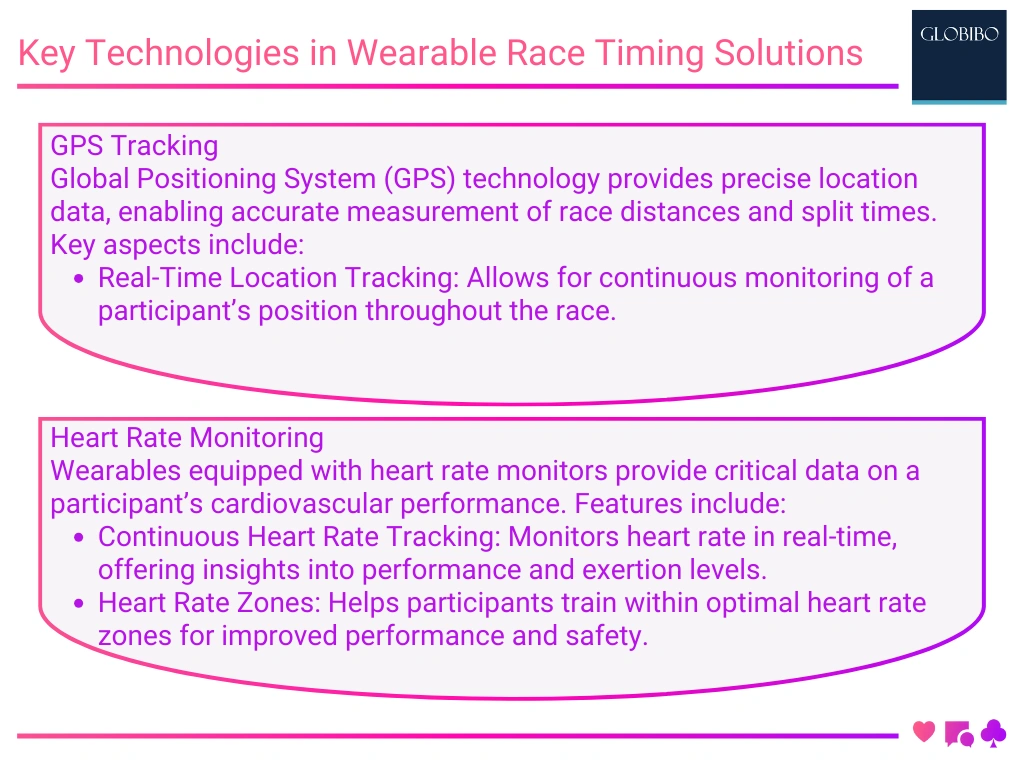
Global Positioning System (GPS) technology provides precise location data, enabling accurate measurement of race distances and split times. Key aspects include:
- Real-Time Location Tracking: Allows for continuous monitoring of a participant’s position throughout the race.
- Geofencing: Enables the creation of virtual boundaries for automatic timing and notifications when participants cross specific points.
Features of GPS in Wearable Race Timing Solutions
| Feature | Description | Importance |
| Real-Time Location | Continuous tracking of participant’s position | Ensures accurate distance and split times |
| Geofencing | Virtual boundaries for automatic timing | Provides notifications and checkpoints |
Heart Rate Monitoring
Wearables equipped with heart rate monitors provide critical data on a participant’s cardiovascular performance. Features include:
- Continuous Heart Rate Tracking: Monitors heart rate in real-time, offering insights into performance and exertion levels.
- Heart Rate Zones: Helps participants train within optimal heart rate zones for improved performance and safety.
Features of Heart Rate Monitoring in Wearable Race Timing Solutions
| Feature | Description | Importance |
| Continuous Monitoring | Real-time tracking of heart rate | Provides insights into exertion levels |
| Heart Rate Zones | Training within optimal heart rate zones | Enhances performance and safety |
Performance Analytics
Wearables provide detailed performance analytics, which are crucial for both participants and race organizers. Key metrics include:
- Pace and Speed: Measurement of average pace and speed throughout the race.
- Cadence: Analysis of the participant’s stride frequency and efficiency.
- Recovery Data: Insights into recovery times and post-race performance.
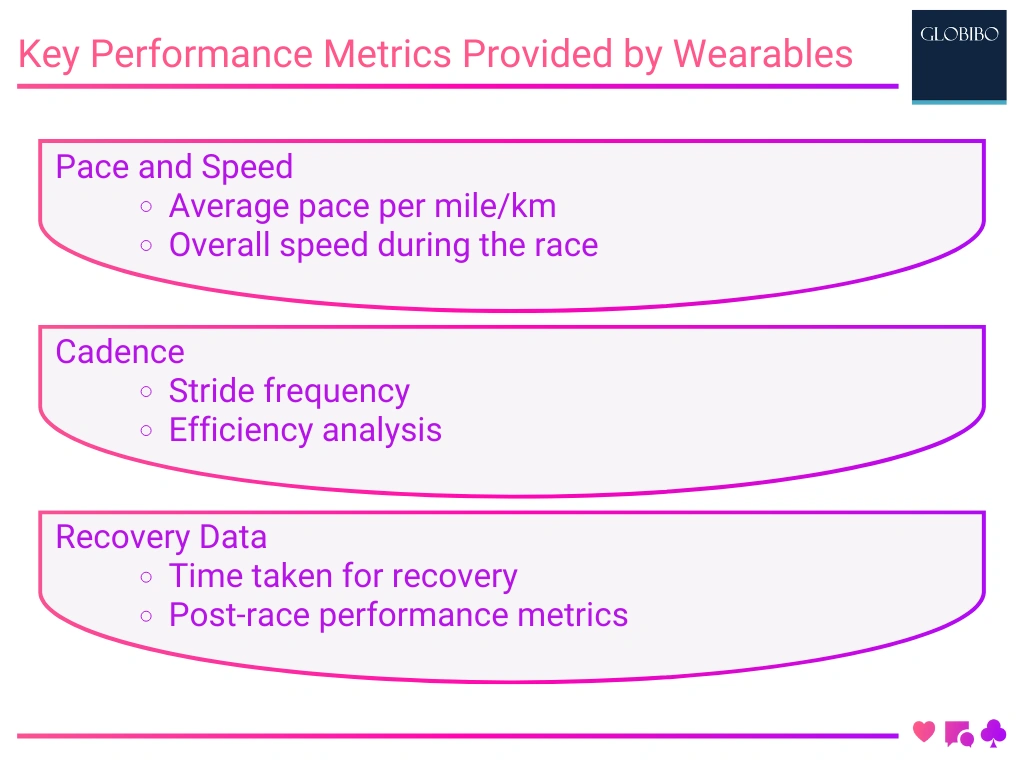
Key Performance Metrics Provided by Wearables
- Pace and Speed
- Average pace per mile/km
- Overall speed during the race
- Cadence
- Stride frequency
- Efficiency analysis
- Recovery Data
- Time taken for recovery
- Post-race performance metrics
Benefits of Wearables in Race Timing Solutions
Enhanced Accuracy
Wearable technology significantly improves the accuracy of race timing solutions. Advanced sensors and algorithms ensure precise measurement of time, distance, and split times, reducing the likelihood of errors associated with manual timing methods.
Real-Time Feedback
Participants benefit from real-time feedback on their performance, including pace, heart rate, and distance covered. This immediate feedback allows runners to adjust their strategies during the race, enhancing their overall performance and experience.
Data-Driven Insights
Post-race analytics provide valuable insights into performance metrics, enabling participants to evaluate their results comprehensively. These insights can be used to tailor future training regimens and improve performance over time.
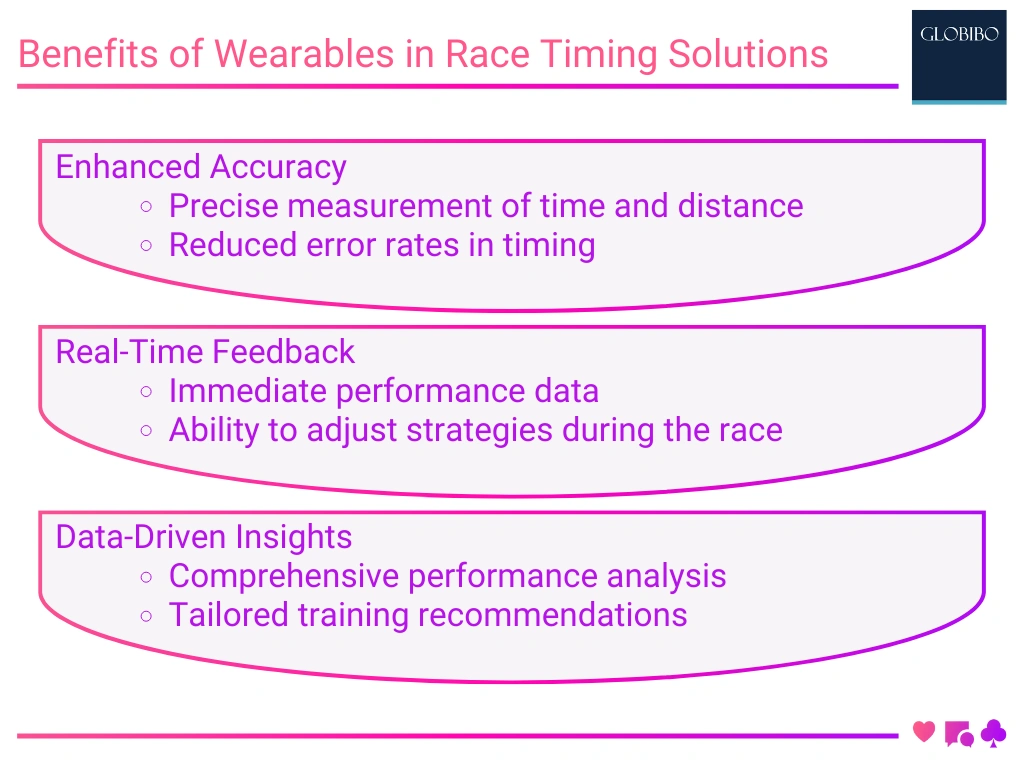
- Enhanced Accuracy
- Precise measurement of time and distance
- Reduced error rates in timing
- Real-Time Feedback
- Immediate performance data
- Ability to adjust strategies during the race
- Data-Driven Insights
- Comprehensive performance analysis
- Tailored training recommendations
Integration and Implementation
Choosing the Right Wearable Technology
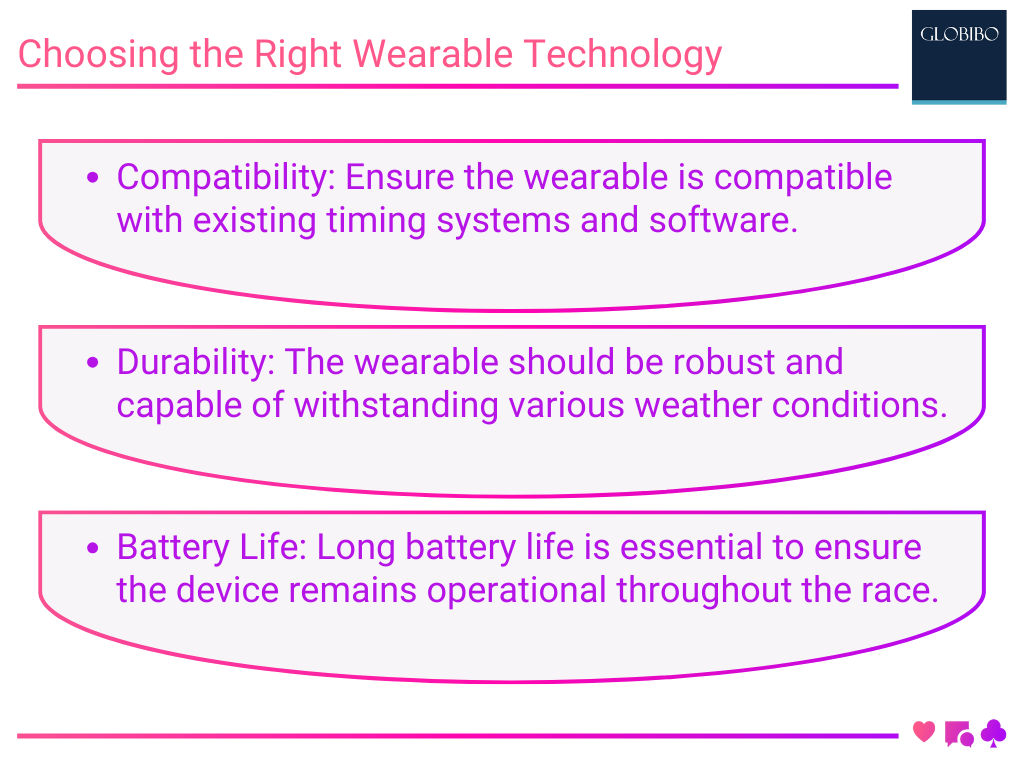
When selecting wearable technology for race timing solutions, consider the following factors:
- Compatibility: Ensure the wearable is compatible with existing timing systems and software.
- Durability: The wearable should be robust and capable of withstanding various weather conditions.
- Battery Life: Long battery life is essential to ensure the device remains operational throughout the race.
Data Management and Security
Effective data management and security practices are crucial when handling sensitive participant data. Implement the following measures:
- Data Encryption: Encrypt data both in transit and at rest to protect against unauthorized access.
- Access Controls: Implement strict access controls to limit who can view and manage race data.
- Regular Audits: Conduct regular audits to ensure compliance with data protection regulations and identify potential vulnerabilities.
Future Trends in Wearable Technology for Racing
Advancements in Sensor Technology
Future advancements in sensor technology are expected to enhance the accuracy and functionality of wearables. Innovations such as improved biometric sensors and more accurate GPS modules will further refine race timing solutions.
Iation with Augmented Reality (AR)Integr
The integration of wearables with augmented reality (AR) could provide participants with immersive experiences, including real-time visual feedback and enhanced navigation during races.
Personalized Performance Optimization
Wearables will continue to evolve towards more personalized performance optimization, leveraging artificial intelligence (AI) and machine learning to offer tailored insights and recommendations based on individual performance data.

Conclusion of Race Timing Solutions
Wearable technology has revolutionized race timing solutions and participant experiences by offering precise timing, real-time feedback, and detailed performance analytics. As advancements in sensor technology and data management continue, wearables will further enhance the accuracy and effectiveness of race timing solutions. By integrating these technologies thoughtfully and adhering to best practices in data security and management, race organizers can significantly improve the quality of racing events and participant satisfaction.
The role of wearables in modern racing extends beyond mere timing; it encompasses a comprehensive approach to enhancing performance, ensuring safety, and providing valuable insights. Embracing these technologies will be essential for staying at the forefront of race timing solutions and delivering exceptional experiences for participants.
Academic Reference for Race Timing Solutions
- [HTML] Accuracy and adoption of wearable technology used by active citizens: a marathon event field study
- The utility of wearable fitness trackers and implications for increased engagement: An exploratory, mixed methods observational study
- Snot, sweat, pain, mud, and snow: Performance and experience in the use of sports watches
- Real-time feedback by wearables in running: Current approaches, challenges and suggestions for improvements
- [HTML] Wearable device signals and home blood pressure data across age, sex, race, ethnicity, and clinical phenotypes in the Michigan Predictive Activity & Clinical …
- Runners’ perspectives on ‘smart’wearable technology and its use for preventing injury
- [HTML] Exploring the role of wearable technology in sport kinematics and kinetics: A systematic review
- New considerations for wearable technology data: changes in running biomechanics during a marathon
- [HTML] The Impact of Wearable Technologies on Marginal Gains in Sports Performance: An Integrative Overview on Advances in Sports, Exercise, and Health
- Social fabric fitness: the design and evaluation of wearable E-textile displays to support group running

Rick Lee
Project Manager – Event Technology
With over 10 years of experience in event technology, Rick is an expert in integrating cutting-edge tech solutions for seamless event execution. His expertise includes audio-visual setups, interactive displays, and live-streaming technologies. Rick’s innovative approach ensures every event is technologically advanced and highly engaging.
Youtube Video on Race Timing Solutions
Key Articles for Race Timing Solutions
- Cost-Effective Race Timing Solutions for Small and Remote Events
- Advancements in GPS Technology for Race Timing
- The Role of Wearables in Enhancing Race Timing and Participant Experience
- Active vs. Passive Transponders: Which Race Timing System is Right for Your Event?
- How Real-Time Data Integration is Transforming Race Day Operations
- Ensuring Race Accuracy with Dual-Band GPS in Challenging Environments
- Backup Timing Solutions: Why Every Race Needs a Contingency Plan
- Innovative Race Timing Software: Features to Look for in 2024
Contacts
Certification

Testimonials



Event Technology