Ensuring Race Accuracy with Dual-Band GPS in Challenging Environments
In the realm of competitive sports, precise race timing is crucial for fair competition and accurate performance analysis. Dual-band GPS technology has emerged as a significant advancement in ensuring race accuracy, particularly in challenging environments. This article explores the technical aspects of dual-band GPS, its application in race timing solutions, and its advantages over traditional GPS systems. By examining various use cases, challenges, and solutions, we aim to provide a comprehensive overview of how dual-band GPS enhances race accuracy.
Race timing solutions are integral to competitive sports, from marathons and triathlons to cycling and skiing. The accuracy of these solutions is paramount, as even minor discrepancies can impact the fairness and credibility of the competition. Traditional GPS systems, while effective in many scenarios, can struggle in environments with high multipath interference, dense foliage, or urban canyons. Dual-band GPS technology offers a solution to these challenges by leveraging multiple frequency bands to improve accuracy and reliability.
Understanding Dual-Band GPS Technology
- Basics of GPS
Global Positioning System (GPS) technology relies on signals from satellites orbiting Earth. A GPS receiver calculates its position by measuring the time it takes for signals to travel from several satellites. Traditional GPS systems use a single frequency band (L1), which can be susceptible to errors caused by atmospheric conditions, multipath interference, and signal degradation.
- Introduction to Dual-Band GPS
Dual-band GPS systems utilize two frequency bands: L1 and L5. The L1 band is the primary frequency used by standard GPS receivers, while the L5 band is a newer, more advanced frequency designed to enhance accuracy and robustness.
The dual-band approach provides several benefits:
- Improved Accuracy: By comparing signals from both bands, dual-band GPS systems can better account for atmospheric distortions and multipath effects.
- Enhanced Reliability: The use of two frequency bands reduces the likelihood of signal loss and improves performance in challenging environments.
-
- Technical Specifications
| Feature | Single-Band GPS | Dual-Band GPS |
| Frequency Bands | L1 | L1, L5 |
| Signal Accuracy | Limited by atmospheric errors | Reduced atmospheric errors |
| Multipath Mitigation | Lower | Higher |
| Reliability | Lower in challenging conditions | Higher in challenging conditions |
Applications in Race Timing Solutions
- Marathon and Endurance Events
Marathons and endurance events often occur in environments with varying terrain and potential signal obstructions. Dual-band GPS systems can provide more accurate tracking of runners by:
- Mitigating Multipath Effects: Dual-band systems can distinguish between direct and reflected signals, reducing errors caused by tall buildings or dense foliage.
- Improving Signal Acquisition: The L5 band provides better performance in difficult conditions, ensuring continuous tracking of participants.
- Cycling and Triathlons
Cycling races and triathlons involve high-speed movement and diverse terrains. Accurate race timing is essential for fair competition and performance analysis. Dual-band GPS systems offer:
- Enhanced Speed Measurement: The improved accuracy of dual-band GPS allows for precise speed and distance measurements, crucial for evaluating athlete performance.
- Reliable Tracking in Urban Environments: Dual-band systems excel in urban environments where signal reflections can distort data.

- Skiing and Winter Sports
In skiing and other winter sports, GPS signals can be challenged by snow-covered landscapes and mountainous terrain. Dual-band GPS technology helps by:
- Accurate Positioning in Remote Areas: The L5 band’s improved performance ensures accurate positioning even in remote or high-altitude locations.
- Robust Tracking in Snowy Conditions: Dual-band systems can better handle signal attenuation caused by snow and ice.
Challenges and Solutions in Race Timing Solution
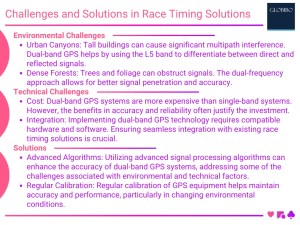
- Environmental Challenges
- Urban Canyons: Tall buildings can cause significant multipath interference. Dual-band GPS helps by using the L5 band to differentiate between direct and reflected signals.
- Dense Forests: Trees and foliage can obstruct signals. The dual-frequency approach allows for better signal penetration and accuracy.
- Technical Challenges
- Cost: Dual-band GPS systems are more expensive than single-band systems. However, the benefits in accuracy and reliability often justify the investment.
- Integration: Implementing dual-band GPS technology requires compatible hardware and software. Ensuring seamless integration with existing race timing solutions is crucial.
- Solutions
- Advanced Algorithms: Utilizing advanced signal processing algorithms can enhance the accuracy of dual-band GPS systems, addressing some of the challenges associated with environmental and technical factors.
- Regular Calibration: Regular calibration of GPS equipment helps maintain accuracy and performance, particularly in changing environmental conditions.
Case Studies and Real-World Applications in Race Timing Solutions
- Case Study: Marathon Race
In a recent marathon held in a city with dense urban infrastructure, traditional GPS systems struggled with signal accuracy due to high multipath interference. The implementation of dual-band GPS technology provided:
- Improved Timing Accuracy: Runners’ positions and times were recorded with greater precision, ensuring accurate race results.
- Enhanced Participant Tracking: Spectators and race organizers benefited from real-time tracking of participants, improving the overall race experience.
- Case Study: Cycling Race
During a high-speed cycling race through mountainous terrain, traditional GPS systems faced challenges with signal reliability. Dual-band GPS systems offered:
- Better Performance in Challenging Terrain: The dual-frequency approach ensured continuous tracking and accurate speed measurements, even in remote areas.
- Enhanced Data Quality: Detailed performance data was available for athletes and coaches, aiding in post-race analysis.

Future Developments in Race Timing Solutions
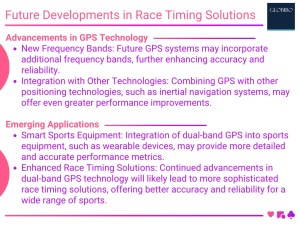
- Advancements in GPS Technology
- New Frequency Bands: Future GPS systems may incorporate additional frequency bands, further enhancing accuracy and reliability.
- Integration with Other Technologies: Combining GPS with other positioning technologies, such as inertial navigation systems, may offer even greater performance improvements.
- Emerging Applications
- Smart Sports Equipment: Integration of dual-band GPS into sports equipment, such as wearable devices, may provide more detailed and accurate performance metrics.
- Enhanced Race Timing Solutions: Continued advancements in dual-band GPS technology will likely lead to more sophisticated race timing solutions, offering better accuracy and reliability for a wide range of sports.
Advantages of Dual-Band GPS
- Enhanced Accuracy: Better compensation for atmospheric errors and multipath interference.
- Improved Reliability: More consistent performance in challenging environments.
- Better Signal Acquisition: Enhanced ability to acquire and maintain signals in difficult conditions.
- Greater Precision: More accurate tracking of speed, distance, and position.
Common Challenges and Solutions for Dual-Band GPS
- Urban Canyons:
- Challenge: Multipath interference from tall buildings.
- Solution: Use of L5 band to distinguish between direct and reflected signals.
- Dense Forests:
- Challenge: Signal obstruction from trees and foliage.
- Solution: Improved signal penetration with dual-frequency technology.
- Cost:
- Challenge: Higher cost compared to single-band GPS systems.
- Solution: Justification through enhanced accuracy and reliability.
- Integration:
- Challenge: Compatibility with existing hardware and software.
- Solution: Implementation of advanced algorithms and regular calibration.
Conclusion of Race Timing Solutions
Dual-band GPS technology represents a significant advancement in race timing solutions, offering improved accuracy and reliability in challenging environments. By leveraging both L1 and L5 frequency bands, dual-band GPS systems address the limitations of traditional single-band systems and provide more precise and dependable tracking of athletes. As technology continues to evolve, the integration of dual-band GPS into race timing solutions will enhance the fairness and accuracy of competitive sports events, benefiting both participants and organizers.
Academic Reference for Race Timing Solutions
- [BOOK] Dual–band antenna for integrated GPS/PCS terminals.
- Continuous athlete monitoring in challenging cycling environments using IoT technologies
- [PDF] Bandpass Sampling Methodology for Uniformly Spaced Multiband Energy-Sparse Spectrum
- [PDF] Detection and Mitigation of GNSS Interference for Robust Navigation and Timing
- The race to 5G era; LTE and Wi-Fi
- Robust Localization for an Autonomous Racing Vehicle
- Dual band GNSS antenna with high back lobe suppression
- Environment perception for an autonomous radio-controlled vehicle with artificial intelligence algorithm
- [PDF] Absolute positioning of vehicles in indoor environments using Wireless LAN and Bluetooth LE
- [PDF] THE UTILIZATION OF GPS IN ORIENTEERING MAPPING IN URBAN HELSINKI AND RURAL KENYA

Rick Lee
Project Manager – Event Technology
With over 10 years of experience in event technology, Rick is an expert in integrating cutting-edge tech solutions for seamless event execution. His expertise includes audio-visual setups, interactive displays, and live-streaming technologies. Rick’s innovative approach ensures every event is technologically advanced and highly engaging.
Youtube Video on Race Timing Solutions
Key Articles for Race Timing Solutions
- Cost-Effective Race Timing Solutions for Small and Remote Events
- Advancements in GPS Technology for Race Timing
- The Role of Wearables in Enhancing Race Timing and Participant Experience
- Active vs. Passive Transponders: Which Race Timing System is Right for Your Event?
- How Real-Time Data Integration is Transforming Race Day Operations
- Ensuring Race Accuracy with Dual-Band GPS in Challenging Environments
- Backup Timing Solutions: Why Every Race Needs a Contingency Plan
- Innovative Race Timing Software: Features to Look for in 2024
Contacts
Certification

Testimonials










Event Technology