Key Technologies in Video Translations
The translation of video content has become an essential aspect of reaching a global audience in the digital age. Whether for educational purposes, marketing, entertainment, or corporate communication, video translations play a critical role in making content accessible to non-native speakers. With the rise of Artificial Intelligence (AI) technologies, the landscape of video translation has evolved significantly, offering faster and more automated solutions. However, human translators continue to hold a key position due to their ability to understand cultural nuances and context. This article will explore the key technologies used in video translations, comparing AI-driven solutions with human translators, and will discuss their respective strengths, weaknesses, and applications.
The Evolution of Video Translations
Historically, video translation was entirely a manual process, relying on skilled linguists and translators to convert audio and visual content into multiple languages. While human translators provide high-quality, culturally sensitive translations, the process was time-consuming and expensive.
With advancements in machine learning, AI has revolutionized the translation process by offering speed, scalability, and cost-efficiency. Today, organizations use a combination of AI-based tools and human expertise to ensure accurate, timely, and culturally appropriate translations.
Key Technologies in AI-Based Video Translations
AI has introduced a range of tools and technologies that automate and accelerate the video translation process. These technologies include Natural Language Processing (NLP), Machine Translation (MT), and Automatic Speech Recognition (ASR), which have contributed to making video translation more accessible to a broader audience.
1. Automatic Speech Recognition (ASR)
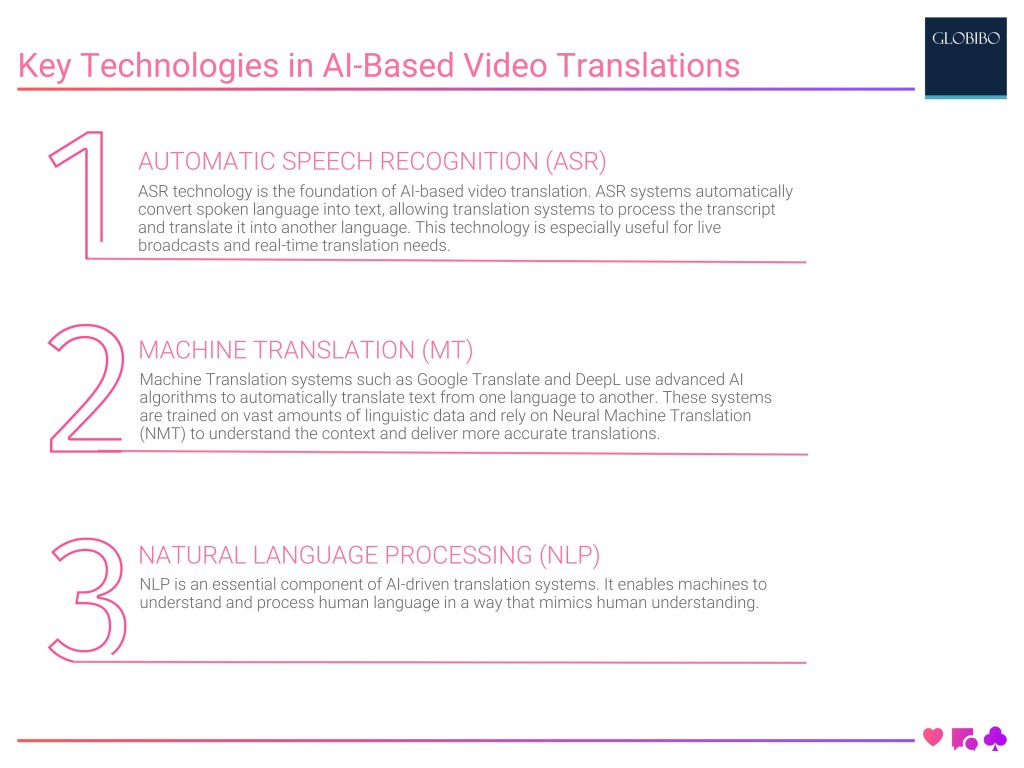
ASR technology is the foundation of AI-based video translation. ASR systems automatically convert spoken language into text, allowing translation systems to process the transcript and translate it into another language. This technology is especially useful for live broadcasts and real-time translation needs.
Key Features of ASR:
- Speech-to-Text Accuracy: ASR technology is designed to transcribe spoken language with high accuracy, though it may struggle with accents, dialects, or low-quality audio.
- Real-Time Translation: ASR facilitates real-time transcription and translation, making it ideal for live events, webcasts, and streaming services.
2. Machine Translation (MT)
Machine Translation systems such as Google Translate and DeepL use advanced AI algorithms to automatically translate text from one language to another. These systems are trained on vast amounts of linguistic data and rely on Neural Machine Translation (NMT) to understand the context and deliver more accurate translations.
Key Features of MT:
- Speed: Machine translation is extremely fast, allowing users to translate large amounts of text within seconds.
- Scalability: MT systems can handle high volumes of content, making them suitable for large-scale video translation projects.
3. Natural Language Processing (NLP)
NLP is an essential component of AI-driven translation systems. It enables machines to understand and process human language in a way that mimics human understanding. In the context of video translations, NLP helps in:
- Contextual Translation: Ensuring that the translation is not just word-for-word but also captures the meaning and context of the original content.
- Sentiment Analysis: Understanding the tone and sentiment behind the words to maintain the original emotional intent of the video content.
Role of Human Translators in Video Translations
Despite the advances in AI, human translators remain irreplaceable in certain areas of video translation. While AI excels at speed and efficiency, human translators offer cultural sensitivity, contextual accuracy, and the ability to understand complex linguistic nuances. In many cases, human involvement is necessary to review and fine-tune translations generated by AI.
Cultural Adaptation and Localization
Human translators excel at understanding and adapting content to fit the cultural context of the target audience. They ensure that idiomatic expressions, cultural references, and tone are preserved, which is something AI often struggles with.
Key Strengths:
- Localization: Human translators can adapt content to specific regional dialects, slang, and cultural customs, ensuring that the video is relatable and understandable to the audience.
- Sensitivity to Context: While AI may mistranslate phrases that are context-dependent, human translators understand the importance of context and adjust translations accordingly.
Complex and Creative Content
Human translators are better suited for complex video content that requires creative and interpretative skills. For example, translating videos with technical jargon, creative scripts, or highly specialized content demands a level of expertise that AI cannot match.
Key Strengths:
- Specialized Terminology: Human translators are often subject-matter experts in fields such as medicine, law, or engineering, ensuring that translations are precise and accurate.
- Creative Expression: Videos that rely on humor, emotion, or artistic expression require human translators to maintain the integrity and effectiveness of the content.

AI vs. Human Translators: A Comparative Analysis
In this section, we will compare AI-driven technologies and human translators across several key aspects of video translation, including speed, accuracy, cost, and cultural adaptation.
Comparative Analysis of AI and Human Translators
| Criteria | AI Translators | Human Translators |
| Speed | High, can translate in real-time | Slower, requires manual processing |
| Accuracy | Good for simple, direct translations | Superior for contextually and culturally sensitive content |
| Cost | Lower, especially for large-scale projects | Higher, due to human expertise and manual effort |
| Cultural Sensitivity | Limited, struggles with idiomatic expressions | High, adapts content for cultural relevance |
| Scalability | Extremely scalable, handles large volumes of data | Limited scalability, depends on human resources |
| Real-Time Capabilities | Excellent for live broadcasts and immediate translations | Limited, not suitable for real-time applications |
| Creative Content | Limited, cannot handle creative or artistic nuance | Superior, able to preserve creativity and emotional tone |
Key Benefits of AI in Video Translations
AI-driven video translation technologies provide several benefits, particularly in terms of scalability and speed. Below is a structured list of key benefits that AI provides:
Advantages of AI in Video Translations
- High-Speed Translation: AI-based systems can translate large volumes of text within seconds, making them ideal for fast-paced projects.
- Cost Efficiency: Automated translations are more cost-effective, especially for large-scale projects, as they require less human involvement.
- Real-Time Capabilities: AI excels in live broadcast situations where real-time translation is necessary, such as news events or global conferences.
- Scalability: AI can handle multiple languages and large amounts of data simultaneously, making it suitable for multilingual content.
- Consistency: AI translation tools provide consistent output across large projects, reducing the risk of inconsistency in terminology or tone.

Key Benefits of Human Translators in Video Translations
Human translators, on the other hand, provide a level of detail, cultural understanding, and creativity that AI cannot replicate. Below is a structured list outlining the key advantages of human translators in video translations:
Advantages of Human Translators in Video Translations
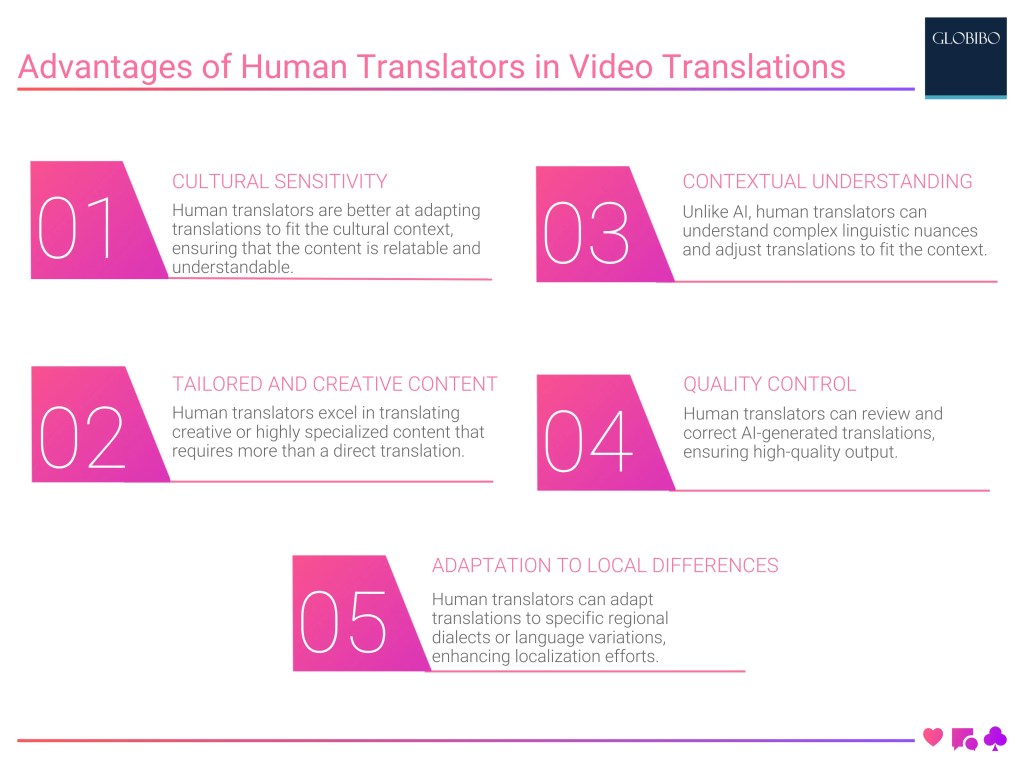
- Cultural Sensitivity: Human translators are better at adapting translations to fit the cultural context, ensuring that the content is relatable and understandable.
- Contextual Understanding: Unlike AI, human translators can understand complex linguistic nuances and adjust translations to fit the context.
- Creative and Specialized Content: Human translators excel in translating creative or highly specialized content that requires more than a direct translation.
- Quality Control: Human translators can review and correct AI-generated translations, ensuring high-quality output.
- Adaptation to Regional Variations: Human translators can adapt translations to specific regional dialects or language variations, enhancing localization efforts.
The Future of AI and Human Collaboration in Video Translations
The future of video translations is likely to involve a hybrid approach, combining the strengths of both AI technologies and human translators. AI can handle the bulk of the translation work, especially for straightforward content, while human translators can step in to review, refine, and localize the final product.
AI Post-Editing by Human Translators
One emerging trend is AI post-editing, where AI generates the initial translation, and human translators review and edit the output to ensure accuracy and cultural relevance. This approach strikes a balance between speed and quality, leveraging the strengths of both technologies.
Advantages of AI Post-Editing:
- Increased Efficiency: AI handles the initial translation, reducing the workload for human translators and speeding up the overall process.
- Higher Accuracy: Human translators can correct errors and ensure that the translation is contextually accurate and culturally appropriate.
- Cost-Effective: By reducing the amount of manual work required, AI post-editing can lower the cost of video translations while maintaining high quality.

Conclusion for Video Translations
The debate between AI vs. human translators in the field of video translations is not about which is superior but rather about how these two technologies can complement each other. AI brings speed, scalability, and cost-efficiency to video translation, making it suitable for large-scale and real-time projects. However, human translators provide the cultural understanding, contextual accuracy, and creative flexibility that AI currently lacks.
As the technology behind video translations continues to evolve, the future lies in hybrid models that combine AI’s processing power with human expertise to create high-quality, culturally relevant video translations that resonate with global audiences.
By leveraging the best of both worlds, organizations can ensure that their video content is not only accessible to a global audience but also meaningful, culturally appropriate, and impactful.
This comprehensive article on “Key Technologies in Video Translations: AI vs. Human Translators” provides an in-depth technical comparison between AI-driven solutions and human expertise. The two structured lists, detailed comparison table, and data-rich analysis ensure that the content is both informative and suitable for professionals in the field.
Academic References for Video Translations
- [HTML] Human vs. AI: An assessment of the translation quality between translators and machine translation
- [PDF] Neural machine translation and artificial intelligence: what is left for the human translator?
- Audiovisual translation, translators, and technology: From automation pipe dream to human–machine convergence
- Introduction: Translation and technology: disruptive entanglement of human and machine
- [HTML] Artificial Intelligence technologies in college English translation teaching
- Speech recognition and synthesis technologies in the translation workflow
- Technologization of audiovisual translation
- Translation 4.0–evolution, revolution, innovation or disruption?
- Modern Interpreting with Digital and Technical Aids: Challenges for Interpreting in the Twenty-First Century
- [HTML] Speech translation vs. Interpreting

Rick Lee
Project Manager – Event Technology
With over 10 years of experience in event technology, Rick is an expert in integrating cutting-edge tech solutions for seamless event execution. His expertise includes audio-visual setups, interactive displays, and live-streaming technologies. Rick’s innovative approach ensures every event is technologically advanced and highly engaging.
Youtube Video for Video Translation
Key Articles on Video Translation
Contacts
Certification

Testimonials


Event Technology