How AI-Powered Live Captions Work
In recent years, live captioning has become an essential tool for improving accessibility and inclusivity in various settings, from live broadcasts and online streaming to corporate meetings and educational webinars. With advancements in artificial intelligence (AI) and machine learning, the process of creating live captions has evolved significantly. AI-powered live captions provide real-time transcription of spoken language into text, making content accessible to individuals who are deaf or hard of hearing, as well as those who prefer reading along with the audio.
This article delves into the technical aspects of AI-powered live captioning, explaining the underlying technologies, processes, and challenges involved. By understanding how these systems work, we can appreciate their impact on accessibility and the future potential of live captioning technology.
The Importance of Live Captions
Before exploring the mechanics of AI-powered live captions, it is crucial to understand their importance in today’s digital and professional environments. Captions serve multiple functions:
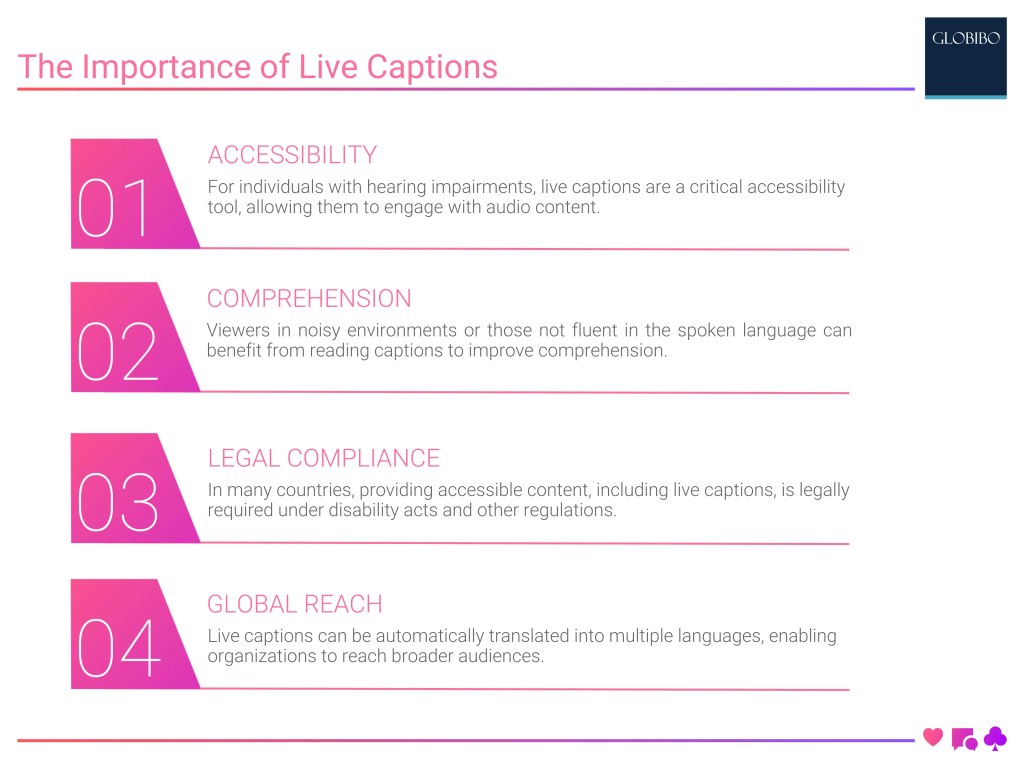
- Accessibility: For individuals with hearing impairments, live captions are a critical accessibility tool, allowing them to engage with audio content.
- Comprehension: Viewers in noisy environments or those not fluent in the spoken language can benefit from reading captions to improve comprehension.
- Legal Compliance: In many countries, providing accessible content, including live captions, is legally required under disability acts and other regulations.
- Global Reach: Live captions can be automatically translated into multiple languages, enabling organizations to reach broader audiences.
Key Technologies Behind AI-Powered Live Captions
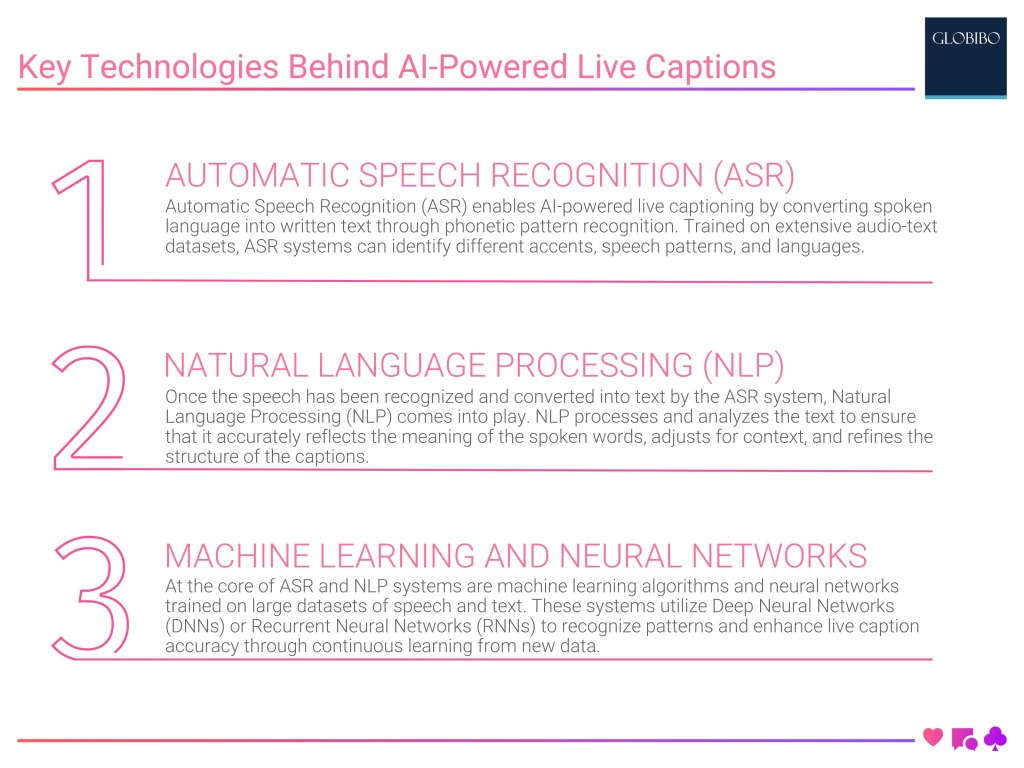
The process of generating AI-powered live captions involves a combination of sophisticated technologies, including Automatic Speech Recognition (ASR), Natural Language Processing (NLP), and Machine Learning (ML) models. These technologies work together to capture spoken words, convert them into text, and ensure that the captions are accurate, contextually relevant, and delivered in real-time.
Automatic Speech Recognition (ASR)
Automatic Speech Recognition (ASR) is the cornerstone of AI-powered live captioning. It is responsible for converting spoken language into written text by identifying phonetic patterns in the audio signal. ASR systems are trained on large datasets of audio and text pairs, allowing them to recognize various accents, speech patterns, and languages.
Key Components of ASR:
- Acoustic Model: The acoustic model is trained to understand the relationship between linguistic units (phonemes) and their acoustic representations. It processes the sound waves from speech and identifies individual sounds.
- Language Model: The language model ensures that the recognized phonemes are combined in a way that forms coherent words and sentences. This model relies on a database of language patterns, rules, and contextual understanding.
- Decoding: The decoding process involves converting the recognized phonemes and words into meaningful text output, often applying algorithms to ensure the final text is grammatically correct and contextually appropriate.
Natural Language Processing (NLP)
Once the speech has been recognized and converted into text by the ASR system, Natural Language Processing (NLP) comes into play. NLP processes and analyzes the text to ensure that it accurately reflects the meaning of the spoken words, adjusts for context, and refines the structure of the captions.
Key Functions of NLP in Live Captions:
- Contextual Understanding: NLP systems help ensure that words are placed in the correct context, reducing errors that may arise from homophones or ambiguous phrases.
- Grammatical Corrections: NLP algorithms adjust the grammar and sentence structure of the transcribed text to improve readability and coherence.
- Handling Accents and Dialects: NLP assists in understanding regional accents and dialects by applying language-specific rules and adjusting the transcription to match local nuances.
Machine Learning and Neural Networks
At the heart of ASR and NLP systems are machine learning algorithms and neural networks. These algorithms are trained on massive datasets of speech and text to recognize patterns and improve the accuracy of live captions over time. The most advanced systems use Deep Neural Networks (DNNs) or Recurrent Neural Networks (RNNs) to continuously learn from new data and optimize their performance.
Key Benefits of Machine Learning:
- Improved Accuracy: As AI-powered systems process more data, their ability to recognize and transcribe speech improves, reducing error rates in live captioning.
- Adaptability: Machine learning allows systems to adapt to new languages, accents, and technical jargon by updating their models based on the data they encounter.
The Process Flow of AI-Powered Live Captions
The process of generating AI-powered live captions involves several steps, from capturing the audio to delivering the captions in real-time. Below is an overview of the key steps in the process.
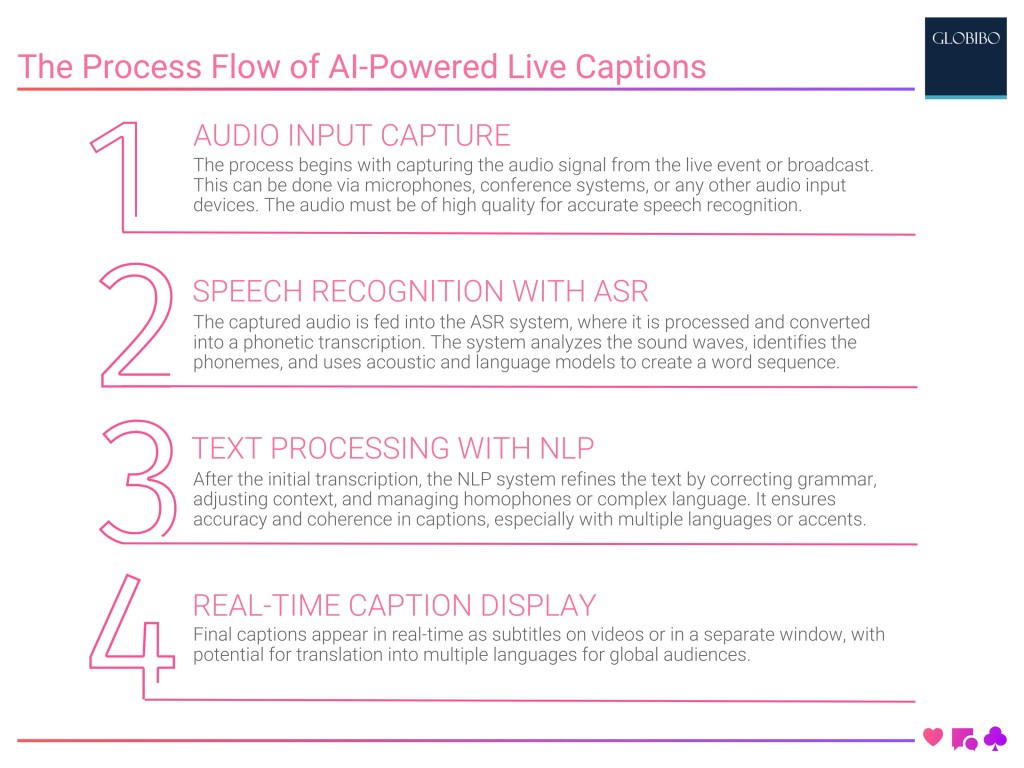
Audio Input Capture
The process begins with capturing the audio signal from the live event or broadcast. This can be done via microphones, conference systems, or any other audio input devices. The audio must be of high quality for accurate speech recognition.
Speech Recognition with ASR
The captured audio is fed into the ASR system, where it is processed and converted into a phonetic transcription. The system analyzes the sound waves, identifies the phonemes, and uses acoustic and language models to create a word sequence.
Text Processing with NLP
Once the initial transcription is generated, the NLP system refines the text. This step includes applying grammatical corrections, contextual adjustments, and handling homophones or complex linguistic structures. In cases where there are multiple languages or accents, the NLP system ensures that the captions remain accurate and coherent.
Real-Time Caption Display
The final captions are displayed in real-time, either as subtitles on the video feed or as text in a separate window for viewers to follow. Depending on the platform, captions can also be translated into different languages, offering multilingual support for global audiences.
Benefits of AI-Powered Live Captions
AI-powered live captions offer numerous benefits, especially when compared to traditional manual transcription methods. Below is a structured list of key benefits:
Advantages of AI-Powered Live Captions
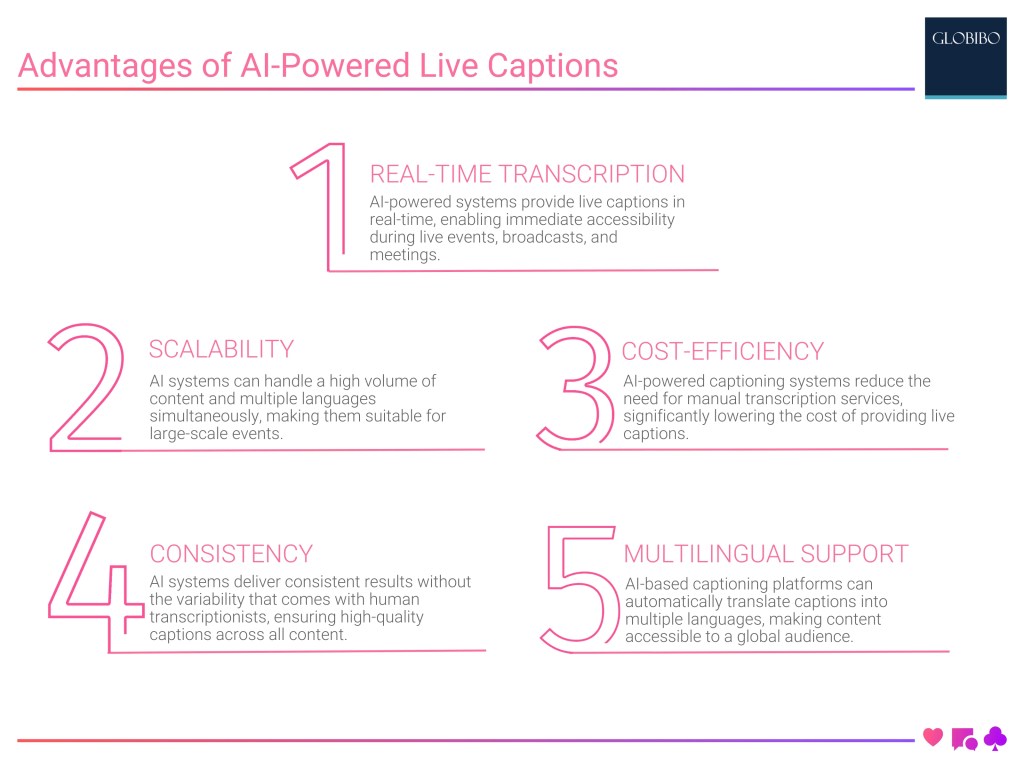
- Real-Time Transcription: AI-powered systems provide live captions in real-time, enabling immediate accessibility during live events, broadcasts, and meetings.
- Scalability: AI systems can handle a high volume of content and multiple languages simultaneously, making them suitable for large-scale events.
- Cost-Efficiency: AI-powered captioning systems reduce the need for manual transcription services, significantly lowering the cost of providing live captions.
- Consistency: AI systems deliver consistent results without the variability that comes with human transcriptionists, ensuring high-quality captions across all content.
- Multilingual Support: AI-based captioning platforms can automatically translate captions into multiple languages, making content accessible to a global audience.
Challenges of AI-Powered Live Captions
Despite their benefits, AI-powered live captions also face several challenges. Below is a structured list of key limitations:
Challenges of AI-Powered Live Captions
- Accuracy in Noisy Environments: Background noise and poor audio quality can affect the accuracy of AI-powered systems, leading to incorrect transcriptions.
- Handling Complex Speech: AI struggles with transcribing complex speech patterns, heavy accents, or dialects that deviate from standard language models.
- Lack of Contextual Understanding: AI systems may misinterpret phrases or homophones without human-level understanding of context, leading to errors.
- Latency Issues: While real-time captioning is possible, there is often a slight delay between speech and captions appearing on the screen, which can disrupt the viewing experience.
- Difficulty with Specialized Terminology: AI may struggle with industry-specific jargon, technical terms, or slang that is not well-represented in its training data.
AI vs. Human Transcription: A Comparative Analysis
While AI-powered live captions are increasingly popular, human transcription services remain a viable option in certain contexts. Below is a comparison between AI and human transcription across several key criteria.
Comparison of AI-Powered Live Captions vs. Human Transcription
| Criteria | AI-Powered Live Captions | Human Transcription |
| Speed | Real-time, with minimal delay | Slower, requires post-production processing |
| Accuracy | High, but varies with audio quality and context | Very high, especially with complex content |
| Cost | Low, as AI reduces the need for manual labor | Higher, due to labor costs |
| Scalability | Scalable for large events and multiple languages | Limited scalability, dependent on human resources |
| Contextual Understanding | Limited, struggles with cultural and contextual nuances | Strong, especially in specialized content |
| Handling Accents/Dialects | May struggle with strong accents or dialects | Effective in understanding regional speech patterns |
| Adaptability | Continually improving with machine learning | Requires training for new languages or topics |
The Future of AI-Powered Live Captions
The future of AI-powered live captions is promising, with ongoing advancements in machine learning and natural language processing. As AI models become more sophisticated, we can expect improvements in the following areas:
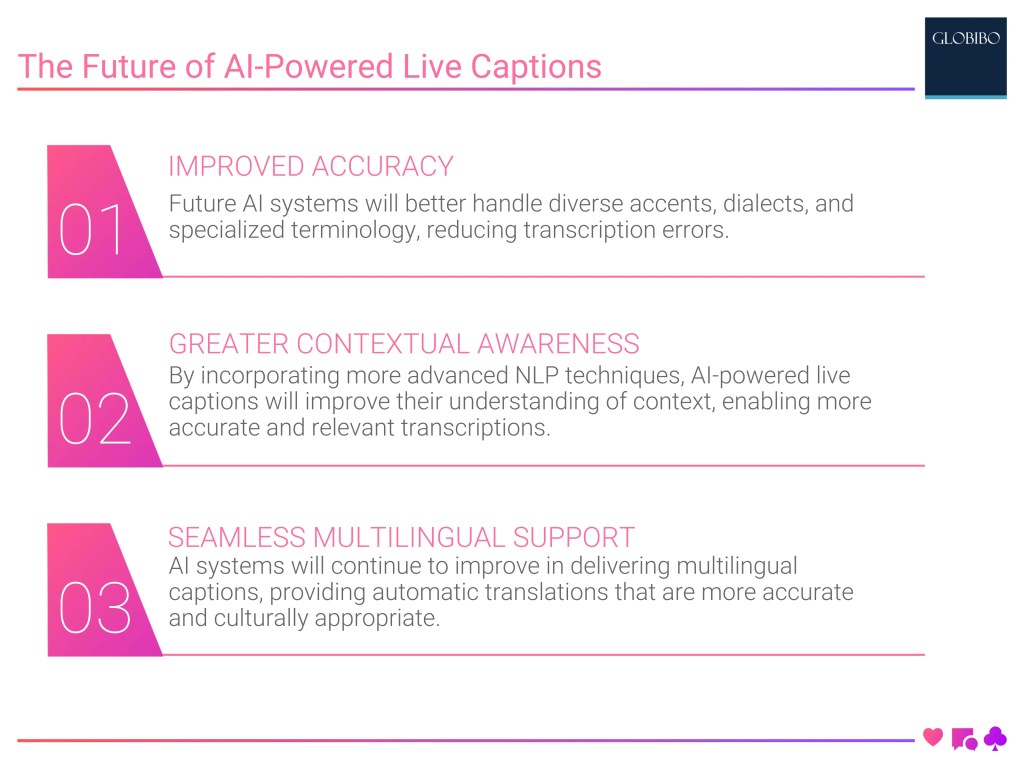
- Improved Accuracy: Future AI systems will better handle diverse accents, dialects, and specialized terminology, reducing transcription errors.
- Greater Contextual Awareness: By incorporating more advanced NLP techniques, AI-powered live captions will improve their understanding of context, enabling more accurate and relevant transcriptions.
- Seamless Multilingual Support: AI systems will continue to improve in delivering multilingual captions, providing automatic translations that are more accurate and culturally appropriate.
- Integration with Augmented Reality (AR): Live captions may be integrated into AR environments, allowing real-time captions to be overlaid in virtual spaces for enhanced accessibility.
Conclusion for AI-Powered Live Captions
AI-powered live captions have revolutionized the way we approach accessibility in live broadcasts, streaming, and virtual events. By leveraging ASR, NLP, and machine learning technologies, AI systems can provide real-time, scalable, and cost-efficient captioning solutions. However, challenges such as accuracy in noisy environments and handling complex speech patterns remain. As AI technology continues to advance, we can expect further improvements in the capabilities and accessibility of live captioning, making it an indispensable tool in our increasingly digital world.
Academic References for AI-Powered Live Captions
- GENERATIVE AI–POWERED FRAMEWORK
- Investigating Use Cases of AI–Powered Scene Description Applications for Blind and Low Vision People
- AI in the media and creative industries
- Investigating Use Cases of AI–Powered Scene Description Applications for Blind and Low Vision People
- Empowering Content Creation using Artificial Intelligence-The Role of Caption Writing: An Overview
- Unlocking Creator-AI Synergy: Challenges, Requirements, and Design Opportunities in AI–Powered Short-Form Video Production
- [BOOK] AI–Powered Productivity
- [HTML] An AI–powered approach to the semiotic reconstruction of narratives
- The Rise of AI‐Generated News Videos: A Detailed Review
- Unleashing the Power of AI: Transforming Indian Cinema

Rick Lee
Project Manager – Event Technology
With over 10 years of experience in event technology, Rick is an expert in integrating cutting-edge tech solutions for seamless event execution. His expertise includes audio-visual setups, interactive displays, and live-streaming technologies. Rick’s innovative approach ensures every event is technologically advanced and highly engaging.
Youtube Video on AI-Powered Live Captions
Key Articles on AI-Powered Live Captions
Contacts
Certification

Testimonials






Event Technology