Challenges in AI-Powered Live Captions and How to Ensure Accuracy
AI-powered live captions have transformed real-time communication by making content more accessible to diverse audiences. From live broadcasts and virtual meetings to educational webinars and online events, these captions offer an essential service by translating spoken language into text. However, the technology behind AI-powered live captions is not without its challenges. Ensuring accuracy and effectiveness in real-time scenarios requires addressing several issues and understanding the underlying technological mechanisms.
This article delves into the key challenges faced by AI-powered live captioning services and provides strategies for ensuring caption accuracy. It includes structured lists detailing common issues and solutions, as well as a comparative table highlighting features of prominent services.
Key Challenges in AI-Powered Live Captions
AI-powered live captioning systems use advanced algorithms to transcribe spoken words into text. Despite significant advancements, several challenges persist:
Accuracy of Speech Recognition
Accuracy is paramount for effective AI-powered live captions. However, achieving high accuracy is challenging due to:
- Variability in Speech: Different accents, speech speeds, and vocal tones can affect recognition accuracy.
- Background Noise: Ambient sounds and overlapping conversations can interfere with the ASR (Automatic Speech Recognition) system’s ability to accurately transcribe speech.
Contextual Understanding
AI systems often struggle with contextual understanding, which affects the relevance and coherence of captions:
- Homophones and Ambiguity: Words that sound alike but have different meanings can cause errors.
- Complex Sentences: Long or complex sentences can be misinterpreted by AI models that lack sophisticated NLP (Natural Language Processing) capabilities.
Latency and Real-Time Processing
Latency is the delay between spoken words and their appearance as captions:
- Processing Time: AI systems need to process and transcribe speech quickly to minimize delay.
- Network Delays: Internet connectivity issues can contribute to latency and affect caption delivery.
Language and Dialect Variability
Support for multiple languages and dialects presents its own set of challenges:
- Limited Language Support: Not all AI captioning services support a wide range of languages or dialects.
- Dialect Variability: Regional accents and dialects can impact transcription accuracy.
Technical Limitations
Technical constraints can affect the performance of AI-powered live captioning:
- Hardware Limitations: The performance of AI models can be constrained by the hardware on which they are deployed.
- Software Integration: Compatibility issues with different platforms and software can affect the seamless delivery of captions.
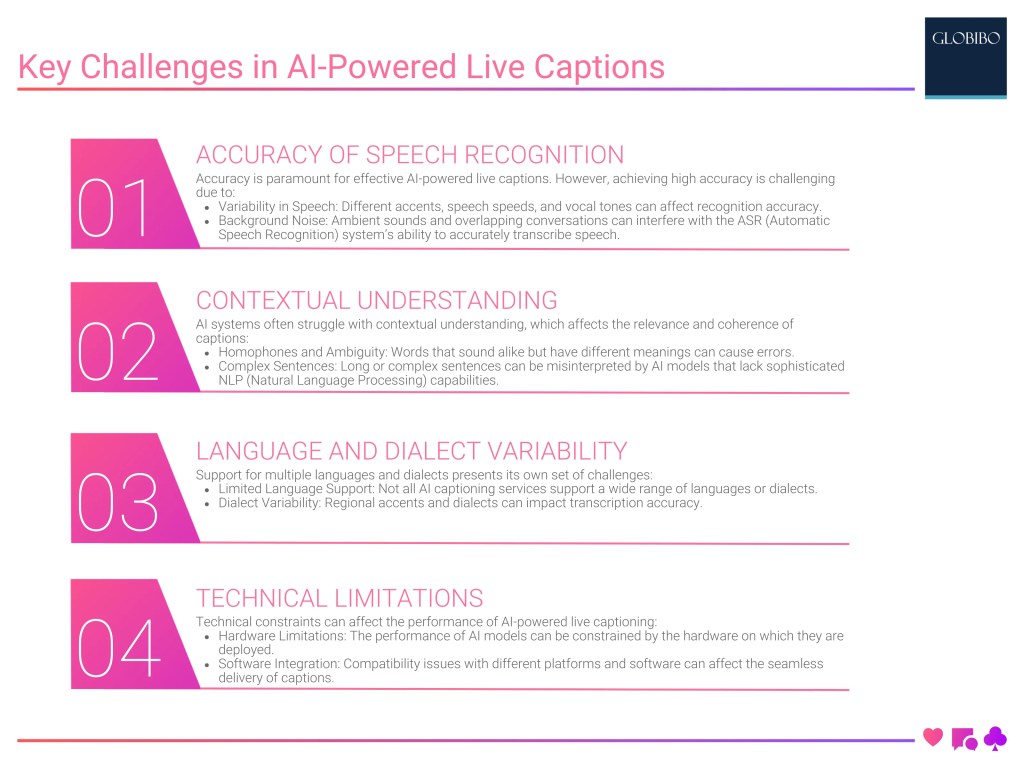
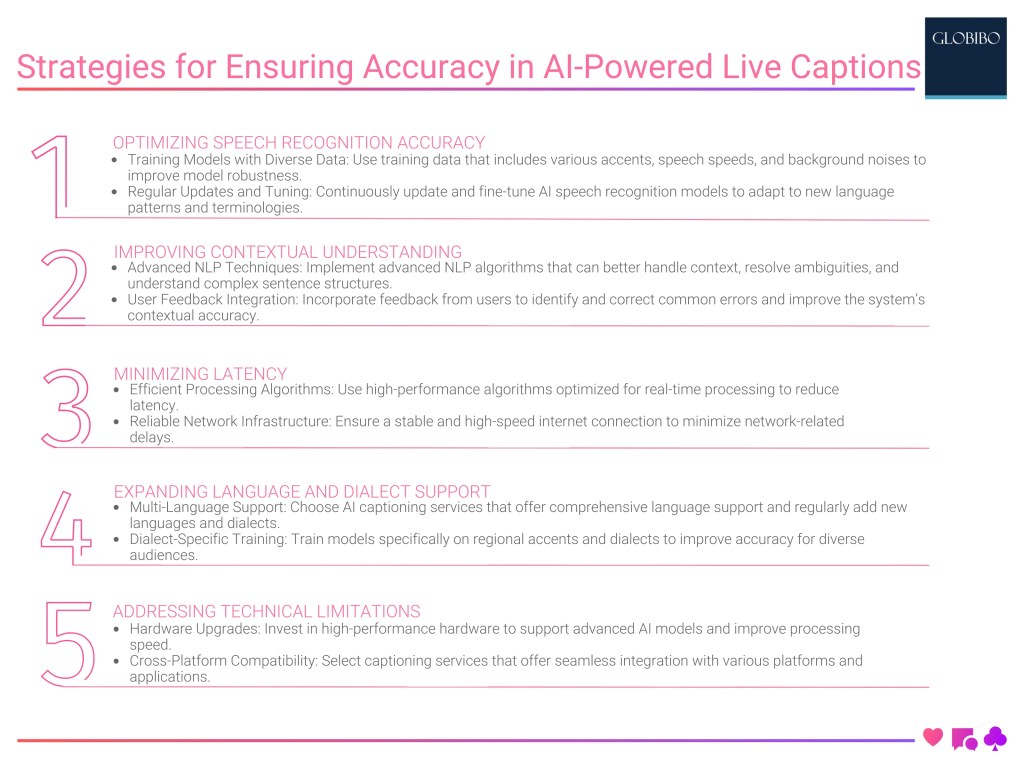
Strategies for Ensuring Accuracy in AI-Powered Live Captions
To address the challenges outlined above and ensure accurate AI-powered live captions, consider the following strategies:
Optimizing Speech Recognition Accuracy
- Training Models with Diverse Data: Use training data that includes various accents, speech speeds, and background noises to improve model robustness.
- Regular Updates and Tuning: Continuously update and fine-tune AI speech recognition models to adapt to new language patterns and terminologies.
Enhancing Contextual Understanding
- Advanced NLP Techniques: Implement advanced NLP algorithms that can better handle context, resolve ambiguities, and understand complex sentence structures.
- User Feedback Integration: Incorporate feedback from users to identify and correct common errors and improve the system’s contextual accuracy.
Minimizing Latency
- Efficient Processing Algorithms: Use high-performance algorithms optimized for real-time processing to reduce latency.
- Reliable Network Infrastructure: Ensure a stable and high-speed internet connection to minimize network-related delays.
Expanding Language and Dialect Support
- Multi-Language Support: Choose AI captioning services that offer comprehensive language support and regularly add new languages and dialects.
- Dialect-Specific Training: Train models specifically on regional accents and dialects to improve accuracy for diverse audiences.
Addressing Technical Limitations
- Hardware Upgrades: Invest in high-performance hardware to support advanced AI models and improve processing speed.
- Cross-Platform Compatibility: Select captioning services that offer seamless integration with various platforms and applications.
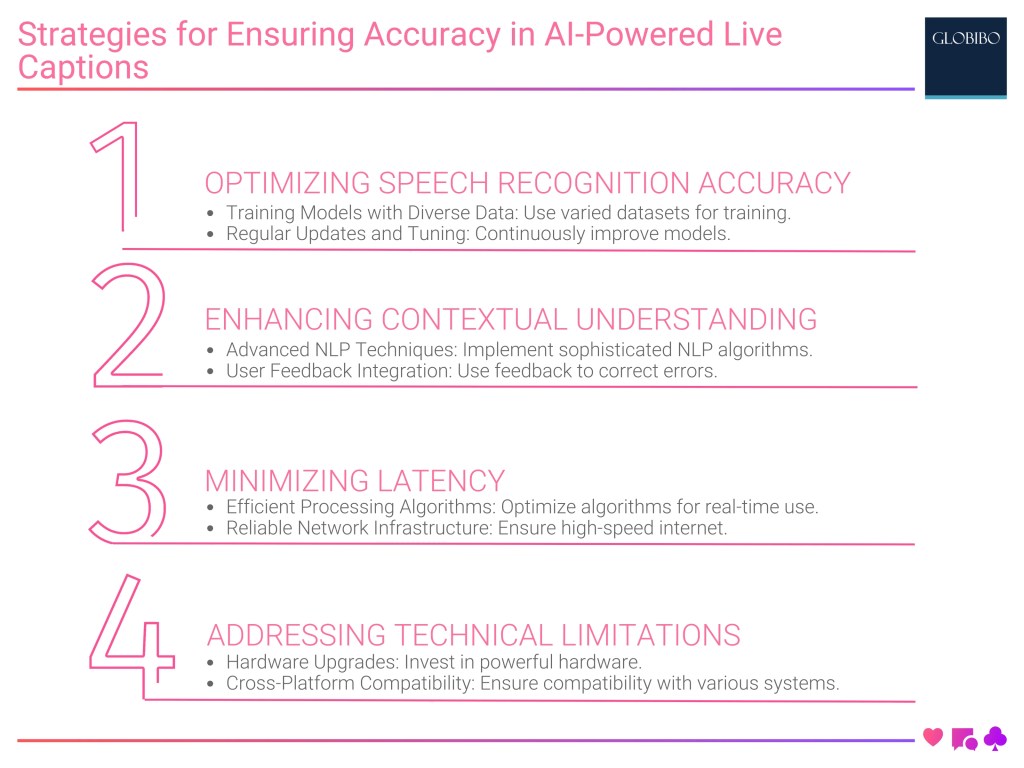
Common Challenges in AI-Powered Live Captions
- Accuracy of Speech Recognition
- Variability in Speech: Accents, speeds, and tones affecting recognition.
- Background Noise: Interference from ambient sounds.
- Contextual Understanding
- Homophones and Ambiguity: Misinterpretation of similar-sounding words.
- Complex Sentences: Difficulty with long or intricate sentences.
- Latency and Real-Time Processing
- Processing Time: Speed of transcription.
- Network Delays: Impact of internet connectivity on caption delivery.
- Language and Dialect Variability
- Limited Language Support: Range of languages supported.
- Dialect Variability: Accuracy with regional accents.
- Technical Limitations
- Hardware Limitations: Constraints of the AI model’s hardware.
- Software Integration: Compatibility with different platforms.
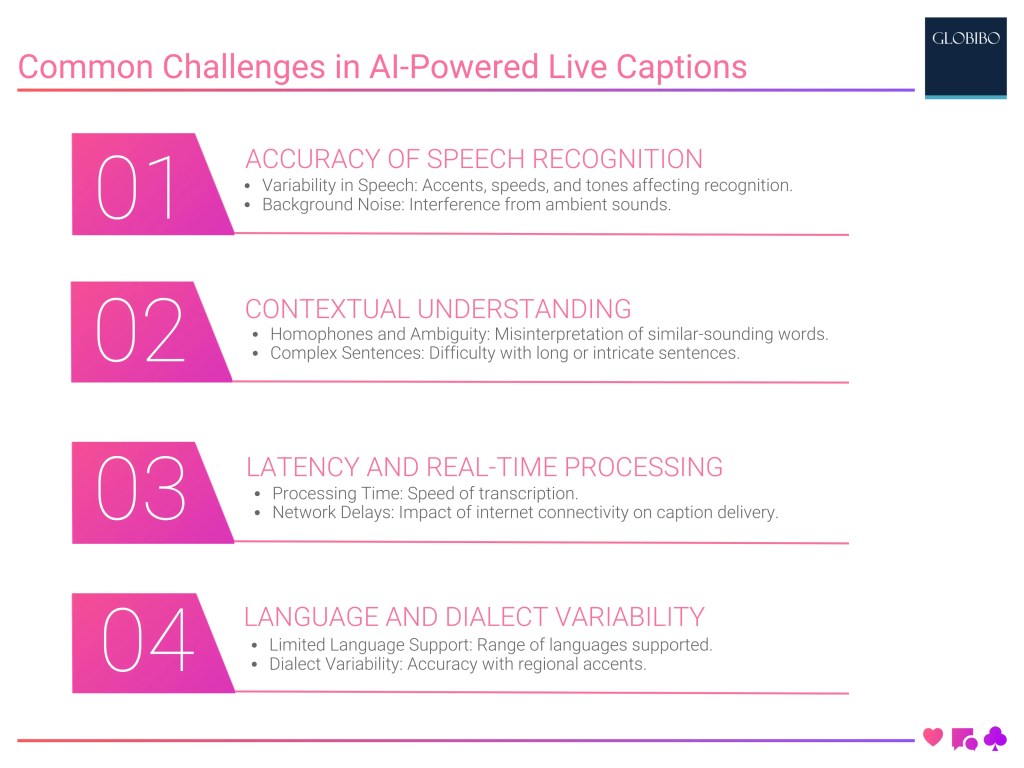
Strategies for Ensuring Accuracy in AI-Powered Live Captions
- Optimizing Speech Recognition Accuracy
- Training Models with Diverse Data: Use varied datasets for training.
- Regular Updates and Tuning: Continuously improve models.
- Enhancing Contextual Understanding
- Advanced NLP Techniques: Implement sophisticated NLP algorithms.
- User Feedback Integration: Use feedback to correct errors.
- Minimizing Latency
- Efficient Processing Algorithms: Optimize algorithms for real-time use.
- Reliable Network Infrastructure: Ensure high-speed internet.
- Expanding Language and Dialect Support
- Multi-Language Support: Choose services with broad language offerings.
- Dialect-Specific Training: Train models on various dialects.
- Addressing Technical Limitations
- Hardware Upgrades: Invest in powerful hardware.
- Cross-Platform Compatibility: Ensure compatibility with various systems.
Conclusion for AI-powered live captioning
AI-powered live captioning services offer significant benefits in enhancing accessibility and engagement across various platforms. However, achieving high accuracy and minimizing challenges such as latency, contextual understanding, and language variability requires careful consideration and the implementation of best practices. By evaluating the key features and addressing common issues, organizations can ensure that their live captioning solutions effectively meet their needs and provide a reliable and inclusive experience for all users.
Academic References for AI-powered live captioning
- Advances, challenges and opportunities in creating data for trustworthy AI
- Evaluating AI assisted subtitling
- Assessing subjective workload for live captioners
- Empowering things with intelligence: a survey of the progress, challenges, and opportunities in artificial intelligence of things
- Image captioning system Using Artificial Intelligence
- A survey on generative ai and llm for video generation, understanding, and streaming
- [PDF] Accuracy of Speech-to-Text Captioning for Students Who are Deaf or Hard of Hearing.
- Measuring the accuracy of automatic speech recognition solutions
- Toward automatic audio description generation for accessible videos
- The Rise of AI‐Generated News Videos: A Detailed Review

Rick Lee
Project Manager – Event Technology
With over 10 years of experience in event technology, Rick is an expert in integrating cutting-edge tech solutions for seamless event execution. His expertise includes audio-visual setups, interactive displays, and live-streaming technologies. Rick’s innovative approach ensures every event is technologically advanced and highly engaging.
Youtube Video for AI-Powered Live Captions
Key Articles on for AI-Powered Live Captions
Contacts
Certification

Testimonials






Event Technology