AI Captioning & Subtitling Work: An Inside Look at the Technology
AI captioning and subtitling technologies have revolutionized the way we interact with video content by making it more accessible and engaging. These technologies utilize advanced artificial intelligence algorithms to automatically generate captions and subtitles for video content, enhancing comprehension, accessibility, and audience reach. This article provides an in-depth technical analysis of AI captioning and subtitling, exploring the underlying technologies, workflows, and best practices. It includes structured lists and data-rich tables to offer a comprehensive understanding of how these technologies work.
Technical Overview of AI Captioning & Subtitling
Core Technologies
AI captioning and subtitling rely on a combination of several advanced technologies. These technologies work together to ensure accurate, synchronized, and contextually relevant captions and subtitles.
Key Technologies Used
- Speech Recognition (ASR): Converts spoken language into text using automated speech recognition (ASR) systems.
- Natural Language Processing (NLP): Processes and understands the text, handling linguistic nuances and context.
- Machine Translation (MT): Translates text into different languages using neural machine translation (NMT) models.
- Text-to-Speech (TTS): Converts text back into speech for certain applications like voiceovers or audio descriptions.
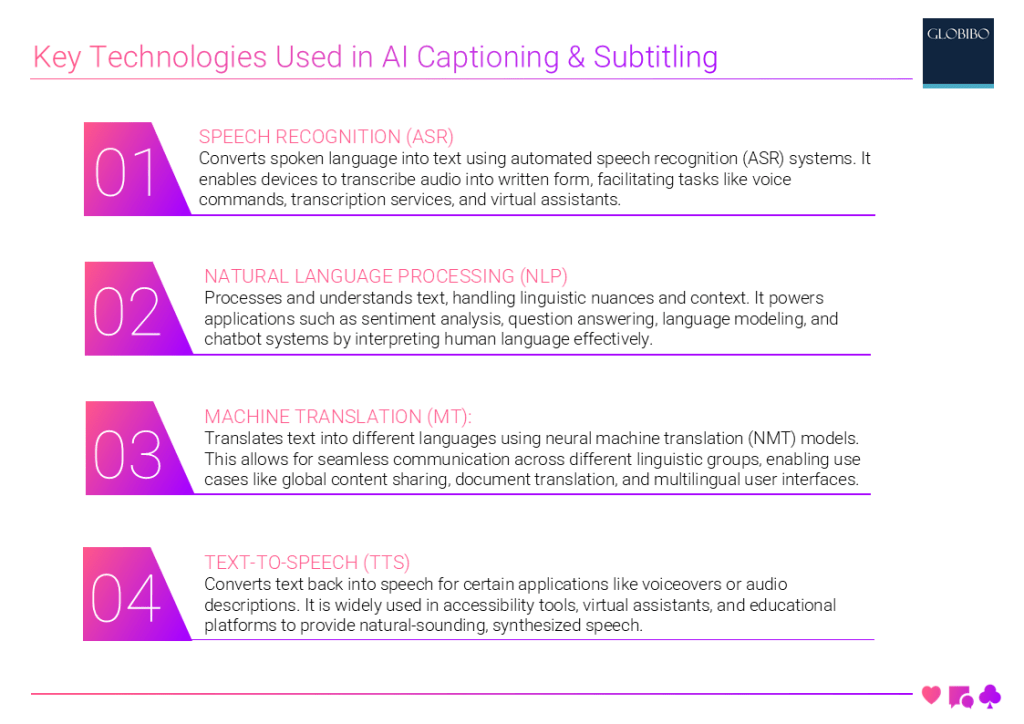
Key Technologies in AI Captioning & Subtitling
| Technology | Description | Application |
| Speech Recognition (ASR) | Converts spoken audio to text | Automated transcription of dialogues |
| Natural Language Processing (NLP) | Analyzes and processes text for context and meaning | Text understanding and context handling |
| Machine Translation (MT) | Translates text into multiple languages | Multilingual subtitles and captions |
| Text-to-Speech (TTS) | Converts text back to speech | Voiceovers and audio descriptions |
AI Captioning & Subtitling Workflow
The workflow for AI captioning and subtitling involves several stages, each crucial for ensuring the accuracy and synchronization of subtitles and captions.
- Audio Input: The process begins with audio input from the video content.
- Speech Recognition: The audio is processed by ASR systems to generate a text transcript.
- Text Processing: The text is analyzed and processed using NLP techniques to ensure linguistic accuracy.
- Translation (if needed): For multilingual content, the text is translated using MT models.
- Captioning/Subtitling: Captions and subtitles are generated and synchronized with the video timeline.
- Quality Assurance: Final checks are conducted to ensure the accuracy and readability of captions and subtitles.

AI Captioning & Subtitling Workflow
| Stage | Description | Key Technologies |
| Audio Input | Initial audio input from video content | – |
| Speech Recognition | Conversion of audio to text | ASR systems |
| Text Processing | Analysis and understanding of text | NLP techniques |
| Translation | Translation of text into multiple languages | MT models |
| Captioning/Subtitling | Generation and synchronization of captions/subtitles | Captioning and subtitling algorithms |
| Quality Assurance | Final verification and correction of captions/subtitles | Manual review and automated checks |
In-Depth Look at AI Captioning & Subtitling Technologies
1. Speech Recognition (ASR)
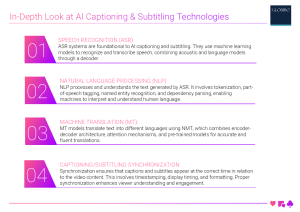
ASR systems are foundational to AI captioning and subtitling, converting spoken language into written text. These systems use machine learning models trained on large datasets to recognize and transcribe speech.
Key Aspects of ASR
- Acoustic Models: Represent the relationship between phonetic units and audio signals.
- Language Models: Predict the likelihood of sequences of words.
- Decoder: Combines acoustic and language models to generate text.
Components of Speech Recognition
| Component | Description | Example |
| Acoustic Models | Maps audio signals to phonetic units | HMM (Hidden Markov Models), DNN (Deep Neural Networks) |
| Language Models | Predicts word sequences and context | N-grams, LSTM (Long Short-Term Memory) models |
| Decoder | Integrates acoustic and language models | Beam search, Viterbi algorithm |
2. Natural Language Processing (NLP)
NLP processes and understands the text generated by ASR. It involves several sub-tasks:
- Tokenization: Splits text into words or phrases.
- Part-of-Speech Tagging: Identifies grammatical parts of speech.
- Named Entity Recognition: Detects and classifies entities like names, dates, and locations.
- Dependency Parsing: Analyzes grammatical structure and relationships between words.
NLP Techniques Used in AI Captioning & Subtitling
| Technique | Description | Application |
| Tokenization | Splits text into smaller units | Text processing |
| Part-of-Speech Tagging | Identifies grammatical roles of words | Syntax analysis |
| Named Entity Recognition | Detects and categorizes entities | Context understanding |
| Dependency Parsing | Analyzes grammatical structure of sentences | Sentence structure analysis |
3. Machine Translation (MT)
MT models translate text into different languages, facilitating multilingual subtitling. Neural Machine Translation (NMT) has become the standard approach due to its superior accuracy.
Key Aspects of NMT
- Encoder-Decoder Architecture: Converts input text into a context vector and then generates translated text.
- Attention Mechanisms: Focuses on different parts of the input text during translation.
- Pre-trained Models: Utilizes models trained on large multilingual corpora for improved accuracy.
Components of Neural Machine Translation
| Component | Description | Example |
| Encoder-Decoder Architecture | Transforms input into context vector and generates translation | Seq2Seq (Sequence-to-Sequence) models |
| Attention Mechanisms | Highlights relevant parts of the input during translation | Attention layers in NMT models |
| Pre-trained Models | Utilizes models trained on extensive datasets | BERT (Bidirectional Encoder Representations from Transformers), GPT (Generative Pre-trained Transformer) |
4. Captioning/Subtitling Synchronization
Synchronization ensures that captions and subtitles appear at the correct time in relation to the video content. This involves:
- Timestamping: Assigns timecodes to each segment of text.
- Display Timing: Ensures captions and subtitles are displayed for the appropriate duration.
- Formatting: Adapts text formatting for readability and aesthetic consistency.
Synchronization Techniques in Captioning & Subtitling
| Technique | Description | Example |
| Timestamping | Assigns timecodes to text segments | SRT (SubRip Subtitle) format |
| Display Timing | Controls the duration and timing of text display | Timing algorithms, subtitle editors |
| Formatting | Ensures readability and consistency | Caption styles, subtitle formatting rules |
Benefits of AI Captioning & Subtitling
1. Enhanced Accessibility
AI captioning and subtitling make video content accessible to a broader audience, including individuals with hearing impairments and non-native speakers.
- Accessibility for the Hearing Impaired: Provides textual representation of spoken content.
- Global Reach: Enables content consumption across different languages.
Benefits of AI Captioning & Subtitling
| Benefit | Description | Example |
| Accessibility for Hearing Impaired | Provides access to video content through text | Educational videos with captions |
| Global Reach | Expands content availability to international audiences | Streaming services with multilingual subtitles |
2. Improved Comprehension and Engagement
Captions and subtitles enhance viewer comprehension and engagement by making content easier to understand.
- Content Comprehension: Clarifies spoken dialogue and technical jargon.
- Increased Engagement: Enhances viewer interaction and retention.
Impact on Comprehension and Engagement
| Metric | Impact Description | Example |
| Content Comprehension | Improves understanding of complex content | Technical tutorials with clear subtitles |
| Increased Engagement | Enhances viewer interaction and retention | Movies with engaging subtitles showing higher viewer ratings |
Challenges and Considerations
1. Accuracy and Quality
Ensuring high accuracy in AI-generated captions and subtitles is a significant challenge. Issues can arise from:
- Speech Recognition Errors: Misinterpretation of spoken words.
- Translation Quality: Inaccuracies in translation due to context or idiomatic expressions.
2. Cultural and Linguistic Nuances
Localization involves adapting captions and subtitles to fit cultural and linguistic contexts, which can be challenging.
- Cultural Sensitivity: Ensuring that subtitles respect cultural norms.
- Idiomatic Expressions: Accurate translation of idioms and colloquialisms.
3. Technical Limitations
Technical limitations can affect the effectiveness of AI captioning and subtitling:
- Synchronization Issues: Challenges in aligning captions with video content.
- Complex Content: Difficulty in handling highly specialized or technical content.
Best Practices for Effective AI Captioning & Subtitling
1. Regular Quality Assurance
Conduct regular quality assurance to ensure the accuracy and effectiveness of captions and subtitles. This includes manual review and automated checks.
2. Customization and Localization
Customize and localize captions and subtitles to fit the specific needs of different audiences, considering linguistic and cultural differences.
3. Integration with Other Technologies
Integrate AI captioning and subtitling with other technologies such as TTS and ASR to enhance overall accessibility and user experience.
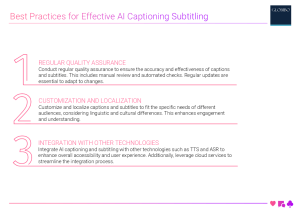
Best Practices for AI Captioning & Subtitling
| Best Practice | Description | Example |
| Regular Quality Assurance | Conduct manual and automated checks for accuracy | Regular audits of generated captions |
| Customization and Localization | Adapt captions to fit different cultural and linguistic contexts | Localized subtitles for international releases |
| Integration with Other Technologies | Enhance accessibility with integrated TTS and ASR | Combined use of ASR for transcription and TTS for voiceovers |
Conclusion for AI Captioning and Subtitling
AI captioning and subtitling technologies have significantly advanced the accessibility and engagement of video content. By leveraging core technologies such as ASR, NLP, and MT, these systems provide accurate and contextually relevant captions and subtitles. Despite challenges related to accuracy, cultural nuances, and technical limitations, best practices can help ensure high-quality results. As technology continues to evolve, AI captioning and subtitling will likely become even more sophisticated, further enhancing the accessibility and global reach of video content.
This comprehensive guide to AI captioning and subtitling provides an in-depth look at the technologies, workflows, and best practices involved. By understanding these elements, stakeholders can better utilize these tools to improve video content accessibility and engagement.
Academic References for AI Captioning and Subtitling
-
- [BOOK] Subtitling: Concepts and practices
- [BOOK] Audiovisual translation: subtitling
- [BOOK] Closed captioning: Subtitling, stenography, and the digital convergence of text with television
- AI in the media and creative industries
- Technology and audiovisual translation
- Image captioning as an assistive technology: Lessons learned from vizwiz 2020 challenge
- Real Time Speech Translation Using Machine Learning
- Subtitlers on the cloud: The use of professional web-based systems in subtitling practice and training
- Video captioning: a review of theory, techniques and practices.
- Captioning for the DHH

Rick Lee
Project Manager – Event Technology
With over 10 years of experience in event technology, Rick is an expert in integrating cutting-edge tech solutions for seamless event execution. His expertise includes audio-visual setups, interactive displays, and live-streaming technologies. Rick’s innovative approach ensures every event is technologically advanced and highly engaging.
Youtube Video for AI Captioning and Subtitling
Key Articles on AI Captioning and Subtitling
Contacts
Certification

Testimonials




Event Technology