Why Every Race Needs Backup Timing Solutions and a Contingency Plan
In competitive sports, the accuracy and reliability of race timing solutions are critical for ensuring fair play and accurate results. Despite advances in technology, race timing systems can be susceptible to various risks, including technical failures, environmental factors, and human errors. This article explores the necessity of backup timing solutions, outlining the importance of having a contingency plan in place for every race. We will delve into common risks associated with race timing systems, strategies for developing effective backup solutions, and best practices for implementing contingency plans.
Race timing solutions are essential for accurately recording participants’ times, distances, and positions in competitive events. The integrity of these solutions is paramount, as even minor errors can impact the fairness and outcomes of the race. Given the potential for system failures, environmental challenges, and other unforeseen issues, it is crucial to have a well-defined backup timing strategy. This article examines why every race needs a contingency plan and provides guidance on how to develop and implement effective backup solutions.
Common Risks to Race Timing Systems
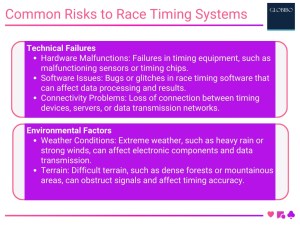
- Technical Failures
Technical failures can arise from various sources, including:
- Hardware Malfunctions: Failures in timing equipment, such as malfunctioning sensors or timing chips.
- Software Issues: Bugs or glitches in race timing software that can affect data processing and results.
- Connectivity Problems: Loss of connection between timing devices, servers, or data transmission networks.
- Environmental Factors
Environmental challenges can impact the accuracy and reliability of race timing systems:
- Weather Conditions: Extreme weather, such as heavy rain or strong winds, can affect electronic components and data transmission.
- Terrain: Difficult terrain, such as dense forests or mountainous areas, can obstruct signals and affect timing accuracy.
- Human Errors
Human errors can occur at various stages of race timing:
- Data Entry Mistakes: Errors in manually entering or processing race data.
- Operational Errors: Mistakes made by race officials or volunteers in operating timing equipment or systems.
Importance of Backup Timing Solutions
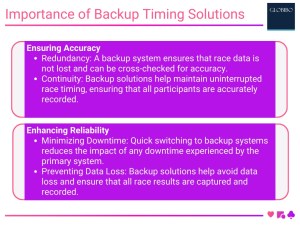
- Ensuring Accuracy
Backup timing solutions are essential for maintaining the accuracy of race results. In the event of a primary system failure, a secondary system can provide:
- Redundancy: A backup system ensures that race data is not lost and can be cross-checked for accuracy.
- Continuity: Backup solutions help maintain uninterrupted race timing, ensuring that all participants are accurately recorded.
- Enhancing Reliability
The reliability of race timing solutions is critical for the credibility of the event. Backup systems contribute by:
- Minimizing Downtime: Quick switching to backup systems reduces the impact of any downtime experienced by the primary system.
- Preventing Data Loss: Backup solutions help avoid data loss and ensure that all race results are captured and recorded.
- Building Trust
Having a contingency plan in place builds trust among participants, spectators, and event organizers by:
- Demonstrating Preparedness: A well-defined backup plan shows that organizers are prepared for potential issues and committed to providing accurate results.
- Ensuring Fairness: Backup systems help ensure that all participants receive accurate and timely results, maintaining the fairness of the competition.
Developing Effective Backup Timing Solutions
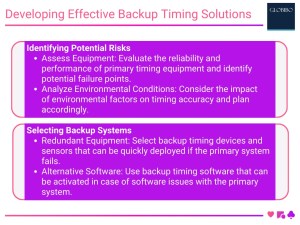
- Identifying Potential Risks
To develop effective backup timing solutions, it is essential to identify potential risks and vulnerabilities:
- Assess Equipment: Evaluate the reliability and performance of primary timing equipment and identify potential failure points.
- Analyze Environmental Conditions: Consider the impact of environmental factors on timing accuracy and plan accordingly.
- Selecting Backup Systems
Choosing appropriate backup systems involves:
- Redundant Equipment: Select backup timing devices and sensors that can be quickly deployed if the primary system fails.
- Alternative Software: Use backup timing software that can be activated in case of software issues with the primary system.
- Implementing Data Synchronization
Ensure that backup systems are synchronized with primary systems to maintain consistency:
- Data Duplication: Implement data duplication strategies to ensure that race data is captured by both primary and backup systems.
- Real-Time Synchronization: Use real-time synchronization techniques to keep backup systems updated with the latest race data.
- Testing and Validation
Regular testing and validation of backup systems are crucial:
- Conduct Drills: Perform regular drills and simulations to test the effectiveness of backup timing solutions and identify any potential issues.
- Validate Accuracy: Ensure that backup systems provide accurate timing and data that align with primary systems.
Best Practices for Implementing Backup Timing Solutions
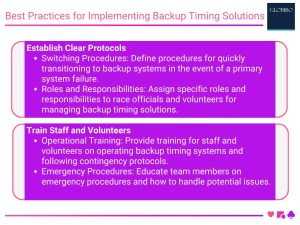
1. Establish Clear Protocols
Develop clear protocols for switching between primary and backup systems:
- Switching Procedures: Define procedures for quickly transitioning to backup systems in the event of a primary system failure.
- Roles and Responsibilities: Assign specific roles and responsibilities to race officials and volunteers for managing backup timing solutions.
2.Train Staff and Volunteers
Proper training is essential for effective implementation:
- Operational Training: Provide training for staff and volunteers on operating backup timing systems and following contingency protocols.
- Emergency Procedures: Educate team members on emergency procedures and how to handle potential issues.
- Communicate with Stakeholders
Effective communication with stakeholders is key to managing race timing solutions:
- Inform Participants: Notify participants about the timing systems and backup plans in place to ensure transparency.
- Update Spectators: Provide real-time updates to spectators and media in case of any timing system changes or issues.
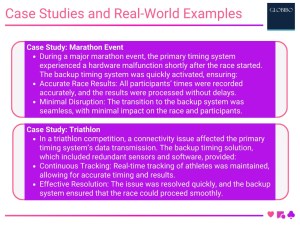
Case Studies and Real-World Examples
- Case Study: Marathon Event
During a major marathon event, the primary timing system experienced a hardware malfunction shortly after the race started. The backup timing system was quickly activated, ensuring:
- Accurate Race Results: All participants’ times were recorded accurately, and the results were processed without delays.
- Minimal Disruption: The transition to the backup system was seamless, with minimal impact on the race and participants.
- Case Study: Triathlon
In a triathlon competition, a connectivity issue affected the primary timing system’s data transmission. The backup timing solution, which included redundant sensors and software, provided:
- Continuous Tracking: Real-time tracking of athletes was maintained, allowing for accurate timing and results.
- Effective Resolution: The issue was resolved quickly, and the backup system ensured that the race could proceed smoothly.
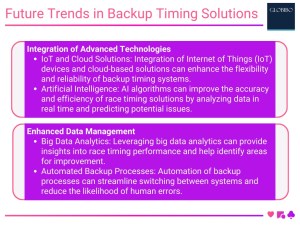
Future Trends in Backup Timing Solutions
- Integration of Advanced Technologies
- IoT and Cloud Solutions: Integration of Internet of Things (IoT) devices and cloud-based solutions can enhance the flexibility and reliability of backup timing systems.
- Artificial Intelligence: AI algorithms can improve the accuracy and efficiency of race timing solutions by analyzing data in real time and predicting potential issues.
2. Enhanced Data Management
- Big Data Analytics: Leveraging big data analytics can provide insights into race timing performance and help identify areas for improvement.
- Automated Backup Processes: Automation of backup processes can streamline switching between systems and reduce the likelihood of human errors.
Common Risks to Race Timing Systems
- Technical Failures:
- Hardware Malfunctions
- Software Issues
- Connectivity Problems
- Environmental Factors:
- Weather Conditions
- Terrain
- Human Errors:
- Data Entry Mistakes
- Operational Errors
Best Practices for Backup Timing Solutions
- Establish Clear Protocols:
- Switching Procedures
- Roles and Responsibilities
- Train Staff and Volunteers:
- Operational Training
- Emergency Procedures
- Communicate with Stakeholders:
- Inform Participants
- Update Spectators
Conclusion of Race Timing Systems
Backup timing solutions are a critical component of race timing systems, ensuring accuracy, reliability, and fairness in competitive sports. By understanding the potential risks, developing effective backup strategies, and implementing best practices, race organizers can safeguard against potential issues and provide a seamless experience for participants and spectators. As technology continues to evolve, incorporating advanced solutions and maintaining a proactive approach will be essential for ensuring the integrity of race timing solutions.
Academic Reference for Race Timing Systems
- [BOOK] Scrappy Business Contingency Planning: How to Bullet-Proof Your Business and Laugh at Volcanoes, Tornadoes, Locust Plagues, and Hard Drive Crashes
- [BOOK] Disaster response and recovery: strategies and tactics for resilience
- [BOOK] Emergency management: Concepts and strategies for effective programs
- [BOOK] Disaster response and planning for libraries
- [PDF] Preparing for the next emergency
- [BOOK] The power of resilience: How the best companies manage the unexpected
- [BOOK] Successful response starts with a map: improving geospatial support for disaster management
- [BOOK] Clusters for high availability: a primer of HP solutions
- [BOOK] Principles and practice of business continuity: Tools and Techniques
- The Case Against the Dodd-Frank Act’s Living Wills: Contingency Planning Following the Financial Crisis

Rick Lee
Project Manager – Event Technology
With over 10 years of experience in event technology, Rick is an expert in integrating cutting-edge tech solutions for seamless event execution. His expertise includes audio-visual setups, interactive displays, and live-streaming technologies. Rick’s innovative approach ensures every event is technologically advanced and highly engaging.
Youtube Video on Race Timing Systems
Key Articles for Race Timing Solutions
- Cost-Effective Race Timing Solutions for Small and Remote Events
- Advancements in GPS Technology for Race Timing
- The Role of Wearables in Enhancing Race Timing and Participant Experience
- Active vs. Passive Transponders: Which Race Timing System is Right for Your Event?
- How Real-Time Data Integration is Transforming Race Day Operations
- Ensuring Race Accuracy with Dual-Band GPS in Challenging Environments
- Backup Timing Solutions: Why Every Race Needs a Contingency Plan
- Innovative Race Timing Software: Features to Look for in 2024
Contacts
Certification

Testimonials



Event Technology