AI Captioning and Subtitling: Enhancing Video Accessibility and Engagement
AI captioning and subtitling represent significant advancements in video technology, providing critical enhancements in accessibility and viewer engagement. These technologies use artificial intelligence to automatically generate captions and subtitles for video content, making it more accessible to a diverse audience, including those with hearing impairments and non-native speakers. This article explores the technical aspects of AI captioning and subtitling, their benefits, challenges, and best practices, and provides structured lists and data-rich tables to offer a comprehensive understanding of these technologies.
Technical Overview of AI Captioning and Subtitling
AI Captioning
AI captioning involves the use of artificial intelligence to automatically generate text captions for spoken dialogue in video content. This technology leverages machine learning algorithms and natural language processing (NLP) to transcribe and display spoken words in real-time or post-production.
Key Components of AI Captioning
- Speech Recognition: Converts spoken words into text using speech-to-text (STT) engines.
- Natural Language Processing (NLP): Analyzes and processes the text to ensure grammatical accuracy and contextual relevance.
- Timestamping: Synchronizes captions with the video timeline to ensure accurate display.
- Contextual Adaptation: Adjusts captions based on context, including speaker identification and ambient sounds.
Components of AI Captioning
| Component | Description | Technology Used |
| Speech Recognition | Converts speech to text | Deep learning models, STT engines |
| Natural Language Processing (NLP) | Ensures text is grammatically correct and contextually relevant | NLP algorithms, language models |
| Timestamping | Synchronizes captions with video content | Time-coding algorithms, synchronization tools |
| Contextual Adaptation | Adapts captions based on context, including speaker identification | Context-aware algorithms, speaker diarization |
AI Subtitling
AI subtitling involves generating subtitles in multiple languages or adding additional information (such as sound effects or speaker identification) to enhance the viewing experience. This process extends beyond basic captioning to include translation and localization features.
Key Components of AI Subtitling
- Machine Translation: Automatically translates captions into different languages using neural machine translation (NMT) systems.
- Localization: Adapts translations to suit cultural and linguistic nuances of the target audience.
- Subtitling Synchronization: Ensures subtitles are properly timed with the video and do not overlap with other on-screen elements.
- Multilingual Support: Provides subtitles in multiple languages to reach a broader audience.
Components of AI Subtitling
| Component | Description | Technology Used |
| Machine Translation | Automatically translates captions into various languages | Neural machine translation (NMT) |
| Localization | Adapts translations to cultural and linguistic contexts | Localization algorithms, cultural adaptation |
| Subtitling Synchronization | Ensures subtitles are correctly timed and do not overlap with other elements | Timing algorithms, synchronization tools |
| Multilingual Support | Provides subtitles in multiple languages | Multi-language translation models, integration systems |

Benefits of AI Captioning and Subtitling
1. Enhanced Accessibility
AI captioning and subtitling significantly improve accessibility for individuals with hearing impairments or those who are non-native speakers.
- Hearing Impairments: Provides textual representation of spoken content, making videos accessible to individuals with hearing loss.
- Non-Native Speakers: Enables understanding of content in multiple languages through accurate translation and localization.
2. Increased Engagement
Videos with captions and subtitles tend to engage a larger audience by providing additional context and making content more accessible.
- Improved Comprehension: Captions and subtitles help viewers better understand complex or technical content.
- Global Reach: Subtitles in multiple languages allow content creators to reach international audiences and expand their viewer base.
3. SEO and Content Discovery
Captions and subtitles enhance search engine optimization (SEO) and content discovery by providing text that search engines can index.
- Indexing: Textual content from captions and subtitles can be indexed by search engines, improving search visibility.
- User Engagement: Captions and subtitles can increase viewer retention and engagement by providing context and supporting diverse viewing preferences.

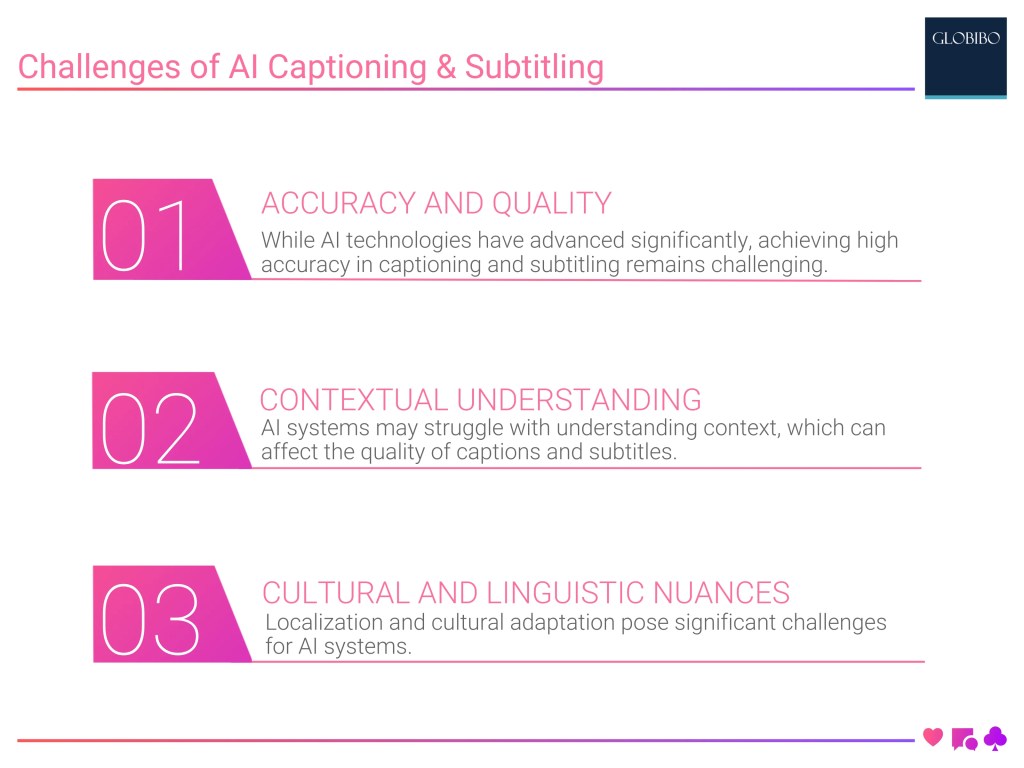
Challenges of AI Captioning and Subtitling
1. Accuracy and Quality
While AI technologies have advanced significantly, achieving high accuracy in captioning and subtitling remains challenging.
- Speech Recognition Errors: Misrecognition of words or phrases can lead to inaccuracies in captions.
- Translation Quality: Machine translation may not always capture the nuances of different languages, leading to potential inaccuracies in subtitles.
2. Contextual Understanding
AI systems may struggle with understanding context, which can affect the quality of captions and subtitles.
- Ambiguity: AI may misinterpret ambiguous terms or phrases, affecting translation and caption accuracy.
- Contextual Relevance: Captions and subtitles may lack contextual adaptation, leading to potential misinterpretations.
3. Cultural and Linguistic Nuances
Localization and cultural adaptation pose significant challenges for AI systems.
- Cultural Sensitivity: Ensuring that translations and subtitles are culturally appropriate can be difficult for AI systems.
- Idiomatic Expressions: AI may struggle with idiomatic expressions and colloquialisms, affecting subtitle quality.
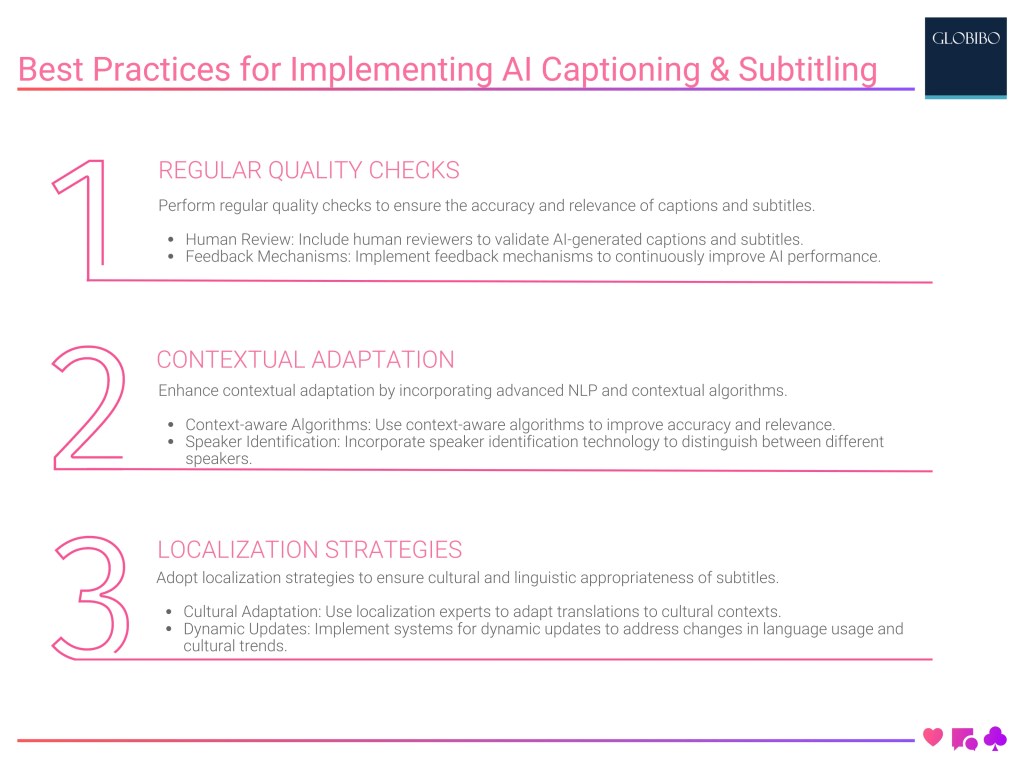
Best Practices for Implementing AI Captioning and Subtitling
1. Regular Quality Checks
Perform regular quality checks to ensure the accuracy and relevance of captions and subtitles.
- Human Review: Include human reviewers to validate AI-generated captions and subtitles.
- Feedback Mechanisms: Implement feedback mechanisms to continuously improve AI performance.
2. Contextual Adaptation
Enhance contextual adaptation by incorporating advanced NLP and contextual algorithms.
- Context-aware Algorithms: Use context-aware algorithms to improve accuracy and relevance.
- Speaker Identification: Incorporate speaker identification technology to distinguish between different speakers.
3. Localization Strategies
Adopt localization strategies to ensure cultural and linguistic appropriateness of subtitles.
- Cultural Adaptation: Use localization experts to adapt translations to cultural contexts.
- Dynamic Updates: Implement systems for dynamic updates to address changes in language usage and cultural trends.
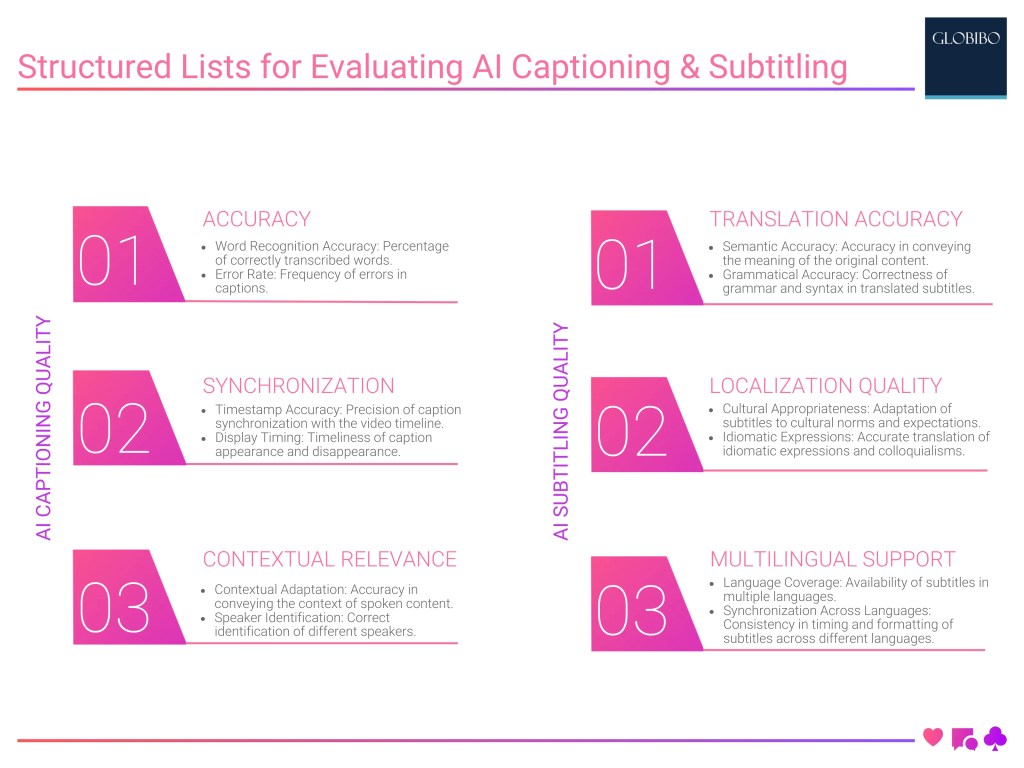
Structured Lists for Evaluating AI Captioning and Subtitling
Metrics for Assessing AI Captioning Quality
- Accuracy
- Word Recognition Accuracy: Percentage of correctly transcribed words.
- Error Rate: Frequency of errors in captions.
- Synchronization
- Timestamp Accuracy: Precision of caption synchronization with the video timeline.
- Display Timing: Timeliness of caption appearance and disappearance.
- Contextual Relevance
- Contextual Adaptation: Accuracy in conveying the context of spoken content.
- Speaker Identification: Correct identification of different speakers.
Metrics for Assessing AI Subtitling Quality
- Translation Accuracy
- Semantic Accuracy: Accuracy in conveying the meaning of the original content.
- Grammatical Accuracy: Correctness of grammar and syntax in translated subtitles.
- Localization Quality
- Cultural Appropriateness: Adaptation of subtitles to cultural norms and expectations.
- Idiomatic Expressions: Accurate translation of idiomatic expressions and colloquialisms.
- Multilingual Support
- Language Coverage: Availability of subtitles in multiple languages.
- Synchronization Across Languages: Consistency in timing and formatting of subtitles across different languages.
Conclusion for AI captioning and subtitling
AI captioning and subtitling are transformative technologies that enhance video accessibility and viewer engagement. By leveraging advanced AI algorithms and technologies, these systems provide significant benefits, including improved accessibility for individuals with hearing impairments and non-native speakers, increased global reach, and enhanced SEO and content discovery.
However, challenges such as accuracy, contextual understanding, and cultural nuances must be addressed to ensure high-quality results. Implementing best practices, including regular quality checks, contextual adaptation, and effective localization strategies, can help overcome these challenges and maximize the benefits of AI captioning and subtitling.
As AI technologies continue to evolve, the potential for improving captioning and subtitling accuracy and effectiveness will increase, further enhancing video accessibility and engagement for diverse audiences worldwide.
Academic References for AI captioning and subtitling
- [HTML] Language Context in the Future of Television and Video Industry: Exploring Trends and Opportunities
- From text to video with AI: the rise and potential of Sora in education and libraries
- A Netflix original closed captioning study: How Netflix closed captions make audiovisual content accessible to deaf audiences
- Empowering Content Creation using Artificial Intelligence-The Role of Caption Writing: An Overview
- [BOOK] Subtitling: Concepts and practices
- Edu-lingo: A Unified NLP Video System with Comprehensive Multilingual Subtitles
- Creating collaborative subtitling communities to increase access to audiovisual materials in academia
- Video question-answering techniques, benchmark datasets and evaluation metrics leveraging video captioning: a comprehensive survey
- Video captions benefit everyone
- Increasing student engagement in lessons and assessing MOOC participants through artificial intelligence

Rick Lee
Project Manager – Event Technology
With over 10 years of experience in event technology, Rick is an expert in integrating cutting-edge tech solutions for seamless event execution. His expertise includes audio-visual setups, interactive displays, and live-streaming technologies. Rick’s innovative approach ensures every event is technologically advanced and highly engaging.
Youtube Video for AI Captioning and Subtitling
Key Articles on AI Captioning and Subtitling
Contacts
Certification

Testimonials


Event Technology