Active vs. Passive Transponders: Which Race Timing System is Right for Your Event?
Race timing solutions are integral to ensuring accurate and efficient event management. Among the various technologies available, transponder systems—specifically active and passive transponders—play a crucial role in capturing and recording race data. Choosing the right type of transponder system can significantly impact the accuracy, cost, and overall efficiency of your event. This article examines the differences between active and passive transponders, their respective advantages and limitations, and helps determine which system is best suited for your race timing needs.
Understanding Transponder Systems
What Are Transponders?
Transponders are electronic devices used in race timing systems to automatically record participants’ times as they cross predefined points, such as start and finish lines. They work by emitting or responding to radio signals, which are detected by timing mats or readers placed along the racecourse.
Active vs. Passive Transponders
Active Transponders: These transponders contain a battery and actively emit signals that are detected by receivers. They offer continuous communication and can provide real-time data.
Passive Transponders: These transponders do not have a power source of their own. Instead, they reflect signals sent by timing mats or readers, which capture the data when the transponder passes through the detection zone.
Comparison of Active and Passive Transponders
| Feature | Active Transponders | Passive Transponders |
| Power Source | Battery-powered, actively emits signals | No battery, reflects incoming signals |
| Signal Transmission | Continuous, real-time data | Intermittent, responds to external signals |
| Data Accuracy | High accuracy with real-time feedback | High accuracy but depends on external signal quality |
| Cost | Generally higher due to battery and technology | Generally lower, no battery required |
| Maintenance | Requires battery replacement and occasional servicing | Minimal maintenance, no batteries to replace |
Advantages and Disadvantages of Active Transponders
Advantages
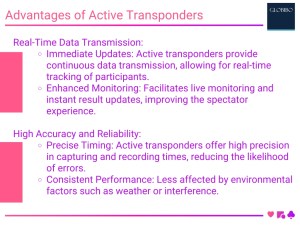
- Real-Time Data Transmission:
- Immediate Updates: Active transponders provide continuous data transmission, allowing for real-time tracking of participants.
- Enhanced Monitoring: Facilitates live monitoring and instant result updates, improving the spectator experience.
- High Accuracy and Reliability:
- Precise Timing: Active transponders offer high precision in capturing and recording times, reducing the likelihood of errors.
- Consistent Performance: Less affected by environmental factors such as weather or interference.
Disadvantages
-
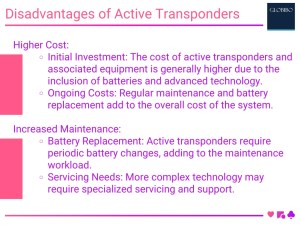
- Higher Cost:
- Initial Investment: The cost of active transponders and associated equipment is generally higher due to the inclusion of batteries and advanced technology.
- Ongoing Costs: Regular maintenance and battery replacement add to the overall cost of the system.
- Higher Cost:
- Increased Maintenance:
- Battery Replacement: Active transponders require periodic battery changes, adding to the maintenance workload.
- Servicing Needs: More complex technology may require specialized servicing and support.
Disadvantages of Active Transponders
- Higher Cost
- Initial investment and equipment costs
- Ongoing maintenance expenses
- Increased Maintenance
- Battery replacement requirements
- Need for specialized servicing
Advantages and Disadvantages of Passive Transponders
Advantages
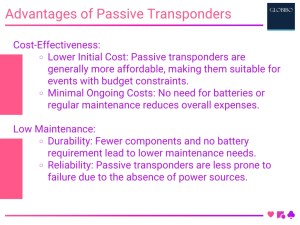
- Cost-Effectiveness:
- Lower Initial Cost: Passive transponders are generally more affordable, making them suitable for events with budget constraints.
- Minimal Ongoing Costs: No need for batteries or regular maintenance reduces overall expenses.
- Low Maintenance:
- Durability: Fewer components and no battery requirement lead to lower maintenance needs.
- Reliability: Passive transponders are less prone to failure due to the absence of power sources.
Advantages of Passive Transponders
- Cost-Effectiveness
- Lower initial cost
- Minimal ongoing expenses
- Low Maintenance
- Durable with fewer components
- Reliable performance with reduced maintenance needs
Disadvantages
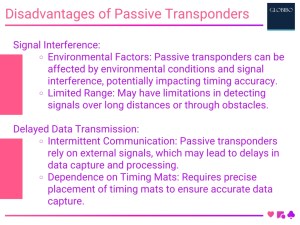
- Signal Interference:
- Environmental Factors: Passive transponders can be affected by environmental conditions and signal interference, potentially impacting timing accuracy.
- Limited Range: May have limitations in detecting signals over long distances or through obstacles.
- Delayed Data Transmission:
- Intermittent Communication: Passive transponders rely on external signals, which may lead to delays in data capture and processing.
- Dependence on Timing Mats: Requires precise placement of timing mats to ensure accurate data capture.
Disadvantages of Passive Transponders
- Signal Interference
- Impacted by environmental conditions
- Limited detection range
- Delayed Data Transmission
- Intermittent communication
- Dependence on timing mat placement
Choosing the Right Transponder System for Your Event
Factors to Consider
When deciding between active and passive transponders, consider the following factors:
- Event Size and Complexity:
- Small Events: Passive transponders may be sufficient for smaller events with fewer participants.
- Large or Complex Events: Active transponders provide better accuracy and real-time tracking for larger or multi-stage races.
- Budget:
- Cost Constraints: Passive transponders are more budget-friendly, making them ideal for events with limited funds.
- Investment in Quality: If your event budget allows, investing in active transponders can enhance accuracy and participant experience.
- Environmental Conditions:
- Weather and Terrain: Consider the impact of weather and terrain on signal accuracy. Active transponders may offer more reliable performance in challenging conditions.

Key Factors in Choosing a Transponder System
- Event Size and Complexity
- Small events: Passive transponders
- Large or complex events: Active transponders
- Budget
- Cost constraints: Passive transponders
- Higher budget: Active transponders
- Environmental Conditions
- Weather and terrain: Impact on signal accuracy
- Reliable performance: Active transponders in challenging conditions
Implementation Tips
-
- Test the System:
- Pre-Event Testing: Conduct thorough testing of the chosen transponder system before the event to ensure it meets your requirements.
- Simulation Runs: Perform simulation runs to identify any potential issues and fine-tune the system.
- Training and Support:
- Staff Training: Ensure that event staff are trained in the operation and troubleshooting of the transponder system.
- Technical Support: Arrange for technical support to address any issues that may arise during the event.
- Test the System:
Implementation Tips for Transponder Systems
- Test the System
- Conduct pre-event testing
- Perform simulation runs
- Training and Support
- Train event staff
- Arrange for technical support
Conclusion of Race Timing System
Selecting the right transponder system is crucial for ensuring accurate and efficient race timing. Active transponders offer real-time data transmission and high accuracy but come with higher costs and maintenance requirements. Passive transponders are cost-effective and low-maintenance but may face challenges with signal interference and delayed data transmission.
When choosing between active and passive transponders, consider factors such as event size, budget, and environmental conditions. By carefully evaluating these factors and implementing best practices, you can choose the most suitable race timing solution for your event, ensuring a successful and well-managed race experience.
Academic Reference for Race Timing System
- A Low Cost RFID Tracking and Timing System for Bike Races
- [HTML] City Marathon active timing system using bluetooth low energy technology
- [HTML] RFID Timing Antenna for Open Water Swimming Competitions
- Multiple reader algorithm for sports timing systems and its application at low frequency bandwidth
- Bluetooth vs RFID in Time Tracking
- eParticipation in Sports
- An Environmentally Friendly Race Timing System Based on Cameras Only
- Advanced RFID applications for sports events management: the case of SPORTident in Latvia
- [PDF] Endpoint Confirmation and Timing Image Digital Processing for Competitive Athletics
- Smart le tour checkpoint using RFID

Rick Lee
Project Manager – Event Technology
With over 10 years of experience in event technology, Rick is an expert in integrating cutting-edge tech solutions for seamless event execution. His expertise includes audio-visual setups, interactive displays, and live-streaming technologies. Rick’s innovative approach ensures every event is technologically advanced and highly engaging.
Youtube Video on Race Timing System
Key Articles for Race Timing System
- Cost-Effective Race Timing Solutions for Small and Remote Events
- Advancements in GPS Technology for Race Timing
- The Role of Wearables in Enhancing Race Timing and Participant Experience
- Active vs. Passive Transponders: Which Race Timing System is Right for Your Event?
- How Real-Time Data Integration is Transforming Race Day Operations
- Ensuring Race Accuracy with Dual-Band GPS in Challenging Environments
- Backup Timing Solutions: Why Every Race Needs a Contingency Plan
- Innovative Race Timing Software: Features to Look for in 2024
Contacts
Certification

Testimonials



Event Technology