Key Metrics to Measure During Live Tests for Translation and Transcription
Live translation and transcription are critical components in many professional and academic settings. Accurate and efficient translation and transcription services can significantly impact communication, decision-making, and accessibility. To ensure these services meet the required standards, it is essential to measure specific metrics during live tests. These metrics help evaluate the effectiveness and accuracy of the translation and transcription processes and identify areas for improvement.
This article provides a comprehensive overview of the key metrics to measure during live translation and transcription tests. It will cover essential performance indicators, methods for assessing these metrics, and structured lists for evaluating translation and transcription quality. The information will be presented in a technical tone, supported by detailed explanations and data-rich tables.
Key Metrics for Live Test in Translation and Transcription Services
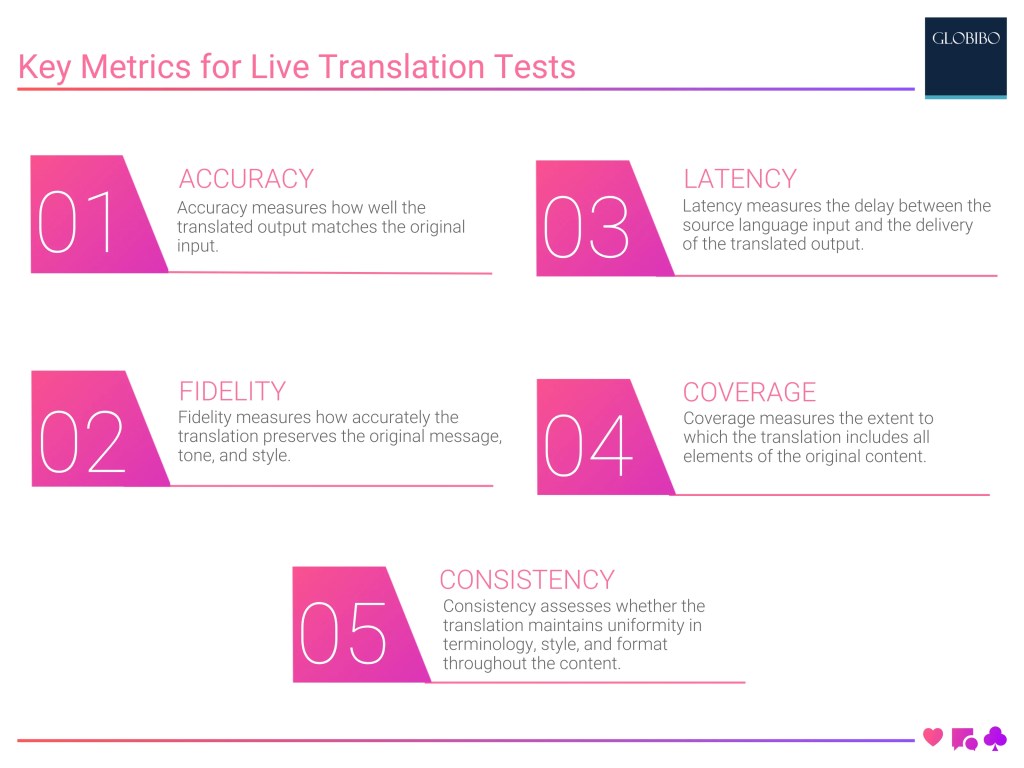
Live translation involves the real-time conversion of spoken or written content from one language to another. To evaluate the effectiveness of live translation, the following metrics are crucial:
1. Accuracy
Accuracy measures how well the translated output matches the original input. It includes several sub-metrics:
- Semantic Accuracy: Ensures that the translated text conveys the same meaning as the original.
- Grammatical Accuracy: Assesses whether the translated text adheres to the grammatical rules of the target language.
Accuracy Metrics
| Metric | Description | Measurement Method |
| Semantic Accuracy | Degree to which the meaning is preserved | Human evaluation, expert review |
| Grammatical Accuracy | Correctness of grammar and syntax | Automated grammar check tools, expert review |
2. Latency
Latency measures the delay between the source language input and the delivery of the translated output. This metric is critical for ensuring real-time communication.
- Response Time: Time taken to start translating after the source input.
- Processing Time: Time taken to complete the translation.
Latency Metrics
| Metric | Description | Measurement Method |
| Response Time | Delay in starting the translation process | Stopwatch, timestamp logs |
| Processing Time | Total time taken to translate content | Stopwatch, automated tracking systems |
3. Fidelity
Fidelity measures how accurately the translation preserves the original message, tone, and style. It is particularly important in contexts requiring precise and nuanced communication.
- Contextual Fidelity: Adherence to the context of the original message.
- Tone Fidelity: Preservation of the original tone and style.
Fidelity Metrics
| Metric | Description | Measurement Method |
| Contextual Fidelity | Accuracy in maintaining the original context | Human evaluation, expert review |
| Tone Fidelity | Consistency in tone and style | Human evaluation, expert review |
4. Coverage
Coverage measures the extent to which the translation includes all elements of the original content. It ensures that no part of the message is omitted or distorted.
- Content Coverage: Completeness of the translated message.
- Terminology Coverage: Accuracy of specialized terms.
Coverage Metrics
| Metric | Description | Measurement Method |
| Content Coverage | Extent to which all content is translated | Comparison with source content |
| Terminology Coverage | Accuracy of specialized terminology | Expert review, automated tools |
5. Consistency
Consistency assesses whether the translation maintains uniformity in terminology, style, and format throughout the content.
- Terminological Consistency: Use of consistent terms across the translation.
- Stylistic Consistency: Uniformity in style and format.
Consistency Metrics
| Metric | Description | Measurement Method |
| Terminological Consistency | Consistency in terminology usage | Automated tools, expert review |
| Stylistic Consistency | Uniformity in style and format | Human evaluation, expert review |
Key Metrics for Live Transcription Tests
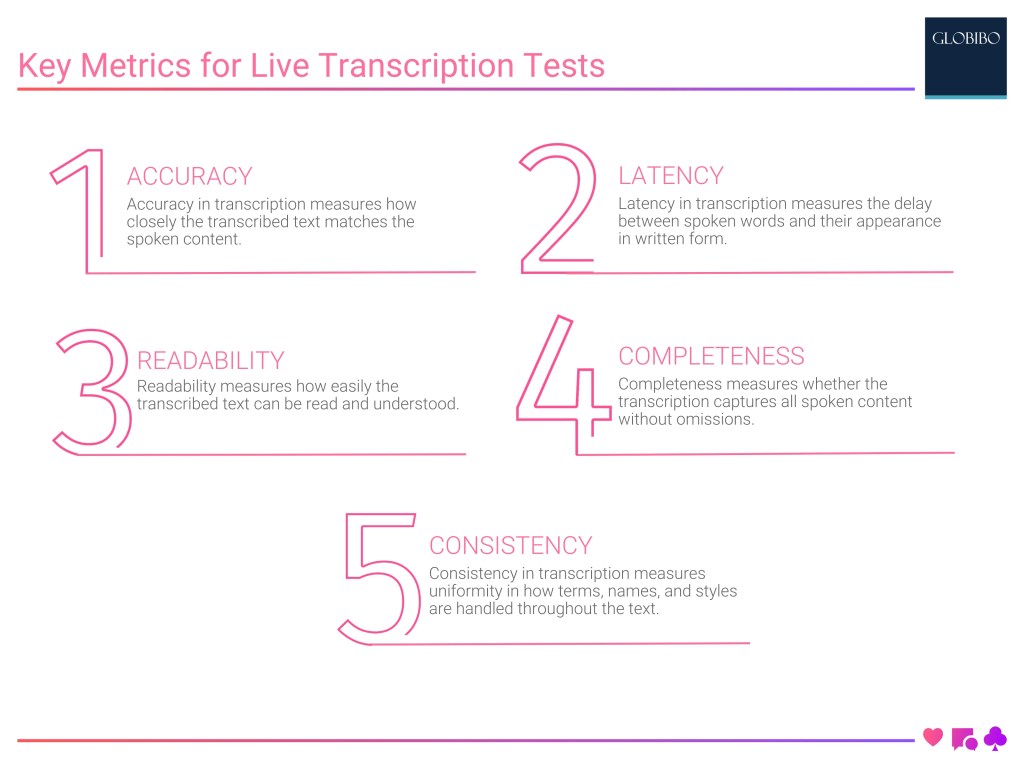
Live transcription involves converting spoken language into written text in real-time. The following metrics are essential for evaluating live transcription:
1. Accuracy
Accuracy in transcription measures how closely the transcribed text matches the spoken content.
- Word Accuracy: Percentage of correctly transcribed words.
- Error Rate: Frequency of errors in the transcription.
Accuracy Metrics for Transcription
| Metric | Description | Measurement Method |
| Word Accuracy | Correctness of transcribed words | Comparison with original audio |
| Error Rate | Frequency of errors in transcription | Automated tools, expert review |
2. Latency
Latency in transcription measures the delay between spoken words and their appearance in written form.
- Real-time Delay: Time taken for spoken words to appear in text.
- Processing Delay: Time taken to process and display the text.
Latency Metrics for Transcription
| Metric | Description | Measurement Method |
| Real-time Delay | Delay in displaying spoken words in text | Stopwatch, timestamp logs |
| Processing Delay | Total time taken to process and display text | Stopwatch, automated tracking systems |
3. Readability
Readability measures how easily the transcribed text can be read and understood.
- Clarity: How clear and understandable the transcribed text is.
- Formatting: Proper use of punctuation, paragraphs, and line breaks.
Readability Metrics
| Metric | Description | Measurement Method |
| Clarity | Ease of understanding the transcribed text | Human evaluation, readability tests |
| Formatting | Proper use of punctuation and line breaks | Automated formatting tools, human review |
4. Completeness
Completeness measures whether the transcription captures all spoken content without omissions.
- Content Completeness: Extent to which all spoken words are transcribed.
- Contextual Completeness: Accuracy in capturing the context of the conversation.
Completeness Metrics
| Metric | Description | Measurement Method |
| Content Completeness | Completeness of transcribed content | Comparison with original audio |
| Contextual Completeness | Accuracy in capturing the context of the conversation | Expert review, human evaluation |
5. Consistency
Consistency in transcription measures uniformity in how terms, names, and styles are handled throughout the text.
- Terminological Consistency: Consistent use of terms and names.
- Stylistic Consistency: Uniformity in transcription style and format.
Consistency Metrics for Transcription
| Metric | Description | Measurement Method |
| Terminological Consistency | Consistent use of terms and names | Automated tools, expert review |
| Stylistic Consistency | Uniformity in transcription style | Human evaluation, expert review |
Conclusion for Live Test in Translation and Transcription Services
Measuring key metrics during live translation and transcription tests is essential for ensuring the accuracy, efficiency, and effectiveness of these services. By focusing on accuracy, latency, fidelity, coverage, consistency, readability, and completeness, organizations can assess the quality of their translation and transcription processes. Structured lists and tables provide a clear framework for evaluating these metrics and identifying areas for improvement.
These metrics not only help in refining live translation and transcription services but also enhance overall communication and accessibility in various settings. Ensuring that these services meet high standards is crucial for achieving successful outcomes in multilingual and real-time communication scenarios.
Academic References for Live Test in Translation and Transcription Services
- A transcription and translation protocol for sensitive cross-cultural team research
- [BOOK] Statistics translated: A step-by-step guide to analyzing and interpreting data
- Using software in qualitative research: A step-by-step guide
- [BOOK] Step by step: A course in contrastive linguistics and translation
- How to develop children as researchers: A step by step guide to teaching the research process
- [BOOK] Biomolecular kinetics: a step-by-step guide
- [BOOK] The copywriter’s handbook: a step-by-step guide to writing copy that sells
- The transcription of interpreting data
- [BOOK] Current protocols essential laboratory techniques
- [BOOK] Effective Methods for Software Testing, CafeScribe: Includes Complete Guidelines, Checklists, and Templates

Rick Lee
Project Manager – Event Technology
With over 10 years of experience in event technology, Rick is an expert in integrating cutting-edge tech solutions for seamless event execution. His expertise includes audio-visual setups, interactive displays, and live-streaming technologies. Rick’s innovative approach ensures every event is technologically advanced and highly engaging.
Youtube Video on Live Test in Translation and Transcription Services
Key Articles for Live Test in Translation and Transcription Services
- The Importance of Live Testing in Translation and Transcription Services
- How to Conduct a Live Test for Translation & Transcription: A Step-by-Step Guide
- Key Metrics to Measure During Live Translation & Transcription Tests
- Live Test Scenarios for Real-Time Translation Accuracy
- Live Translation in International Conferences: Key Considerations
- The Benefits of Live Translation for Virtual Events and Webinars
- Live Translation Services: How They Facilitate Cross-Cultural Communication
- How to Choose the Right Language Pair for Live Translation Services
Contacts
Certification

Testimonials



Event Technology