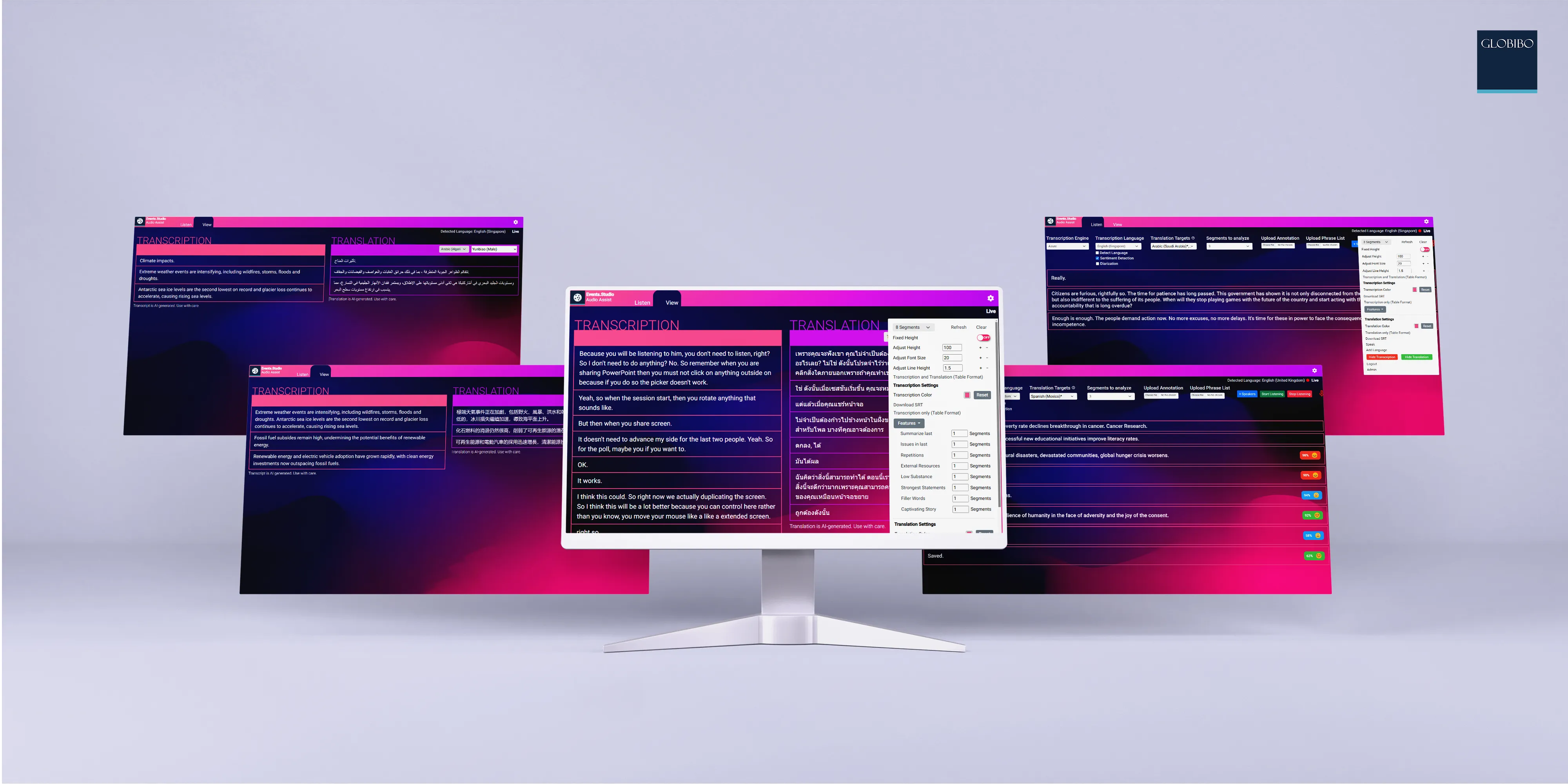
Live AI Transcription with speaker identification & analytics
Live AI transcription with speaker identification & analytics
Live AI transcription is transforming how modern organizations capture, understand, and analyze spoken dialogue in real time. Powered by transformer-based Automatic Speech Recognition (ASR), neural speaker diarization, and semantic natural language processing, the Events.studio transcription engine converts live multi-speaker conversations into time-stamped, speaker-attributed transcripts with sub-second latency and 99%+ accuracy across 100+ languages.
Live AI transcription & diarization platform — at a glance
| Specification | Details |
|---|---|
| Core ASR engine | Streaming neural transformer models with sub-second token latency |
| Speaker diarization | Real-time acoustic embedding clustering with automated speaker change detection (SCD) |
| Speaker attribution | Named speaker profiles, visual role badges, and voice biometrics matching |
| Acoustic pre-processing | Neural background noise suppression, room de-reverberation, and beamforming VAD |
| Transcription modes | Strict verbatim (legal/medical), light cleaned (fillers removed), and synthesized summary |
| Analytics layers | Speaker participation share, sentiment trajectory, talk-to-listen ratios, and key topic extraction |
| Export formats | Time-aligned SRT, VTT, JSON (with word-level timestamps), Word DOCX, and PDF |
| Security & compliance | SOC-2 Type II certified, GDPR compliant, TLS 1.3/AES-256 encryption, zero data retention mode |
Introduction: The evolution of real-time speech intelligence
Live AI transcription — the real-time conversion of spoken language into structured digital text — has emerged as a foundational technology in modern communication systems, corporate governance, customer intelligence, legal proceedings, and academic congresses. Beyond basic speech-to-text conversion, advanced platforms incorporate neural speaker identification (diarization) and transcription analytics, enabling automated meta-analysis of live conversations as they unfold.
This article synthesizes recent engineering developments, empirical research benchmarks, and platform architectures to explain how live AI transcription systems operate, why speaker diarization is vital for context clarity, and how analytics transforms raw transcripts into structured business intelligence.
Core technologies behind live AI transcription
1. Automatic speech recognition (ASR)
At the core of live AI transcription is Automatic Speech Recognition (ASR), an advanced class of deep neural networks that transform raw acoustic waveforms into textual tokens. While historical ASR relied on statistical Hidden Markov Models (HMMs), modern engines leverage end-to-end attention architectures, conforming transformers, and streaming Whisper derivatives. These models achieve Word Error Rates (WER) below 6–8% in clean environments and under 10% in complex multi-party conference settings.
Real-time ASR operates under strict latency constraints — streaming tokens with sub-second latency per spoken word — distinguishing it from offline human transcription pipelines that require minutes or hours of post-session turnaround.
2. Neural speaker identification & diarization
Speaker diarization is the process that partitions an audio stream into homogeneous segments attributed to distinct individuals — solving the foundational question of “who spoke when”. Unlike single-speaker dictation, reliable live AI transcription for events must dynamically distinguish between multiple presenters, panelists, and audience questions in real time.
Contemporary architectures employ neural speaker change detection (SCD) coupled with continuous x-vector and d-vector acoustic embeddings. These streaming algorithms reduce speaker attribution errors and identity confusion by over 50% compared to legacy offline clustering methods, maintaining accurate tracking even during rapid conversational exchanges.
3. Joint speaker-attributed transcription architectures
Recent deep learning innovations combine ASR, timestamping, and diarization into unified end-to-end models. By utilizing extended contextual attention windows that maintain conversational memory across sessions exceeding 90 minutes, these models prevent speaker identity drift, resolve ambiguous pronoun references, and eliminate errors caused by fragmented modular pipelines.
How live AI transcription works: From audio capture to structured insight
1. Audio capture, beamforming, and acoustic preprocessing
The pipeline begins with high-resolution 48 kHz audio ingestion from stage microphones, room array mics, or digital conference platforms:
- Neural background noise suppression: Deep learning filters eliminate ambient HVAC hum, microphone handling noise, projector fans, and room echo before audio reaches the acoustic encoder.
- Voice activity detection (VAD): Spatial beamforming and neural VAD isolate active human speech segments from background silence, music, or applause.
- Dynamic level normalization: Balances uneven vocal volumes across quiet remote speakers and loud stage presenters to maintain consistent acoustic gain.
2. Real-time streaming recognition pipeline
Once preprocessed, continuous audio chunks pass through the streaming inference pipeline:
- Acoustic feature extraction: Converts raw waveforms into multi-dimensional log-mel spectrogram representations.
- Transformer encoding & decoding: Maps acoustic frames to sub-word tokens via multi-head self-attention models.
- Language model rescoring: Applies domain-specific glossaries and vocabulary weighting to ensure proper spelling of brand names, medical compounds, and technical acronyms.
- Anti-flicker segment stabilization: Smooths token generation to prevent visual word jumping on live stage displays while preserving sub-second delivery.
3. Dynamic speaker clustering and profile assignment
Concurrently, the diarization module generates continuous vocal embedding vectors for each speech segment, clustering similar vocal characteristics into distinct speaker tracks. The system matches these clusters against pre-registered speaker profiles or assigns clear color-coded speaker tags (e.g. Speaker 1 [Dr. Aris], Speaker 2 [Moderator]) with sub-second responsiveness.
Advanced analytics on live transcripts
The true enterprise power of live AI transcription lies in its real-time analytics layer, converting raw text and diarization metadata into actionable business intelligence.
1. Temporal & conversational flow analytics
Word-level timestamped transcripts enable comprehensive structural analysis of meetings and panels:
- Agenda adherence tracking: Monitors how much time was dedicated to each agenda item against scheduled time blocks.
- Pacing & speech velocity metrics: Tracks speaker words-per-minute (WPM) to assist presenters with pacing in academic and corporate keynotes.
- Key moment indexing: Automatically flags inflection points, high-engagement debate sections, and motion votes during virtual AGMs.
2. Speaker-centric participation & sentiment metrics
By attributing every phrase to specific participants, the platform computes granular dialogue metrics:
- Talk-time distribution: Calculates exact percentage breakdown of speaking time among panelists and moderators to ensure balanced representation.
- Interruption & overlap analytics: Measures frequency and duration of conversational overlaps to evaluate discussion dynamics.
- Speaker sentiment trajectory: Tracks sentiment shifts (positive, neutral, critical) across individual speakers over the course of high-stakes negotiations.
3. Semantic extraction, summarization, and automated minutes
Integrated Large Language Models (LLMs) parse live transcripts to generate real-time executive summaries:
- Automated action item extraction: Identifies assigned tasks, deadlines, and responsible individuals in real time.
- Multi-tier verbatim summaries: Generates structured executive bullet points, key takeaways, and decision logs instantly upon session conclusion.
- Automated entity & topic tagging: Categorizes discussion points under standardized regulatory, scientific, or financial taxonomy tags.
Live AI transcription platform comparison
How Events.studio’s live transcription engine compares against generic cloud speech APIs and manual stenography:
| Feature capability | Events.studio live AI transcription | Generic cloud ASR APIs (Whisper/AWS) | Traditional human stenography |
|---|---|---|---|
| End-to-end latency | Sub-second (800ms–1.5s) | 3.0–8.0 seconds (high delay) | 1.5–2.5 seconds |
| Real-time speaker diarization | Built-in neural diarization & speaker tagging | Separate offline pipeline required | Manual stenographer typing |
| Multi-tier verbatim modes | Strict Verbatim, Light Cleaned, Synthesized Summary | Single raw output only | Requires extensive post-editing |
| Domain glossary injection | Live pre-loaded custom terminology dictionaries | Limited prompt engineering support | Custom steno dictionaries |
| Real-time conversational analytics | Sentiment, talk-time %, action items, summaries | None (raw text stream only) | None |
| Anti-flicker stage display smoothing | Native buffer stabilization for LED walls | Rapid word jumping / screen flicker | Line-by-line stenocaption feed |
| Deployment cost & scaling | High scalability at fractional cost | Low API cost but complex engineering setup | High hourly cost, limited availability |
Enterprise use cases for live AI transcription & analytics
1. Enterprise summits & corporate board meetings
In executive boardrooms and corporate town halls, live AI transcription platforms deliver instantaneous, speaker-attributed meeting minutes, automated action item assignments, and real-time CRM integration, drastically reducing post-meeting administrative hours.
2. Academic congresses & scientific symposiums
Scientific assemblies utilize live transcription to deliver accessible, readable text on auditorium screens for multi-national researchers. Custom scientific glossaries ensure specialized medical, biochemical, and engineering jargon is transcribed with flawless accuracy.
3. Fiduciary AGMs, legal proceedings & compliance
Organizations conducting virtual and hybrid AGMs require contemporaneous records of attendee questions, shareholder motions, and board responses. Live AI transcription for conferences provides certified, time-aligned records meeting fiduciary compliance standards.
4. Multi-language accessibility & hybrid events
Paired with real-time neural translation, live transcription provides multilingual captions on attendee smartphones and virtual platforms, ensuring deaf, hard-of-hearing, and international delegates participate equally.
Challenges and engineering solutions in real-time diarization
- Overlapping speech & cross-talk: High-density panel debates with simultaneous cross-talk historically degraded diarization. Events.studio uses multi-channel spatial separation and target-speaker extraction to isolate overlapping voices cleanly.
- Acoustic reverb & hall echo: Large convention centers create severe acoustic reverberation. Neural dereverberation filters clean room reflections before acoustic tokenization.
- Regional accents & multi-dialect adaptation: Acoustic models trained across 400+ regional accents and phonetic variants prevent accuracy drops across diverse international delegations.
Frequently asked questions on live AI transcription & analytics
1. What is the difference between simple speech-to-text and live transcription with diarization?
Simple speech-to-text converts audio into a continuous stream of words without identifying who spoke. Live transcription with diarization actively detects speaker transitions, clusters distinct voices, and labels each text segment with the corresponding speaker’s name or role (e.g. Speaker 1: Dr. Chen), delivering structured, readable transcripts in real time.
2. What is the processing latency of Events.studio live AI transcription?
The platform achieves an end-to-end token latency of 800 milliseconds to 1.5 seconds from spoken utterance to on-screen text display. Proprietary anti-flicker algorithms stabilize the live text stream on projection screens and mobile apps, avoiding rapid visual word rewriting.
3. How does the system recognize specialized industry jargon and names?
Event organizers upload speaker bios, session abstracts, and custom domain glossaries into the Events.studio console before the event. The ASR engine dynamically injects these terms into the language model vocabulary weighting, guaranteeing accurate spelling of proper nouns, brand terms, and medical or technical acronyms.
4. What are the three verbatim modes available during live sessions?
The platform offers three configurable output modes: Strict Verbatim (captures every spoken utterance with timestamps for legal and medical sessions), Light Cleaned (removes false starts, stutters, and filler words like ‘um/uh’ for clean display readability), and Synthesized Summary (generates real-time bullet-point takeaways and executive minutes).
5. Can the platform display live transcripts on auditorium LED walls and mobile devices simultaneously?
Yes. Events.studio outputs live captions via HDMI/NDI/SDI feeds directly into venue vision mixers for stage LED screens, lower-third broadcast overlays, and web/mobile apps accessible to attendees via a simple QR code scan without software downloads.
6. What conversational analytics are generated from the live transcripts?
The analytics console tracks talk-time percentage distribution per speaker, sentiment trajectory, speech pacing (WPM), conversational interruptions, keyword frequency clouds, and automated action item extraction.
7. Is the transcript data secure and compliant with privacy regulations?
All audio streams and generated transcripts are encrypted in transit via TLS 1.3 and at rest via AES-256. The platform is fully GDPR compliant and offers an optional Zero Data Retention mode where session data is processed strictly in volatile RAM and purged immediately upon broadcast termination.
8. In what formats can completed transcripts and summaries be downloaded?
Immediately following the session, organizers can export speaker-attributed transcripts in Word (.docx), PDF, time-stamped subtitle files (SRT, VTT), structured JSON (with word-level timestamps), and AI-generated executive summaries.
YouTube videos on live AI transcription
Academic references on live AI transcription & speaker identification
- Lyu, K.-M., et al. (2024). Real-time multilingual speech recognition and speaker diarization system based on Whisper segmentation. PeerJ Computer Science, 10, e1969.
- Zheng, N., et al. (2025). SCDiar: Streaming diarization with speaker change detection and speech recognition. arXiv preprint arXiv:2501.16641.
- Yu, D., et al. (2026). MOSS Transcribe Diarize: Joint speaker-attributed time-stamped transcription for long-form multi-party conversations. arXiv preprint arXiv:2601.01554.
- Mamun, A., & Majumder, A. (2023). Impact of deep learning and speaker diarization on transcription accuracy in noisy acoustic environments. American Journal of Scholarly Research and Innovation, 2(4), 45–58.
- Park, T. J., et al. (2022). A review of speaker diarization: Recent advances with deep learning architectures. Computer Speech & Language, 72, 101317.
- Watanabe, S., et al. (2020). End-to-end speech processing: Challenges and opportunities for conversational meetings. IEEE Journal of Selected Topics in Signal Processing, 14(3), 423–434.

Rick Lee
Project Manager – Event Technology
Key articles on live AI transcription
- Live AI transcription platform overview
- Live AI transcription for events: Accuracy, scale, and speed
- Live AI transcription vs human transcription
- From transcripts to insights: AI transcript analysis
- Using live AI transcription to improve event accessibility
- Live AI transcription platforms: Real-time speech intelligence
- Live AI transcription for conferences: Use cases and ROI
- How live AI transcription works in 2026: From speech to text
Contacts
Certification

Testimonials




Event Technology