Key Benefits of AI Captioning for Live Broadcasts and Streaming
AI captioning has transformed the landscape of live broadcasts and streaming, offering a range of benefits that enhance accessibility, engagement, and overall viewer experience. By leveraging advanced artificial intelligence algorithms, AI captioning systems provide real-time transcription and translation of spoken content, ensuring that broadcasts and streams are accessible to a global audience. This article explores the key benefits of AI captioning for live broadcasts and streaming, delves into the underlying technologies, and outlines best practices for implementation. Structured lists and data-rich tables are included to provide a comprehensive overview.
Technical Overview of AI Captioning
AI captioning involves several sophisticated technologies working in tandem to generate accurate and timely captions for live broadcasts and streaming content. The core components of AI captioning include:
- Speech Recognition (ASR): Converts spoken language into text in real-time.
- Natural Language Processing (NLP): Processes and refines the text to handle linguistic nuances and context.
- Real-Time Data Processing: Ensures that captions are generated and displayed with minimal delay.

Core Technologies in AI Captioning
| Technology | Description | Role in Captioning |
| Speech Recognition (ASR) | Converts spoken audio into text | Generates text from live audio |
| Natural Language Processing (NLP) | Analyzes and refines text for accuracy | Improves contextual understanding and grammar |
| Real-Time Data Processing | Handles live data for immediate captioning | Minimizes delay and synchronizes captions |
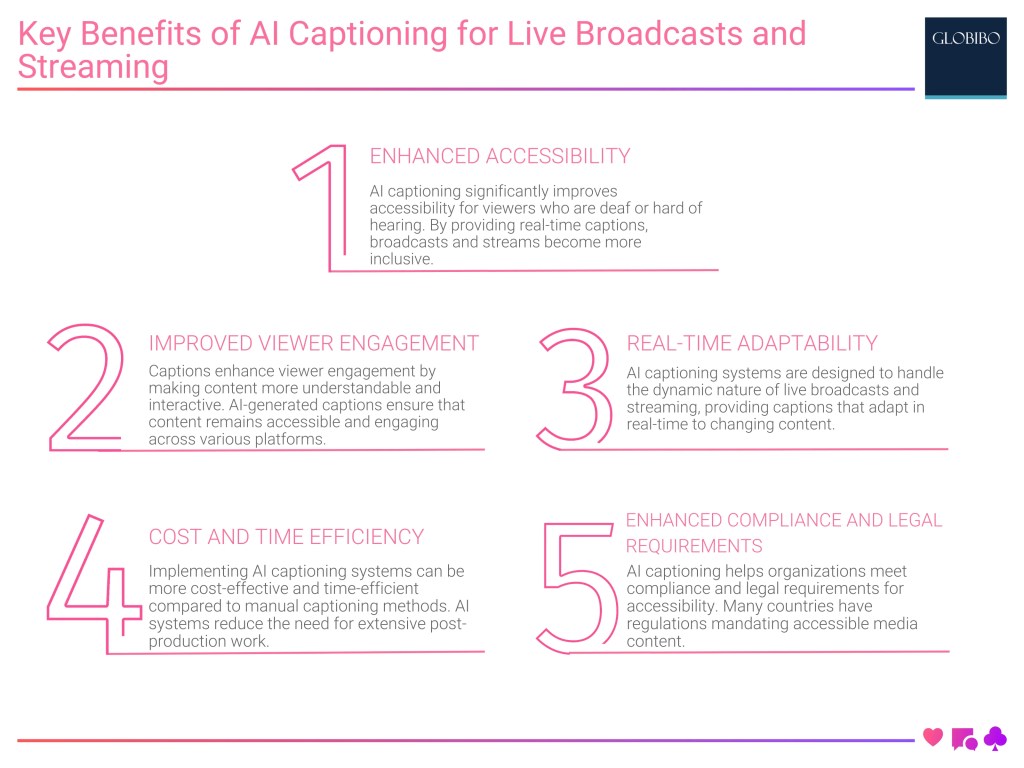
Key Benefits of AI Captioning for Live Broadcasts and Streaming
1. Enhanced Accessibility
AI captioning significantly improves accessibility for viewers who are deaf or hard of hearing. By providing real-time captions, broadcasts and streams become more inclusive.
- Accessibility for Deaf and Hard of Hearing Viewers: Ensures that individuals with hearing impairments can fully participate in live events.
- Support for Non-Native Speakers: Helps viewers who are not fluent in the language of the broadcast understand the content through translated captions.
Accessibility Benefits of AI Captioning
| Benefit | Description | Example |
| Accessibility for Deaf and Hard of Hearing Viewers | Provides text representation of spoken content | Live news broadcasts with real-time captions |
| Support for Non-Native Speakers | Enables understanding through translated captions | International sports events with multilingual captions |
2. Improved Viewer Engagement
Captions enhance viewer engagement by making content more understandable and interactive. AI-generated captions ensure that content remains accessible and engaging across various platforms.
- Increased Comprehension: Captions help viewers follow along with the content, even in noisy environments.
- Enhanced Viewer Interaction: Viewers are more likely to stay engaged with content that is easy to understand and follow.
Engagement Benefits of AI Captioning
| Benefit | Description | Example |
| Increased Comprehension | Enhances understanding of content | Educational live streams with real-time captions |
| Enhanced Viewer Interaction | Keeps viewers engaged and reduces dropout rates | Interactive live events with synchronized captions |
3. Real-Time Adaptability
AI captioning systems are designed to handle the dynamic nature of live broadcasts and streaming, providing captions that adapt in real-time to changing content.
- Dynamic Content Handling: AI systems can manage various types of content, including technical jargon and multiple speakers.
- Real-Time Updates: Captions are updated immediately as the content changes, ensuring accuracy and relevancy.
Real-Time Adaptability Features
| Feature | Description | Example |
| Dynamic Content Handling | Manages diverse content types and speakers | Live conferences with technical discussions |
| Real-Time Updates | Provides immediate updates to captions as content changes | News broadcasts with breaking news updates |
4. Cost and Time Efficiency
Implementing AI captioning systems can be more cost-effective and time-efficient compared to manual captioning methods. AI systems reduce the need for extensive post-production work.
- Reduced Labor Costs: Automated captioning reduces the need for human captioners, lowering overall costs.
- Faster Turnaround: AI systems can generate captions in real-time, speeding up the process compared to traditional methods.
Cost and Time Efficiency
| Benefit | Description | Example |
| Reduced Labor Costs | Lowers costs by reducing reliance on human captioners | Automated live captioning for sports events |
| Faster Turnaround | Provides captions in real-time, reducing post-production time | Live TV broadcasts with instant captions |
5. Enhanced Compliance and Legal Requirements
AI captioning helps organizations meet compliance and legal requirements for accessibility. Many countries have regulations mandating accessible media content.
- Compliance with Accessibility Laws: Ensures that content adheres to regulations such as the Americans with Disabilities Act (ADA) or the European Accessibility Act.
- Improved Legal Coverage: Reduces the risk of legal issues related to accessibility non-compliance.
Compliance and Legal Benefits
| Benefit | Description | Example |
| Compliance with Accessibility Laws | Ensures adherence to legal requirements for accessible media | Live-streamed events with ADA-compliant captions |
| Improved Legal Coverage | Minimizes risk of legal issues related to non-compliance | Broadcasters adhering to European Accessibility Act |
Implementation Best Practices
1. Choosing the Right AI Captioning System
Selecting an AI captioning system that meets the specific needs of your broadcast or streaming platform is crucial. Consider factors such as accuracy, real-time capabilities, and integration options.
Key Considerations
- Accuracy and Reliability: Ensure the system provides high accuracy and reliability in various environments.
- Integration Capabilities: Choose a system that integrates seamlessly with your existing broadcasting or streaming infrastructure.
Considerations for Choosing an AI Captioning System
| Consideration | Description | Example |
| Accuracy and Reliability | High accuracy in diverse environments | Systems with advanced ASR and NLP technologies |
| Integration Capabilities | Compatibility with existing systems and platforms | AI captioning solutions that integrate with streaming services |
2. Regular Monitoring and Quality Assurance
Even with advanced AI systems, regular monitoring and quality assurance are necessary to maintain high standards of captioning.
- Monitor Performance: Regularly assess the performance of the AI system to ensure it meets accuracy and quality standards.
- Conduct Quality Checks: Implement manual and automated quality checks to identify and rectify any issues.

Monitoring and Quality Assurance
| Practice | Description | Example |
| Monitor Performance | Regularly evaluate system performance and accuracy | Performance reviews of captioning systems |
| Conduct Quality Checks | Implement checks to ensure caption quality and accuracy | Manual review of AI-generated captions |
Future Trends in AI Captioning
1. Advancements in Speech Recognition
Future advancements in speech recognition technology will enhance the accuracy and efficiency of AI captioning systems.
- Improved ASR Models: Development of more sophisticated ASR models that better handle diverse accents and noisy environments.
- Contextual Understanding: Enhanced NLP techniques that provide deeper contextual understanding and reduce errors.
Future Trends in Speech Recognition
| Trend | Description | Example |
| Improved ASR Models | More accurate recognition of speech in varied conditions | ASR systems with enhanced accent handling |
| Contextual Understanding | Advanced NLP for better context and meaning | AI systems with improved context-aware algorithms |
2. Integration with Other Technologies
AI captioning systems will increasingly integrate with other technologies to provide a more comprehensive viewing experience.
- Real-Time Translation: Combining AI captioning with real-time translation for multilingual broadcasts.
- Enhanced Interactivity: Integration with interactive features such as live polls and audience engagement tools.

Integration Trends
| Integration | Description | Example |
| Real-Time Translation | Combining captioning with translation for multilingual support | Live-streams with instant language translation |
| Enhanced Interactivity | Integrating AI captioning with interactive tools | Live events with audience polls and feedback |
Conclusion for AI Captioning and Subtitling
AI captioning offers significant benefits for live broadcasts and streaming, including enhanced accessibility, improved viewer engagement, real-time adaptability, cost efficiency, and compliance with legal requirements. By leveraging core technologies such as speech recognition, natural language processing, and real-time data processing, AI captioning systems ensure that content is accessible and engaging for a diverse audience. Implementing best practices and staying abreast of future trends will help organizations maximize the benefits of AI captioning and continue to meet the evolving needs of their viewers.
This comprehensive analysis of AI captioning for live broadcasts and streaming highlights the key benefits and technical aspects of the technology. By understanding and applying these insights, stakeholders can enhance their content offerings and ensure a more inclusive and engaging viewing experience.
Academic References for AI Captioning and Subtitling
- [HTML] Language Context in the Future of Television and Video Industry: Exploring Trends and Opportunities
- Livebot: Generating live video comments based on visual and textual contexts
- [PDF] Impact of AI on Media & Entertainment Industry
- Cloud‐based video streaming services: Trends, challenges, and opportunities
- [BOOK] Subtitling through speech recognition: Respeaking
- Evaluating the benefit of highlighting key words in captions for people who are deaf or hard of hearing
- [BOOK] The Future of Television and Video Industry
- Applications of Computer Vision in Entertainment and Media Industry
- [PDF] Caption-occlusion severity judgments across live-television genres from deaf and hard-of-hearing viewers.
- A Survey on Intelligent Solutions for Increased Video Delivery Quality in Cloud-Edge-End Networks

Rick Lee
Project Manager – Event Technology
With over 10 years of experience in event technology, Rick is an expert in integrating cutting-edge tech solutions for seamless event execution. His expertise includes audio-visual setups, interactive displays, and live-streaming technologies. Rick’s innovative approach ensures every event is technologically advanced and highly engaging.
Youtube Video for AI Captioning and Subtitling
Key Articles on AI Captioning and Subtitling
Contacts
Certification

Testimonials



Event Technology