Understanding Race Timing Technology
Race timing technology has become an essential pillar of modern competitive sports. From community 5Ks and international marathons to triathlons, road cycling grand tours, and motorsports, accurate timing is crucial for ensuring fair competition, maintaining participant safety, and delivering engaging experiences for athletes, spectators, and broadcast media. This comprehensive technical guide explores the core hardware architectures, communication protocols, process flows, and innovations powering modern race timing systems.
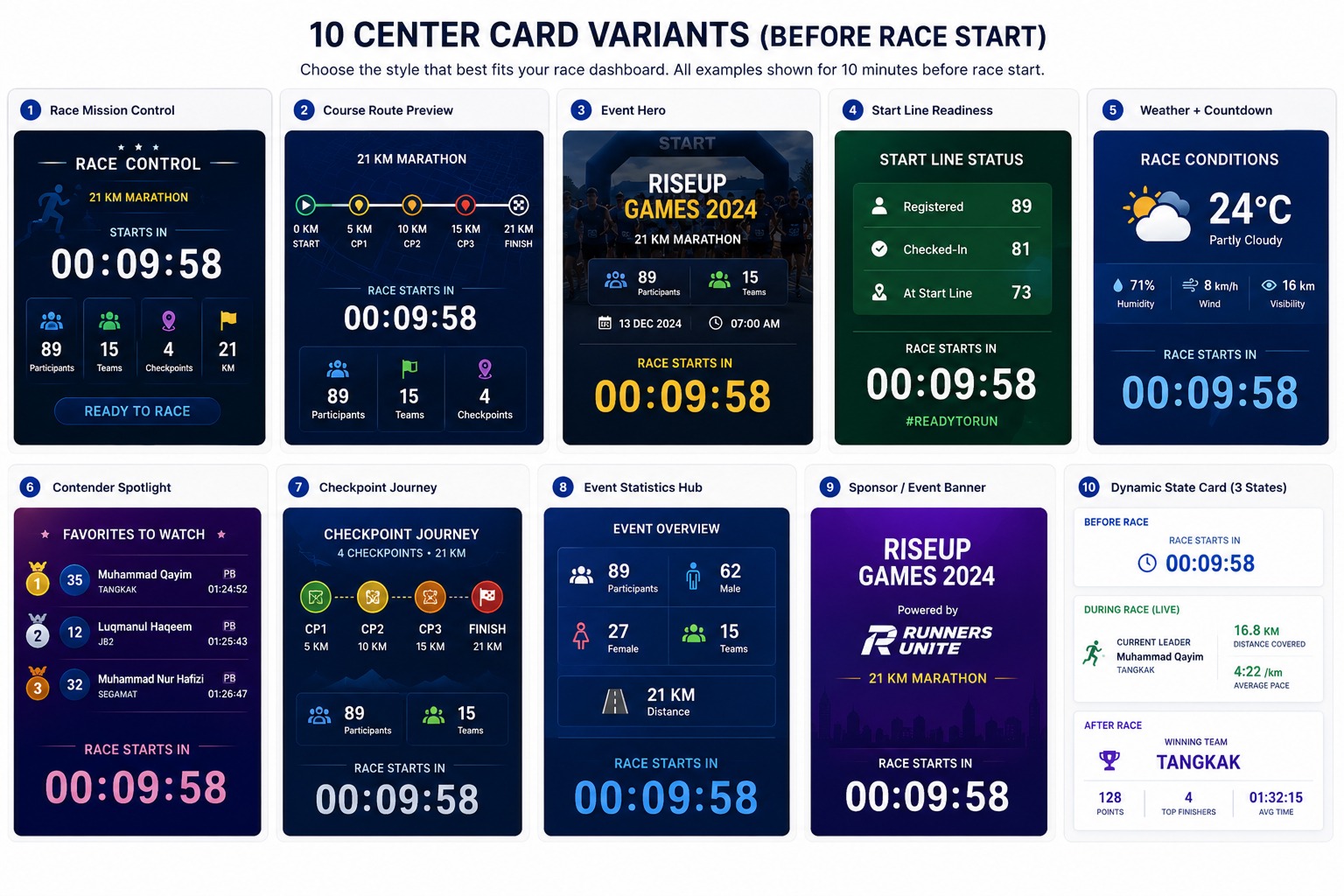
The importance of race timing systems
A well-engineered race timing system provides far more than a simple stopwatch measurement. It serves as an integrated event operations engine that delivers four fundamental benefits:
- Sub-millisecond accuracy: Electronic timing eliminates human reaction time variations (±0.20 to 0.50 seconds), producing verifiable results that meet national and international athletics federation standards.
- Real-time data synchronization: Automated decoders transmit split times to cloud servers within milliseconds, enabling live leaderboards, TV broadcast graphics, and spectator app feeds.
- Participant tracking and safety: Multi-checkpoint timing verifies that athletes complete the full course while enabling medical staff to locate missing or distressed runners.
- Streamlined event management: Bi-directional API integrations link timing decoders with registration databases, packet pickup systems, and results distribution portals.
Types of race timing systems
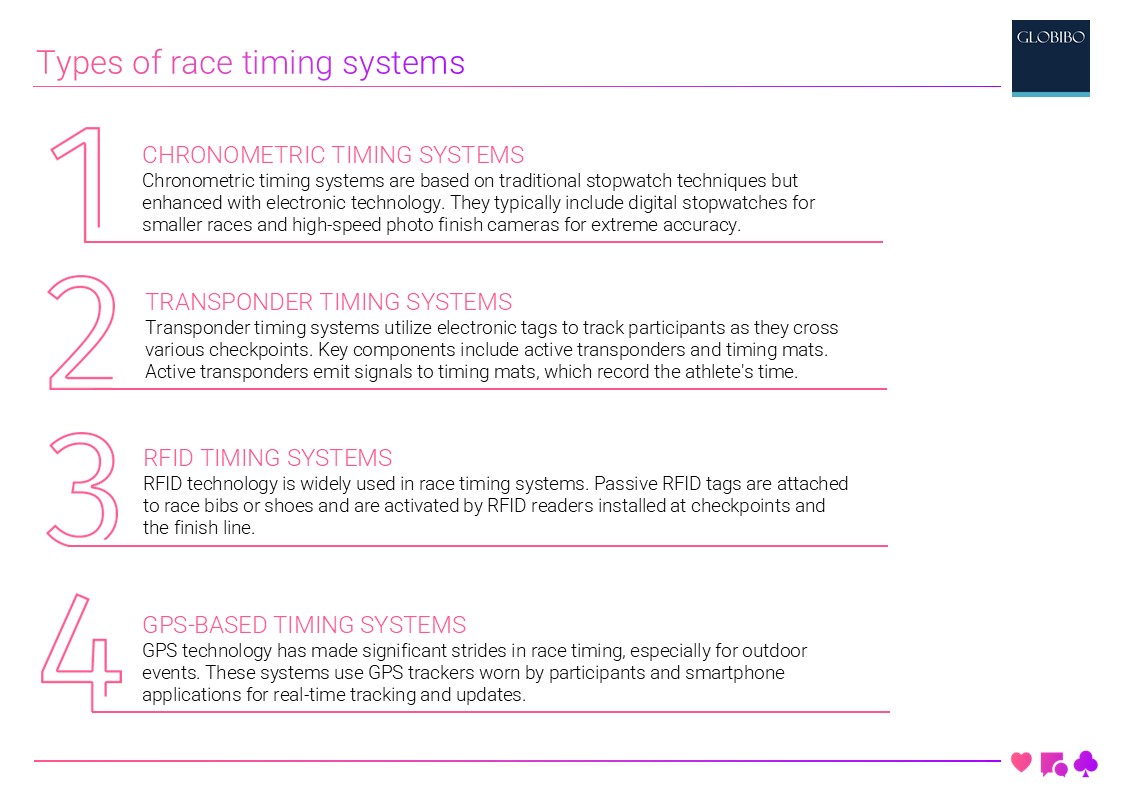
Race timing systems are categorized based on their underlying sensor and transmission physics. The primary technologies used in modern competitive events include:
1. RFID timing systems (passive UHF)
Radio Frequency Identification (RFID) operating in the Ultra-High Frequency band (860–960 MHz) is the most widely deployed race timing technology worldwide.
- Passive RFID tags: Lightweight tags containing an integrated circuit and antenna printed on a paper or foam substrate. The tag has no internal battery; it is energized by the electromagnetic field emitted by the timing mat antenna.
- UHF timing mats & side antennas: Ground mats containing circular-polarized antenna arrays generate a capture zone across the course width, reading passing tags with 99.8%+ accuracy at speeds up to 40 km/h.
2. Transponder timing systems (active RFID)
Active transponder systems utilize battery-powered transponders that emit continuous or triggered radio frequency pulses.
- Active transponders: Enclosed in IP68 waterproof housings, active chips feature internal lithium cells with a 5+ year lifespan. They transmit high-strength signals capable of penetrating water and mud.
- Loop cables and active decoders: Thin wire loops taped to the road or submerged in transition zones detect transponders passing at speeds up to 150+ km/h, making them standard for triathlons, cycling, and motorsports.
3. GPS-based timing and tracking systems
GPS timing leverages Global Navigation Satellite Systems (GNSS) to track participant coordinates continuously across expansive courses.
- Wearable GPS beacons: Compact cellular/satellite beacons worn by runners transmit geolocation coordinates and timestamps to cloud servers every 2 to 5 seconds.
- Mobile tracking applications: Participants’ smartphones utilize internal GPS chipsets to feed real-time positional data to spectator tracking maps during trail ultras and open-water swims.
4. Chronometric and photo-finish optical systems
High-precision optical timing is deployed where mechanical or electronic margins are separated by thousandths of a second.
- Photo-finish line-scan cameras: Capture up to 10,000 vertical pixel lines per second across the finish line, generating a time-stamped composite image that resolves sprint finishes down to 0.0001 seconds.
- Photoelectric cells (light beams): Infrared transmitter-receiver pairs placed across the finish line trigger the timer when a runner’s torso breaks the beam.
How race timing systems work
Key components of a race timing architecture
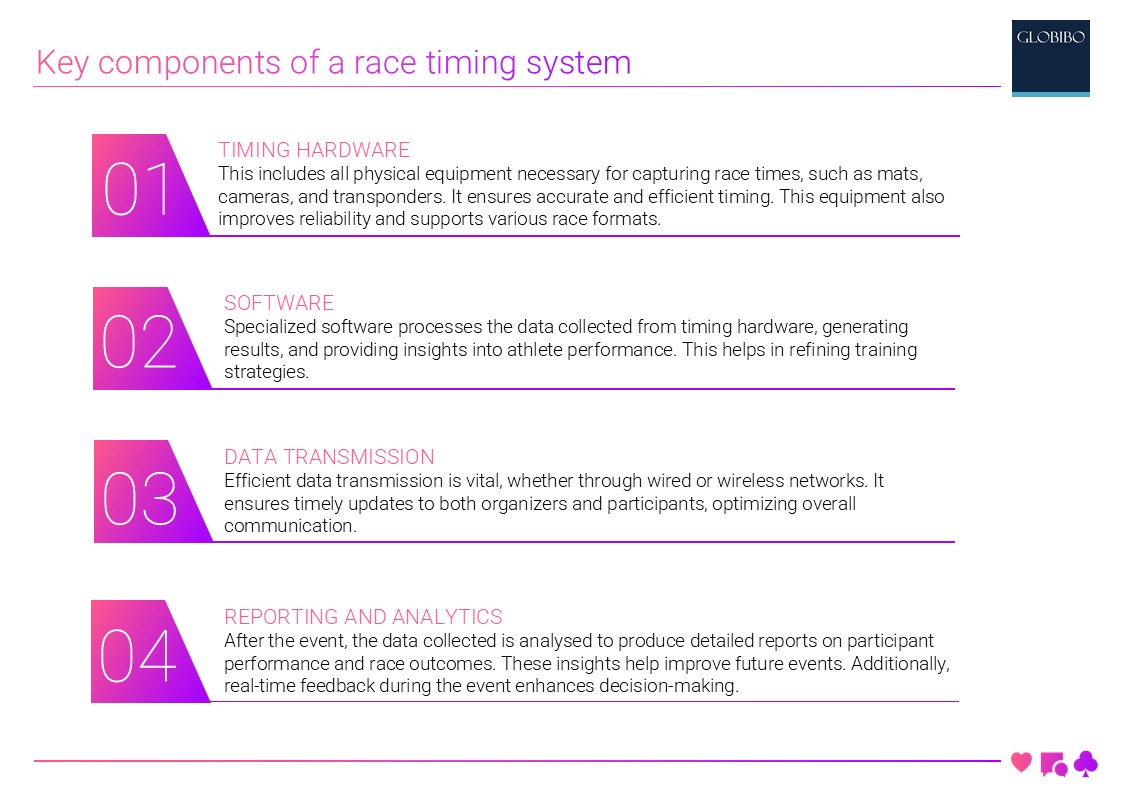
- Timing hardware: Physical transponders, UHF antenna mats, active loop decoders, photoelectric cells, and photo-finish cameras.
- Scoring software: Centralized software that processes raw timestamp records, applies gun/net offsets, computes age-group categories, and flags anomalies.
- Data transmission infrastructure: 4G/5G LTE cellular modems, satellite IoT links, and Ethernet mesh networks connecting checkpoint decoders to cloud servers.
- Reporting and presentation tools: Mobile apps, live results portals, SMS gateways, and stadium video wall controllers.
Process flow of a race timing system
- Pre-race setup & calibration: Deploy timing mats, tune antenna loop frequencies (865–868 MHz Europe / 902–928 MHz US), test backup power supplies, and conduct walk-through tests with sample transponders.
- Participant registration & encoding: Athlete profiles, wave groups, and emergency contacts are imported via API, linking each bib number to its unique RFID tag ID.
- Race day execution:
- Start line: Master decoder captures gun start timestamp and individual net start timestamps as athletes cross the start mat.
- Intermediate split mats: Remote decoders at 5K, 10K, half-marathon, and transition zones log split times and push data to cloud scoring engines.
- Finish line: Dual primary and backup mats record final timestamps, while photo-finish cameras capture synchronized frame verification.
- Post-race audit and certification: Automated algorithms cross-verify split logs against backup video footage, resolve disputed results, and publish certified official standings.
Race timing technology comparison
| Technology type | Operating frequency | Accuracy level | Passing speed rating | Water / mud resistance | Best applications |
|---|---|---|---|---|---|
| Passive UHF RFID | 860–960 MHz | Sub-millisecond (<0.001s) | Up to 40 km/h | Moderate (needs foam spacer) | Road marathons, 5K/10K runs, mass charity walks |
| Active transponder | 125 kHz / 2.4 GHz | Sub-millisecond (<0.001s) | Up to 150+ km/h | High (IP68 fully waterproof) | Triathlons, road cycling, motorsports, obstacle races |
| GPS satellite tracking | 1.575 GHz (L1 GNSS) | 1 to 3 sec latency (±2–5m) | All speeds | High (weatherproof beacon) | Trail ultras, wilderness adventure races, open water |
| Photo-finish camera | Optical sensor (10k fps) | 0.0001 sec | Finish line sprint | Moderate (sheltered finish gantry) | Track sprints, cycling peloton finishes, speed skating |
| Photoelectric beam | Infrared optical beam | 0.001 sec | Single runner finish | High | Ski racing, equestrian, drag racing, athletics track |
Trends in race timing technology

The field of race timing technology is evolving rapidly. Key trends shaping the future of race timing systems include:
Integration of mobile technology and live tracking
Mobile applications allow athletes and spectators to experience races interactively:
- Live GPS mapping: Spectators track athletes’ real-time positions along the course route.
- Automated split alerts: Instant push notifications delivered each time an athlete crosses a timing checkpoint.
Cloud-based scoring and edge computing
- Elastic scalability: Cloud scoring engines process millions of raw reads from hundreds of timing points simultaneously without lag.
- Remote management: Timing directors monitor system health, battery voltages, and antenna read rates from any connected laptop.
Advanced predictive analytics and telemetry
- Predictive finish modeling: Machine learning models analyze early split pacing to project final finish times for broadcast commentators.
- Biometric sensor integration: Syncing smartwatch heart rate and cadence data directly with timing leaderboards to support sustainable event planning.
Enhanced data security and encryption
- End-to-end AES-256 encryption: Protecting participant personal records and timestamps during cellular transmission.
- GDPR compliance: Automated data retention policies that protect athlete privacy and adhere to international data regulations.
Technical challenges and best-practice solutions
- RF signal attenuation and tag collision: In dense start corrals, multiple tags can collide in the RF field. Deploying UHF decoders with dynamic Q-anti-collision algorithms and circular-polarized antennas ensures 99.8%+ read reliability.
- Power continuity at remote splits: Decoders equipped with dual lithium-ion battery buffers provide 10–12 hours of standalone runtime, supported by portable solar panels on multi-day ultras.
- Cellular network dropouts: Standalone decoders store all timestamp records on internal non-volatile flash memory, automatically syncing with cloud servers as soon as connectivity resumes.
- Data integration errors: Direct API integration between timing software and registration platforms eliminates manual spreadsheet errors and speeds up race morning packet pickup.
Summary of race timing technology
Race timing technology is the cornerstone of modern sporting events. By integrating precision RFID transponders, active chips, GPS tracking, optical line-scan cameras, and cloud software, organizers deliver the accurate, verifiable, and engaging race experiences that athletes and fans expect in today’s competitive landscape.

Rick Lee
Project Manager – Event Technology
YouTube videos on race timing systems



Frequently asked questions on race timing technology
1. How does passive RFID timing work without batteries?
Passive RFID tags contain an microchip attached to a printed antenna. When the tag enters the electromagnetic field emitted by the timing mat antenna, the radio waves induce a tiny electrical current that powers the chip, enabling it to broadcast its unique ID back to the mat reader.
2. Why do triathlons use active transponders instead of passive bib tags?
Water strongly absorbs the Ultra-High Frequency (UHF) radio waves used by passive RFID, making bib tags unreliable when wet. Active transponders operate at lower frequencies (125 kHz / 2.4 GHz) with internal battery power, penetrating water and mud effortlessly during the swim and transition segments.
3. What is the difference between circular and linear polarized antennas?
Linear antennas emit radio waves in a single plane, requiring tags to be aligned vertically. Circular polarized antennas rotate the radio wave in a helical pattern, capturing tags regardless of whether they are oriented vertically, horizontally, or angled on a runner’s shoe or chest.
4. How accurate is photo-finish camera technology?
Modern line-scan photo-finish cameras capture between 2,000 and 10,000 vertical pixel lines per second across the finish line. Each line is timestamped to 0.0001 seconds, providing definitive visual resolution for sprint finishes separated by millimeters.
5. What frequency bands are used for race timing globally?
UHF RFID timing operates within regionally regulated industrial, scientific, and medical (ISM) bands: 865–868 MHz in Europe (ETSI standard) and 902–928 MHz in the Americas and Asia (FCC standard). Decoders must be configured to local regulatory standards.
6. How do timing decoders communicate across long marathon courses?
Remote split decoders use integrated 4G/5G LTE cellular modems with dual-SIM auto-failover to transmit MQTT or WebSocket data packets to cloud scoring servers within 200 to 500 milliseconds of each tag read.
7. What is the read range of a typical race timing mat?
A standard ground UHF timing mat creates an electromagnetic capture bubble extending 1.2 to 1.8 meters above the mat surface, ensuring reliable detection of bib tags worn on the chest or transponders laced into running shoes.
8. Can race timing systems operate without grid electricity?
Yes. Professional timing decoders feature integrated lithium-ion battery packs that provide 8 to 12 hours of continuous operation. Remote checkpoints can run indefinitely using compact 50W solar panel arrays or portable inverter generators.
Academic references on race timing technology and sports engineering
- Balbinot, A., Farret, M., Kother, R., & Kern, P. (2015). Electronic system for timing in sport competitions using piezoelectric transducers. Measurement, 73, 312–321.
- Haake, S. J., Foster, L., & James, D. M. (2014). An improvement index to quantify the evolution of world records in sport. Journal of Sports Sciences, 32(7), 610–622.
- Ferreira, J., & Silva, M. (2024). An environmentally friendly race timing system based on cameras only. Springer Nature Computer Science.
- Vander Maelen, G. (2018). Open Source RFID race timing system. Université catholique de Louvain.
- Boldt, P., Thiele, D., & Pfeiffer, M. (2018). Validity of the Garmin Vector 2 power meter. Journal of Human Kinetics, 61(1), 97–106.
- Cejuela Anta, R., & Esteve-Lanao, J. (2011). Training load quantification in triathlon. Journal of Human Sport and Exercise, 6(2), 218–232.
- Paton, C. D., & Hopkins, W. G. (2006). Success in elite cycling: A prospective and retrospective analysis of race results. Journal of Sports Sciences, 24(7), 747–756.
Key articles on race timing technology
Contacts
Certification

Testimonials










Event Technology