Tips for Achieving the Best Results in AI Event Transcription Accuracy
AI Event transcription has become a transformative tool in various industries, enabling automatic conversion of spoken language into text. While these systems provide significant time-saving benefits and accessibility enhancements, achieving high transcription accuracy remains a challenge. The accuracy of AI transcription is influenced by several factors, such as audio quality, speaker accents, background noise, and the specific algorithm or model used. This article delves into the various aspects that affect transcription accuracy and provides technical tips for optimizing results using AI transcription tools.
We will explore best practices for improving transcription precision, challenges in achieving high accuracy, and how businesses can leverage AI transcription tools to their advantage. The article will also present two structured lists and a table of key factors affecting transcription quality to ensure a comprehensive understanding of how to achieve optimal AI transcription results.
Factors Affecting AI Event Transcription Accuracy
Several variables determine the accuracy of AI transcription. Understanding and addressing these factors is crucial to improving performance.
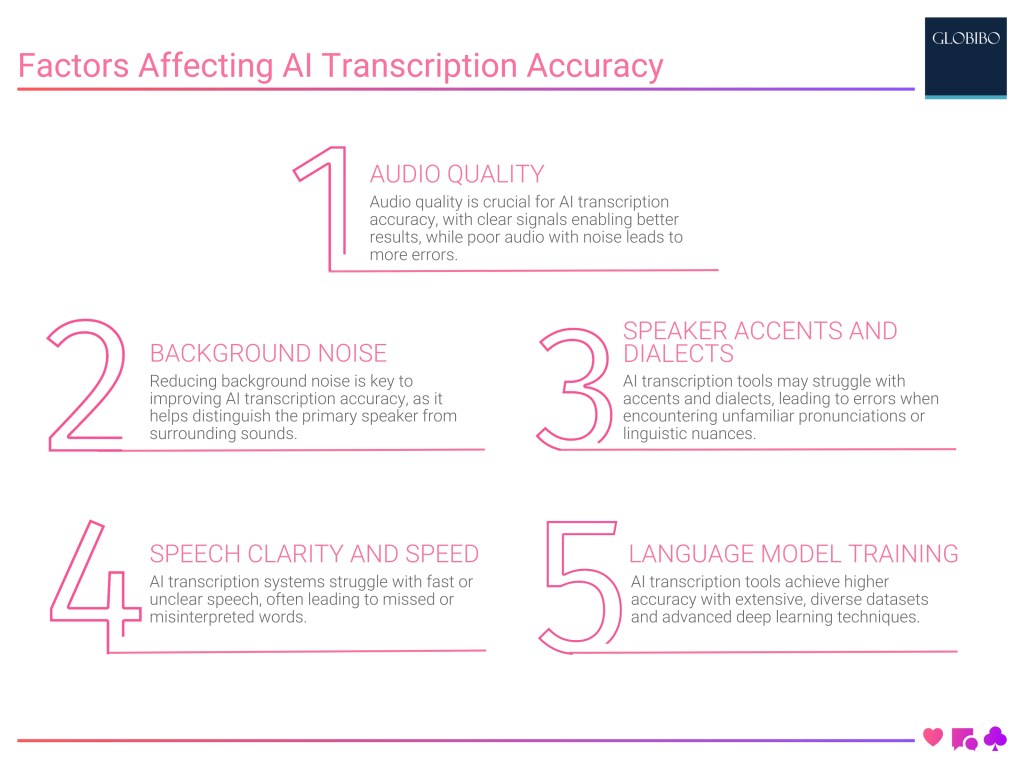
1. Audio Quality
Audio quality plays a critical role in determining the accuracy of AI transcription. Clear, high-quality audio signals allow transcription algorithms to process speech more effectively. Conversely, low-quality audio with distortion or excessive background noise can result in transcription errors.
Key Audio Quality Factors:
- Signal-to-Noise Ratio (SNR): Higher SNR results in clearer audio and more accurate transcription.
- Recording equipment: Using high-quality microphones ensures minimal distortion and clear voice capture.
- Audio format: Lossless audio formats such as WAV files often provide better results than compressed formats like MP3.
2. Background Noise
Background noise can significantly impair the ability of AI transcription tools to distinguish between the primary speaker and surrounding sounds. Reducing or eliminating background noise during recording is one of the most effective ways to improve transcription accuracy.
3. Speaker Accents and Dialects
AI transcription tools may struggle with different accents and dialects. While many systems are trained on diverse datasets, accuracy may vary depending on the accent or dialect of the speaker. This can result in errors when the transcription tool encounters unfamiliar pronunciations or linguistic nuances.
4. Speech Clarity and Speed
The clarity of the speaker’s speech and the speed at which they talk affect how well AI transcription systems can process and transcribe audio. Fast speech or mumbled words can cause the system to miss words or misinterpret them.
5. Language Model Training
AI transcription tools rely on language models that have been trained on specific datasets. The more extensive and diverse the dataset, the better the tool can handle variations in language, jargon, and terminology. Advanced tools use deep learning techniques and large-scale datasets to achieve higher accuracy rates.
Pre-Recording Tips to Enhance AI Event Transcription Accuracy
- Choose the Right Recording Equipment:
- High-quality microphones and recording devices help capture clear audio, minimizing distortion and background noise.
- Record in Controlled Environments:
- Choose environments with minimal background noise or distractions. Consider using soundproofed rooms for professional-quality recordings.
- Maintain Consistent Volume and Speech Pace:
- Speakers should maintain a consistent speaking volume and pace. Avoid speaking too quickly or too softly, as it may affect transcription accuracy.
- Avoid Cross-Talk:
- Ensure that speakers take turns speaking and avoid overlapping conversations. Cross-talk can confuse AI transcription systems and reduce accuracy.
- Use External Noise-Canceling Solutions:
- Implement noise-canceling technologies, such as software filters or hardware solutions, to minimize environmental noise during recordings.
How AI Event Transcription Tools Process Speech
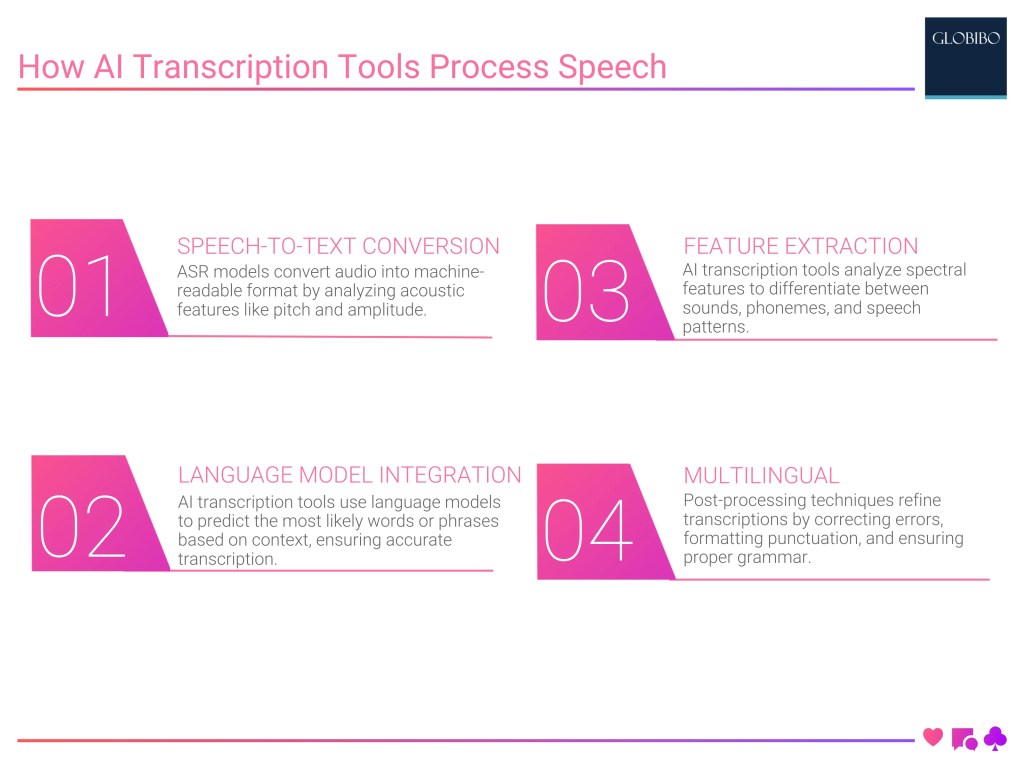
AI Event transcription systems function by utilizing machine learning algorithms, particularly neural networks, to transcribe spoken language into text. Most transcription systems rely on Automatic Speech Recognition (ASR) technology, which processes speech through several key stages:
1. Speech-to-Text Conversion
ASR models convert audio data into a machine-readable format by breaking down sound waves into smaller, recognizable units. This involves analyzing the acoustic features of the speech signal, such as pitch and amplitude.
2. Feature Extraction
The next step is to extract relevant features from the audio. AI transcription tools analyze spectral features, which help the system differentiate between different sounds, phonemes, and patterns in speech.
3. Language Model Integration
AI Event transcription tools incorporate language models to interpret the sequence of sounds in context. The language model is responsible for predicting the most likely word or phrase based on previous words in the sentence, making it crucial for determining the correct transcription.
4. Post-Processing and Text Output
Once the transcription is generated, many systems use post-processing techniques to refine the text. This includes correcting common errors, formatting punctuation, and ensuring proper grammar.
Post-Processing Tips for Refining AI Event Transcription Results
- Manual Review and Editing:
- Even with high transcription accuracy, reviewing the transcription for errors is essential. Manual editing ensures proper formatting, corrects missed words, and adjusts for speaker identification issues.
- Add Domain-Specific Vocabulary:
- Customize the AI transcription system by integrating domain-specific terminology or jargon that may not be included in standard language models. This enhances accuracy in specialized fields such as legal, medical, or technical industries.
- Use Punctuation and Capitalization Tools:
- Some AI transcription tools offer advanced punctuation features, automatically adding commas, periods, and question marks. Ensure these tools are activated to enhance readability.
- Timestamping for Contextual Review:
- Enable timestamping in transcription tools, allowing you to easily review the corresponding section of audio if there are discrepancies in the text.
- Speaker Labeling:
- For multi-speaker recordings, use AI transcription tools that support speaker labeling to differentiate between different participants.
Common Challenges in AI Event Transcription Accuracy
Despite significant advancements in AI transcription technology, challenges remain. Some common issues include:
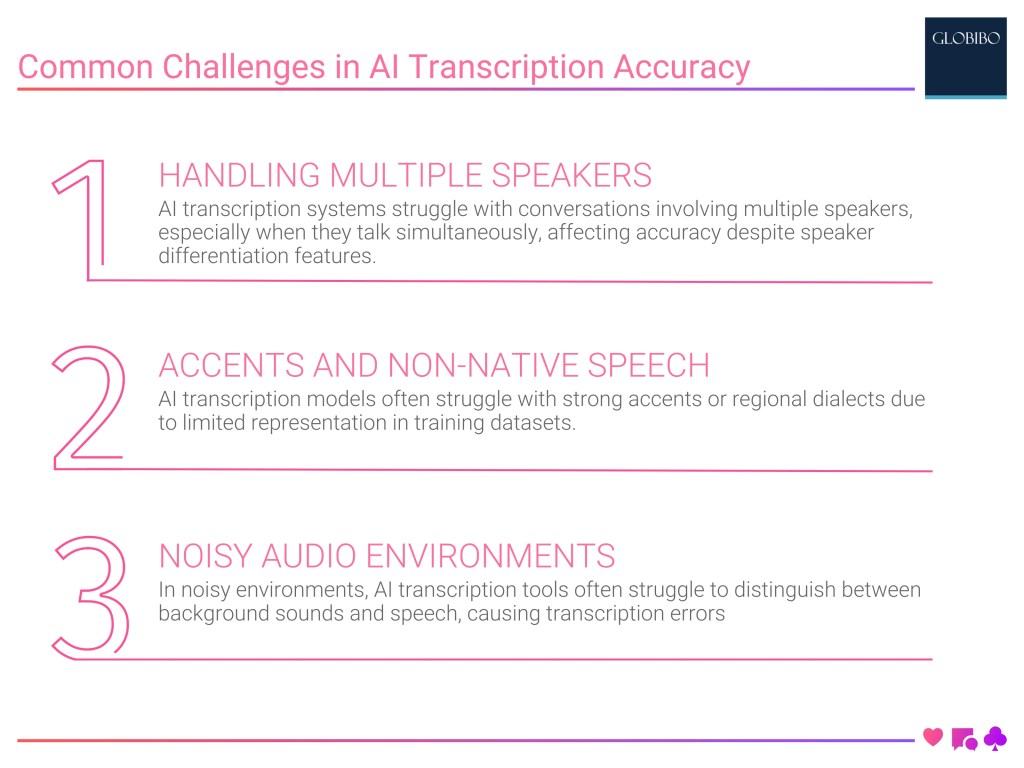
1. Handling Multiple Speakers
Transcribing conversations with multiple speakers, especially when they speak simultaneously or in quick succession, can be challenging for AI transcription systems. While many tools have features that attempt to differentiate between speakers, accuracy can still be impacted.
2. Accents and Non-Native Speech
Even sophisticated AI transcription models can struggle with strong accents, non-native speech, or regional dialects. This is because the training datasets may not fully represent the wide variety of accents spoken globally.
3. Jargon and Industry-Specific Terms
Industry-specific terminology or jargon that is uncommon in everyday language may not be recognized by standard AI transcription tools. This can result in inaccurate transcriptions or misinterpretation of key terms.
4. Noisy Audio Environments
Noisy environments, such as public spaces or outdoor settings, can interfere with the clarity of recorded audio. AI transcription tools may struggle to differentiate between background sounds and speech, leading to transcription errors.
Key Challenges in AI Event Transcription Accuracy
| Challenge | Impact on Transcription Accuracy | Mitigation Strategies |
| Multiple Speakers | AI may confuse or overlap speakers’ words | Use speaker labeling and ensure speakers take turns talking |
| Accents and Dialects | Difficulty in recognizing non-native speech or strong regional accents | Utilize transcription tools with diverse language models |
| Industry-Specific Jargon | Misinterpretation of unfamiliar or technical terms | Customize the tool with a specialized vocabulary or glossary |
| Background Noise | Decreases clarity and increases transcription errors | Record in quiet environments, use noise cancellation technologies |
Best Practices for Optimizing AI Event Transcription Results
By adhering to best practices during recording and post-processing, organizations can significantly improve transcription accuracy:
1. Selecting High-Quality Transcription Tools
Choosing the right transcription tool with advanced features such as speaker identification, noise cancellation, and support for multiple languages is critical for achieving high accuracy.
2. Customizing Language Models
Advanced AI transcription tools allow users to integrate custom dictionaries or train the model on specific datasets. This is particularly useful for businesses in technical fields where industry-specific jargon is commonly used.
3. Leveraging Human-in-the-Loop Models
Some AI transcription tools offer a “human-in-the-loop” model, where human reviewers oversee the transcription process. This hybrid approach combines the speed of AI with the precision of manual editing, resulting in higher accuracy.
4. Continuous Monitoring and Feedback
Regularly reviewing transcriptions and providing feedback to the AI model can improve long-term performance. Many systems allow users to flag inaccuracies, enabling the tool to learn from mistakes and refine future transcriptions.

Conclusion for AI Event Transcription
Achieving high accuracy in AI Event transcription requires a multi-faceted approach, combining careful pre-recording preparation, advanced transcription technologies, and diligent post-processing. Factors such as audio quality, speaker accents, and background noise play a crucial role in the effectiveness of AI transcription tools. By following best practices like selecting high-quality recording equipment, leveraging specialized language models, and implementing manual reviews, organizations can significantly improve transcription precision.
As AI Event transcription tools continue to evolve, their accuracy will become even more reliable, making them indispensable for businesses that rely on transcription for content creation, legal documentation, accessibility, and compliance purposes. By applying the tips outlined in this article, organizations can optimize AI transcription performance and achieve superior results.
Academic References for AI Transcription
- [PDF] THE IMPACT OF AI-GENERATED AUDIO TRANSCRIPTIONS ON SOLVING LISTENING COMPREHENSION PROBLEMS: THE ATTITUDES OF VIETNAMESE …
- Automatic music transcription: An overview
- Automatic music transcription: challenges and future directions
- The LIMSI broadcast news transcription system
- Melody transcription from music audio: Approaches and evaluation
- [HTML] Artificial intelligence in clinical and genomic diagnostics
- [BOOK] Rebooting AI: Building artificial intelligence we can trust
- When will AI exceed human performance? Evidence from AI experts
- [BOOK] Human-in-the-Loop Machine Learning: Active learning and annotation for human-centered AI
- Computer model for recognition of functional transcription start sites in RNA polymerase II promoters of vertebrates

Rick Lee
Project Manager – Event Technology
With over 10 years of experience in event technology, Rick is an expert in integrating cutting-edge tech solutions for seamless event execution. His expertise includes audio-visual setups, interactive displays, and live-streaming technologies. Rick’s innovative approach ensures every event is technologically advanced and highly engaging.
Youtube Video on AI Event Transcription
Key Articles for AI Event Transcription
Contacts
Certification

Testimonials









Event Technology