The Importance of Live Testing in Translation and Transcription Services
Live testing is a crucial step in ensuring the accuracy and effectiveness of translation and transcription services. As global communication becomes increasingly essential, the demand for precise and reliable translation and transcription has never been higher. Live testing, also known as real-time testing, plays a pivotal role in validating the performance and quality of these services before they are deployed in critical scenarios. This article explores the significance of live testing in translation and transcription services, including its impact on service quality, the methodologies involved, and best practices for implementation.
Understanding Live Testing in Translation and Transcription
Live testing involves evaluating translation and transcription services under real-time conditions to assess their effectiveness and accuracy. This process helps identify potential issues and ensures that the services meet the required standards before they are used in actual settings.
Benefits of Live Testing
- Accuracy Verification: Live testing helps verify the accuracy of translations and transcriptions, ensuring that they meet the required linguistic and technical standards.
- Performance Evaluation: By simulating real-world scenarios, live testing evaluates the performance of translation and transcription tools and services under various conditions.
- Issue Identification: Live testing helps identify and address issues such as errors, inconsistencies, and technical glitches before the services are used in critical applications.

Key Aspects of Live Testing for Translation and Transcription Services
- Test Planning:
- Objective Definition: Clearly define the objectives of the live test, including what aspects of the service will be evaluated.
- Scenario Development: Develop scenarios that accurately represent real-world conditions where the translation or transcription service will be used.
- Execution:
- Live Environment Setup: Set up a controlled live environment that mimics actual conditions to test the service effectively.
- Data Collection: Collect data during the live test, including performance metrics, error rates, and user feedback.
- Analysis:
- Result Evaluation: Analyze the collected data to assess the accuracy and performance of the translation or transcription service.
- Issue Resolution: Identify and address any issues or areas for improvement based on the analysis.
- Feedback and Improvement:
- Stakeholder Feedback: Gather feedback from stakeholders and end-users to understand their experiences and expectations.
- Service Enhancement: Use the feedback and analysis to make necessary improvements to the service.

The Role of Live Testing in Translation Services
Live testing is particularly critical in translation services where real-time accuracy and context comprehension are essential. It ensures that translations are not only linguistically correct but also contextually appropriate and culturally sensitive.
Methodologies for Live Testing in Translation Services
- Simulated Live Sessions: Conduct simulated translation sessions with professional interpreters to test the service under controlled conditions.
- Pilot Testing: Implement a pilot phase where the translation service is used in a limited scope before full deployment.
- Real-Time Feedback Integration: Collect feedback from live sessions and incorporate it into the service for continuous improvement.
Methodologies for Live Testing in Translation Services
- Simulated Live Sessions:
- Setup: Create realistic scenarios that represent typical translation tasks.
- Execution: Use professional interpreters to perform translations during the simulated sessions.
- Evaluation: Assess the accuracy and effectiveness of the translations.
- Pilot Testing:
- Scope Definition: Define a limited scope for the pilot test, including the number of sessions and participants.
- Monitoring: Monitor the performance of the translation service during the pilot phase.
- Feedback Collection: Collect feedback from users to identify strengths and weaknesses.
- Real-Time Feedback Integration:
- Feedback Collection: Gather feedback from live translation sessions to identify areas for improvement.
- Service Adjustments: Make necessary adjustments based on feedback to enhance the service quality.

The Role of Live Testing in Transcription Services
Live testing is equally important in transcription services, where accuracy and timely delivery of transcribed content are crucial. It ensures that transcription services can handle various types of audio and video content effectively.
Methodologies for Live Testing in Transcription Services
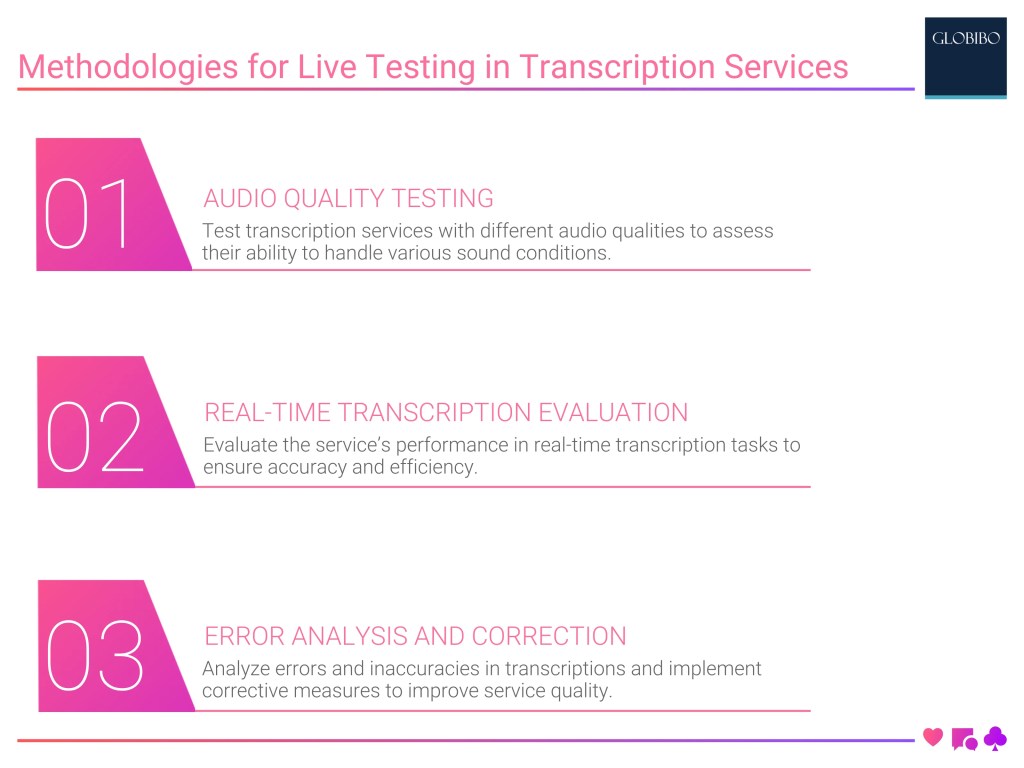
- Audio Quality Testing: Test transcription services with different audio qualities to assess their ability to handle various sound conditions.
- Real-Time Transcription Evaluation: Evaluate the service’s performance in real-time transcription tasks to ensure accuracy and efficiency.
- Error Analysis and Correction: Analyze errors and inaccuracies in transcriptions and implement corrective measures to improve service quality.
Comparison of Live Testing Methodologies for Translation and Transcription Services
| Methodology | Application | Advantages | Challenges |
| Simulated Live Sessions | Translation Services | Provides realistic testing conditions, evaluates interpreter performance | May not fully replicate real-world conditions |
| Pilot Testing | Translation and Transcription Services | Allows for gradual implementation and feedback collection | Limited scope may not capture all issues |
| Real-Time Feedback Integration | Translation and Transcription Services | Enables continuous improvement based on user feedback | Requires effective feedback collection methods |
Best Practices for Implementing Live Testing
- Define Clear Objectives: Establish clear objectives for the live test to ensure that all relevant aspects of the service are evaluated.
- Use Realistic Scenarios: Create test scenarios that closely mimic real-world conditions to obtain accurate results.
- Engage Professional Testers: Utilize experienced professionals for testing to ensure accurate and reliable results.
- Collect Comprehensive Data: Gather detailed data during the live test, including performance metrics, error rates, and user feedback.
- Analyze and Act on Feedback: Thoroughly analyze the collected data and feedback to identify areas for improvement and make necessary adjustments.

Challenges and Solutions in Live Testing
1. Realism in Test Scenarios
Challenge: Ensuring that test scenarios accurately represent real-world conditions can be difficult.
Solutions:
- Scenario Development: Collaborate with experts to develop realistic scenarios that mimic actual usage conditions.
- Diverse Testing Conditions: Include a range of scenarios to account for different conditions and use cases.
2. Handling Technical Issues
Challenge: Technical issues during live testing can disrupt the evaluation process.
Solutions:
- Backup Systems: Implement backup systems for critical components to minimize disruptions.
- Technical Support: Provide dedicated technical support during live tests to address issues promptly.
3. Interpreting Feedback Effectively
Challenge: Interpreting and acting on feedback from live testing can be complex.
Solutions:
- Structured Feedback Collection: Use structured methods for collecting feedback to ensure consistency and clarity.
- Feedback Analysis: Employ analytical tools and methods to systematically analyze feedback and identify key areas for improvement.
Conclusion for Live Test in Translation & Transcription
Live testing is an essential component of ensuring the quality and effectiveness of translation and transcription services. By carefully planning and executing live tests, organizations can verify the accuracy and performance of these services, identify and address potential issues, and make necessary improvements. The insights gained from live testing help enhance the reliability and effectiveness of translation and transcription services, ultimately contributing to successful communication in multilingual and cross-cultural settings.
As the demand for accurate and efficient translation and transcription services continues to grow, the importance of live testing remains paramount. Organizations that invest in rigorous live testing processes will be better equipped to deliver high-quality services that meet the needs of diverse audiences and ensure effective communication across languages and cultures.
Academic References for Live Test in Translation & Transcription
- Testing in translation: Conducting usability studies with transnational users
- Trainers’ and employers’ perceptions of training in intralingual and interlingual live subtitling: A survey study
- Qualitative research and translation dilemmas
- Live subtitling through respeaking
- [PDF] Methodology for cognitive testing of translations in multiple languages
- Translation in the shadows of interpreting in US court systems: Standards, guidelines and practice
- The politics of transcription
- [PDF] Fostering access for all through respeaking at live events
- [HTML] Negotiating quality assessment in media accessibility: The case of live subtitling
- Quality assessment in interlingual live subtitling: The NTR Model

Rick Lee
Project Manager – Event Technology
With over 10 years of experience in event technology, Rick is an expert in integrating cutting-edge tech solutions for seamless event execution. His expertise includes audio-visual setups, interactive displays, and live-streaming technologies. Rick’s innovative approach ensures every event is technologically advanced and highly engaging.
Youtube Video for Live Test in Translation and Transcription
Key Articles for Live Test in Translation and Transcription Services
- The Importance of Live Testing in Translation and Transcription Services
- How to Conduct a Live Test for Translation & Transcription: A Step-by-Step Guide
- Key Metrics to Measure During Live Translation & Transcription Tests
- Live Test Scenarios for Real-Time Translation Accuracy
- Live Translation in International Conferences: Key Considerations
- The Benefits of Live Translation for Virtual Events and Webinars
- Live Translation Services: How They Facilitate Cross-Cultural Communication
- How to Choose the Right Language Pair for Live Translation Services
Contacts
Certification

Testimonials








Event Technology