How to Choose the Right Language Pair for Live Translation Services
Selecting the appropriate language pair for live translation services is a critical decision that impacts the effectiveness of communication in multilingual settings. Live translation, or simultaneous interpretation, involves real-time translation of spoken content, requiring precise pairing of languages to ensure accurate and meaningful communication. This article explores the factors to consider when choosing the right language pair for live translation services, highlighting key considerations, benefits, and technical aspects involved in making an informed choice.
Understanding Live Translation Services
Live translation services provide real-time interpretation of spoken language during events such as conferences, webinars, and meetings. The choice of language pair—comprising the source and target languages—determines the success of the translation process. Proper selection ensures that all participants understand and engage with the content effectively.
Key Factors in Choosing a Language Pair
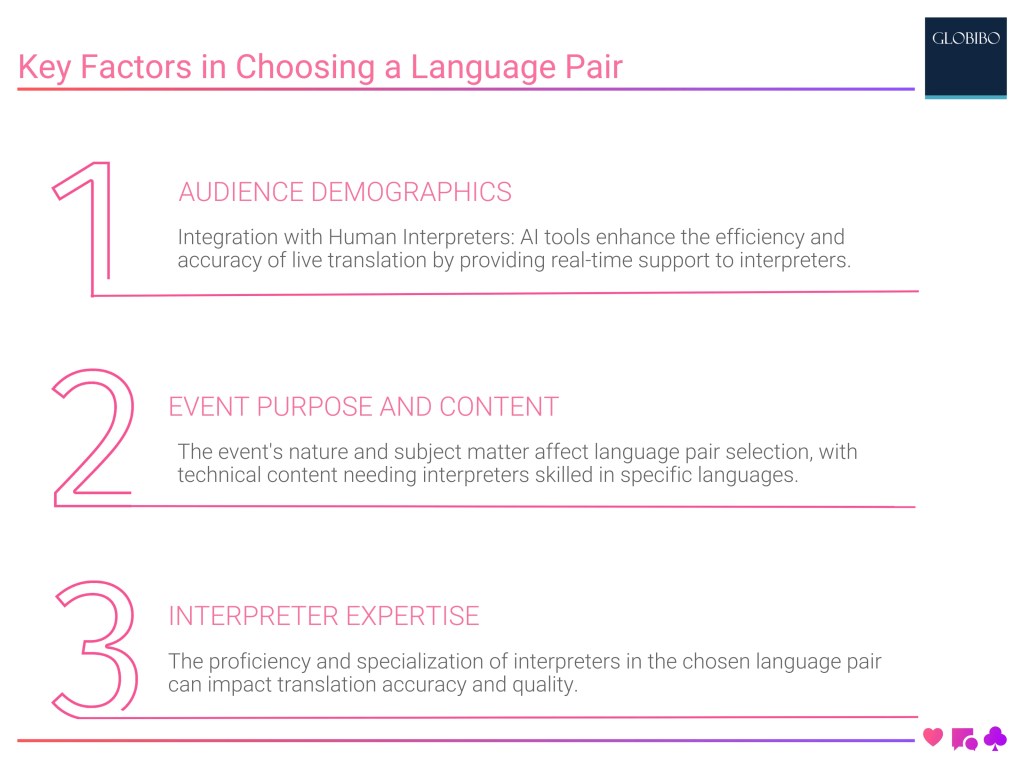
- Audience Demographics: Understanding the linguistic background of the audience is crucial. The language pair should align with the primary languages spoken by the participants.
- Event Purpose and Content: The nature of the event and the subject matter influence the choice of language pair. Technical or specialized content may require interpreters with specific expertise in those languages.
- Interpreter Expertise: The proficiency and specialization of interpreters in the chosen language pair can impact translation accuracy and quality.
Benefits of Choosing the Right Language Pair for Live Translation Services
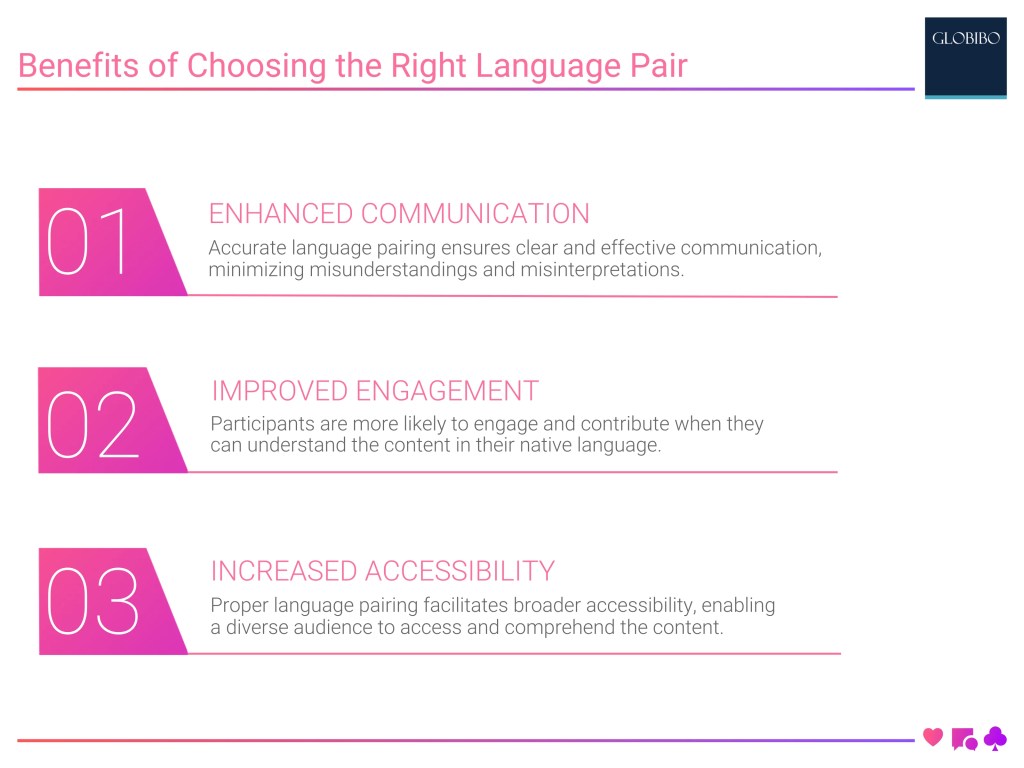
- Enhanced Communication: Accurate language pairing ensures clear and effective communication, minimizing misunderstandings and misinterpretations.
- Improved Engagement: Participants are more likely to engage and contribute when they can understand the content in their native language.
- Increased Accessibility: Proper language pairing facilitates broader accessibility, enabling a diverse audience to access and comprehend the content.
Factors to Consider When Choosing a Language Pair
- Audience Demographics:
- Primary Languages: Identify the main languages spoken by the audience.
- Language Proficiency Levels: Consider the language proficiency levels of participants.
- Event Purpose and Content:
- Technical Content: Choose a language pair with interpreters who have expertise in the technical field.
- General Content: Opt for a language pair that covers commonly spoken languages if the content is general.
- Interpreter Expertise:
- Specialization: Ensure interpreters are specialized in the language pair and subject matter.
- Experience: Assess the interpreters’ experience in live translation and their familiarity with the content.
Evaluating Language Pairs for Live Translation
1. Identifying Common Language Pairs
Popular Language Pairs: Certain language pairs are more commonly used due to their wide applicability and demand.
Examples:
- English-Spanish: Widely used for events involving participants from English and Spanish-speaking regions.
- English-Mandarin: Commonly used in international business and diplomatic contexts involving Chinese-speaking participants.
2. Assessing Language Pair Availability
Interpreter Availability: The availability of qualified interpreters for specific language pairs can vary.
Considerations:
- Demand for Languages: High-demand language pairs may have more interpreters available.
- Specialized Pairs: Less common language pairs may require finding interpreters with specialized skills.
3. Ensuring Translation Accuracy
Precision and Clarity: The accuracy of translation is essential for effective communication.
Strategies:
- Pre-Event Preparation: Provide interpreters with relevant materials and context to enhance translation accuracy.
- Quality Assurance: Implement measures such as real-time monitoring and feedback to ensure translation quality.

Common Language Pairs and Their Applications
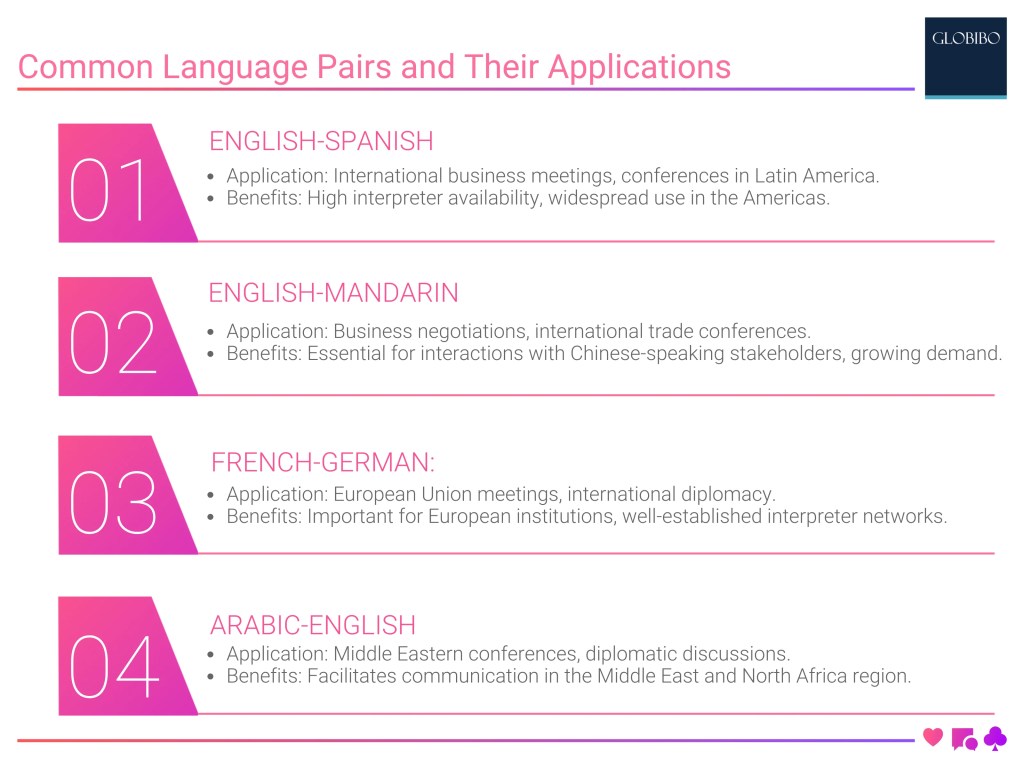
- English-Spanish:
- Application: International business meetings, conferences in Latin America.
- Benefits: High interpreter availability, widespread use in the Americas.
- English-Mandarin:
- Application: Business negotiations, international trade conferences.
- Benefits: Essential for interactions with Chinese-speaking stakeholders, growing demand.
- French-German:
- Application: European Union meetings, international diplomacy.
- Benefits: Important for European institutions, well-established interpreter networks.
- Arabic-English:
- Application: Middle Eastern conferences, diplomatic discussions.
- Benefits: Facilitates communication in the Middle East and North Africa region.
Technical Considerations for Live Translation Services
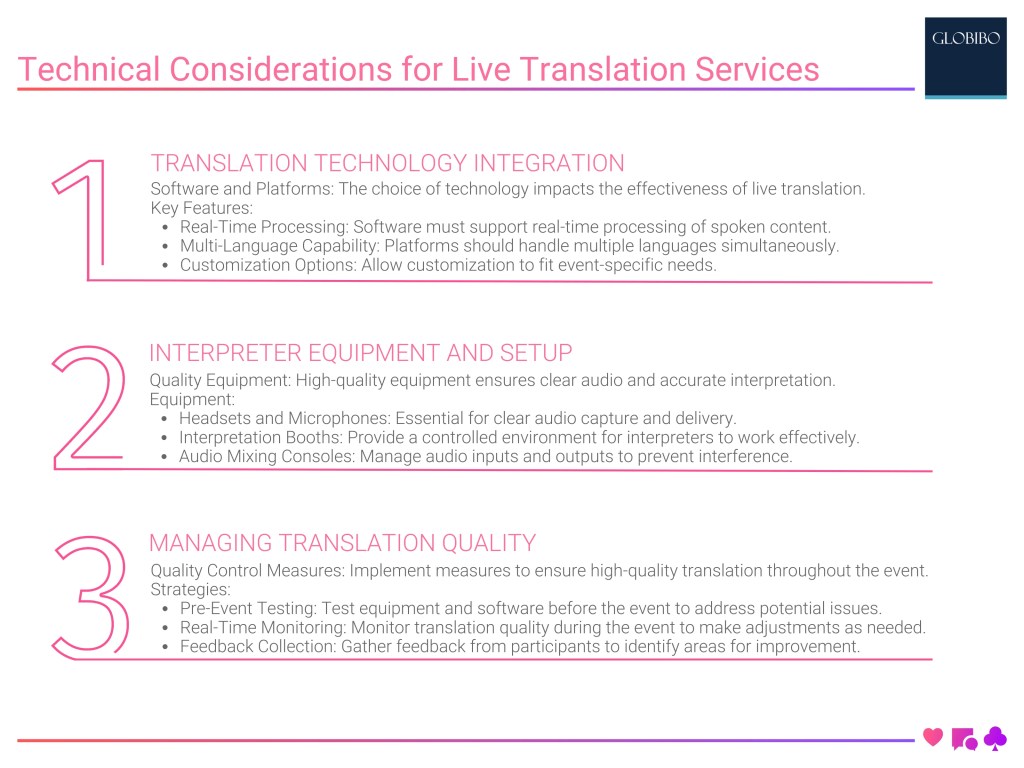
1. Translation Technology Integration
Software and Platforms: The choice of technology impacts the effectiveness of live translation.
Key Features:
- Real-Time Processing: Software must support real-time processing of spoken content.
- Multi-Language Capability: Platforms should handle multiple languages simultaneously.
- Customization Options: Allow customization to fit event-specific needs.
2. Interpreter Equipment and Setup
Quality Equipment: High-quality equipment ensures clear audio and accurate interpretation.
Equipment:
- Headsets and Microphones: Essential for clear audio capture and delivery.
- Interpretation Booths: Provide a controlled environment for interpreters to work effectively.
- Audio Mixing Consoles: Manage audio inputs and outputs to prevent interference.
3. Managing Translation Quality
Quality Control Measures: Implement measures to ensure high-quality translation throughout the event.
Strategies:
- Pre-Event Testing: Test equipment and software before the event to address potential issues.
- Real-Time Monitoring: Monitor translation quality during the event to make adjustments as needed.
- Feedback Collection: Gather feedback from participants to identify areas for improvement.
Comparison of Popular Language Pairs
| Language Pair | Common Applications | Benefits | Challenges |
| English-Spanish | Business meetings, conferences in Latin America | High interpreter availability, widespread use | Regional accents, varied dialects |
| English-Mandarin | International trade, business negotiations | Essential for interactions with Chinese stakeholders | Complex tonal language, interpreter availability |
| French-German | EU meetings, international diplomacy | Well-established networks, crucial for Europe | Similar vocabulary, potential for regional differences |
| Arabic-English | Middle Eastern conferences, diplomacy | Key for MENA region communication, growing demand | Dialect variations, complex grammar |
Challenges and Solutions
1. Addressing Dialect Variations
Challenge: Dialect differences within the same language can affect translation accuracy.
Solutions:
- Interpreter Specialization: Choose interpreters familiar with specific dialects.
- Pre-Event Briefing: Provide context on dialectal variations and terminology.
2. Managing Interpreter Fatigue
Challenge: Long-duration events can lead to interpreter fatigue, affecting translation quality.
Solutions:
- Team Interpreting: Use multiple interpreters to rotate and manage fatigue.
- Breaks and Rest: Schedule regular breaks for interpreters to maintain performance.
3. Ensuring Technical Reliability
Challenge: Technical issues can disrupt live translation services.
Solutions:
- Backup Systems: Implement redundant systems for audio and translation technology.
- Technical Support: Have a dedicated team for technical support during the event.
Conclusion for Live Translation
Choosing the right language pair for live translation services is crucial for effective cross-cultural communication. By considering factors such as audience demographics, event content, and interpreter expertise, organizations can ensure that their multilingual events are successful and inclusive. Evaluating common language pairs, integrating advanced technology, and addressing potential challenges are key to optimizing live translation services.
As global communication continues to expand, the importance of selecting the appropriate language pair will remain significant. Organizations that invest in effective live translation services will enhance their ability to engage with diverse audiences, foster understanding, and achieve their communication goals in a globalized world.
Academic References for Live Translation
- [BOOK] The Savvy Client’s Guide to Translation Agencies: How to find the right agency the first time
- Multilingual communication via best-balanced machine translation
- [BOOK] A practical guide for translators
- [PDF] Multilingual mobile-phone translation services for world travelers
- Multinational language service provider as user
- [BOOK] How to succeed as a freelance translator
- [PDF] Artificial Intelligence Based Language Translation Platform.
- Crowdsourced monolingual translation
- [BOOK] Translating into Success: Cutting-edge strategies for going multilingual in a global age
- [BOOK] Translating into Success: Cutting-edge strategies for going multilingual in a global age

Rick Lee
Project Manager – Event Technology
With over 10 years of experience in event technology, Rick is an expert in integrating cutting-edge tech solutions for seamless event execution. His expertise includes audio-visual setups, interactive displays, and live-streaming technologies. Rick’s innovative approach ensures every event is technologically advanced and highly engaging.
Youtube Video on Live Translation
Key Articles on Live Translation
- The Evolution of AI Transcription: From Manual to Automated Solutions
- Top AI Transcription Tools for Businesses: Features and Comparisons
- How AI Transcription Enhances Accessibility and Compliance in Media
- Accuracy in AI Transcription: Tips for Achieving the Best Results
- Live Translation in International Conferences: Key Considerations
- The Benefits of Live Translation for Virtual Events and Webinars
- Live Translation Services: How They Facilitate Cross-Cultural Communication
- How to Choose the Right Language Pair for Live Translation Services
Contacts
Certification

Testimonials


Event Technology