The Evolution of AI Event Transcription from Manual to Automated Solutions
The rapid development of Artificial Intelligence (AI) has revolutionized various industries, and one such area experiencing significant transformation is AI Transcription. With the rise of AI Event Transcription, this field has seen improvements in speed, accuracy, and scalability. Historically, transcription involved manual processes, requiring substantial human labor to convert audio into text. However, the introduction of AI Transcription, and especially AI Event Transcription, has drastically changed the landscape, offering faster and more accurate solutions. With the introduction of AI Event Transcription, this process has evolved into a more efficient, accurate, and scalable solution. This article explores the evolution of AI Transcription technologies, including AI Event Transcription, examining their history, current state, and potential future developments. Additionally, two structured lists and data in table format will help elucidate the key points discussed.
The History of AI Transcription and AI Event Transcription: Manual Beginnings
Manual Transcription
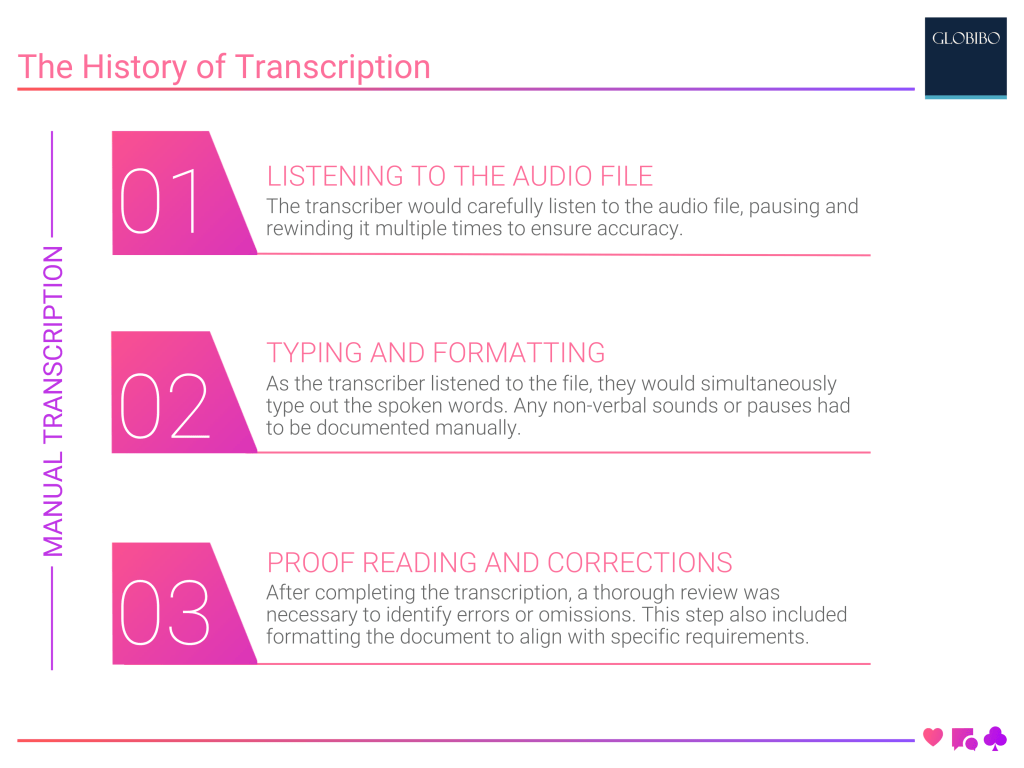
For many decades, transcription was a manual and labor-intensive task. Transcribers would listen to recordings, often using devices such as typewriters or early computers to document what they heard. This method was time-consuming and prone to human errors. The transcription process in these earlier times involved several steps:
- Listening to the Audio File: The transcriber would carefully listen to the audio file, pausing and rewinding it multiple times to ensure accuracy.
- Typing and Formatting: As the transcriber listened to the file, they would simultaneously type out the spoken words. Any non-verbal sounds or pauses had to be documented manually.
- Proofreading and Corrections: After completing the transcription, a thorough review was necessary to identify errors or omissions. This step also included formatting the document to align with specific requirements.
Challenges in Manual Transcription
- Time-Intensive: Manual transcription could take anywhere from 4 to 10 hours to transcribe a single hour of audio, depending on complexity.
- High Cost: Skilled transcribers charged per hour or per project, often resulting in high labor costs.
- Human Error: Factors such as misheard words, distractions, and fatigue often led to inaccuracies in the final transcription.
These limitations underscored the need for more efficient solutions, setting the stage for technological advancements that could automate these tasks.
The Emergence of Early Automated Transcription
Digital Revolution and Speech Recognition
The late 20th century witnessed the advent of digital transcription technologies, including early speech recognition systems. This marked a significant shift in how transcription was approached. Speech recognition technologies initially involved creating a limited vocabulary model that matched pre-defined words spoken by the user. The progress in Natural Language Processing (NLP) and machine learning in the 1990s provided the foundation for more sophisticated AI transcription systems.
Early automated AI transcription systems were rule-based, meaning they relied on pre-defined linguistic rules to convert speech into text. These systems laid the foundation for modern AI event transcription solutions that are much more flexible and accurate. These systems, while innovative, were often inaccurate and slow, especially when dealing with variations in accents, background noise, or dialects. Despite their limitations, they laid the groundwork for modern AI Event transcription.
Key Features of Early Automated Transcription Systems:
- Limited Vocabulary Models: These systems could only recognize a small subset of words, often requiring users to speak slowly and clearly.
- Rule-Based Algorithms: Speech recognition depended on linguistic models with pre-set grammar and syntax rules.
- Poor Handling of Accents and Noise: The systems struggled with variations in speech patterns, accents, or non-native speakers.
Modern AI Event Transcription: The Game Changer
Deep Learning and AI in Transcription
Modern AI transcription technologies, including AI event transcription, utilize deep learning, machine learning, and sophisticated NLP models to improve both the accuracy and speed of transcription. AI event transcription systems can now handle a wider variety of languages, dialects, and accents with increased precision. The use of neural networks enables these systems to “learn” from vast amounts of data, allowing them to continually improve performance over time.
In contrast to manual transcription, AI transcription solutions are highly automated and capable of processing vast amounts of audio data in a fraction of the time. Current AI transcription tools rely on vast datasets, using acoustic and language models to understand context, identify speakers, and capture nuances in spoken language.
Advancements in AI Transcription Technology
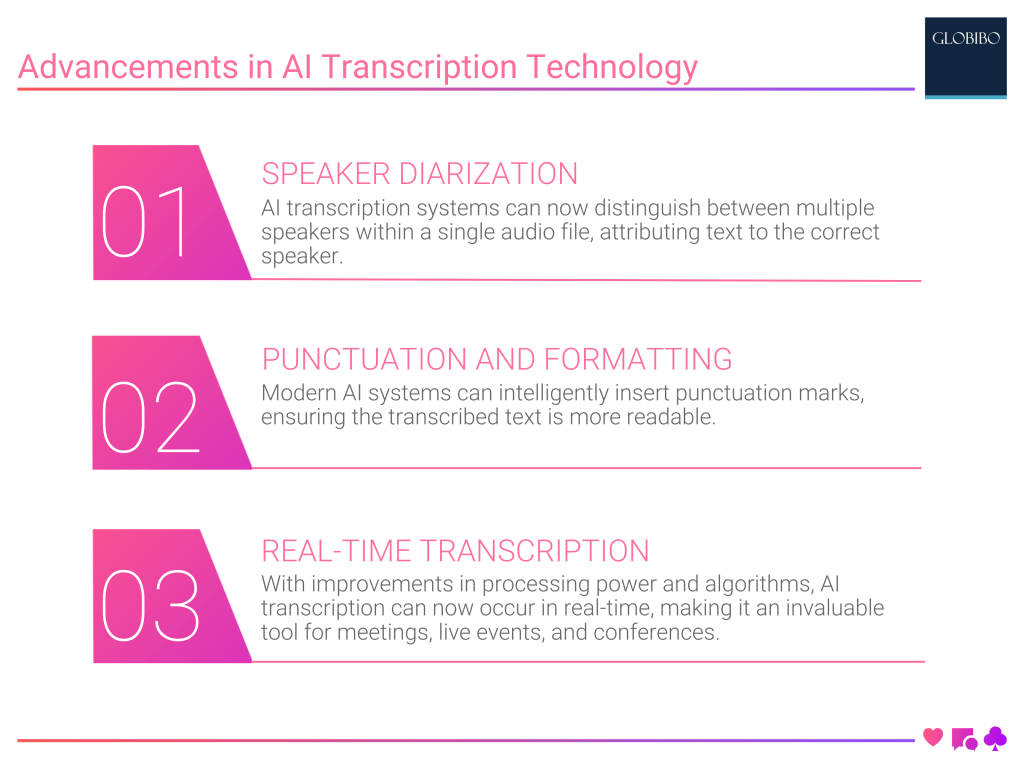
- Speaker Diarization: AI transcription systems can now distinguish between multiple speakers within a single audio file, attributing text to the correct speaker.
- Punctuation and Formatting: Modern AI systems can intelligently insert punctuation marks, ensuring the transcribed text is more readable.
- Real-Time Transcription: With improvements in processing power and algorithms, AI transcription can now occur in real-time, making it an invaluable tool for meetings, live events, and conferences.
Key Differences Between Manual, Early Automated, and Modern AI Transcription
| Feature | Manual Transcription | Early Automated Transcription | Modern AI Transcription |
| Accuracy | Moderate | Low | High |
| Processing Time | 4-10 hours per 1 hour of audio | Several hours | Real-time or near real-time |
| Cost | High (due to human labor) | Moderate | Low (scalable with automation) |
| Speaker Identification | Manual | Not available | Automated via speaker diarization |
| Handling of Accents/Dialects | Dependent on the transcriber | Poor | Excellent, with deep learning |
| Integration with Other Tools | Limited | Limited | Seamless with APIs and software |
Benefits of AI Transcription Solutions
The evolution from manual to AI transcription offers numerous advantages across various industries, including legal, medical, corporate, and entertainment sectors. Below are the key benefits that have made AI transcription solutions widely adopted:
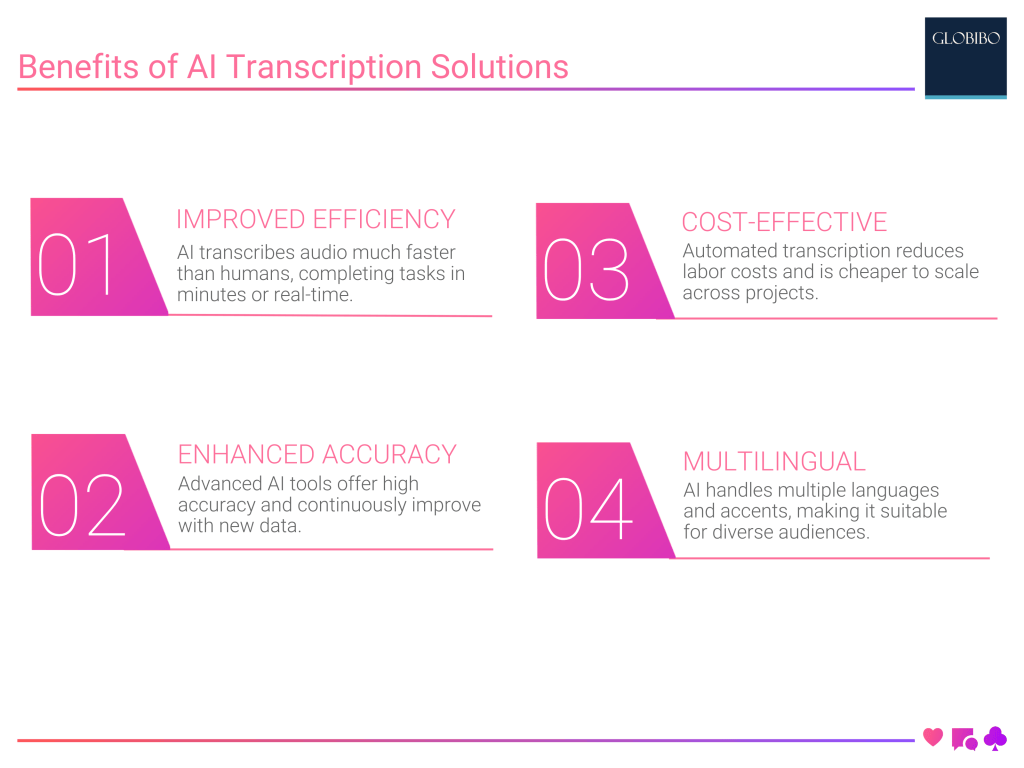
1. Improved Efficiency
AI transcription systems can process large volumes of data at speeds unattainable by human transcribers. For instance, transcribing a 1-hour interview manually can take several hours, while AI systems can complete the task in minutes or real-time, depending on the complexity of the audio.
2. Enhanced Accuracy
Modern AI transcription tools can achieve high levels of accuracy, thanks to advanced neural networks. Continuous learning algorithms enable these systems to refine their transcriptions based on new data, further improving accuracy over time.
3. Cost-Effective
Automated transcription reduces the need for human labor, making transcription more affordable for businesses. Additionally, scaling AI transcription across multiple projects incurs marginal incremental costs compared to manual processes.
4. Multilingual and Multi-Accent Support
AI transcription systems have evolved to support numerous languages and accents, broadening their usability in global industries. This multilingual capability ensures that businesses and organizations can cater to diverse audiences.
5. Real-Time Capabilities
The ability to transcribe conversations in real-time is a crucial advancement in AI transcription. Real-time transcription is especially beneficial in fields like broadcasting, legal proceedings, and customer support.
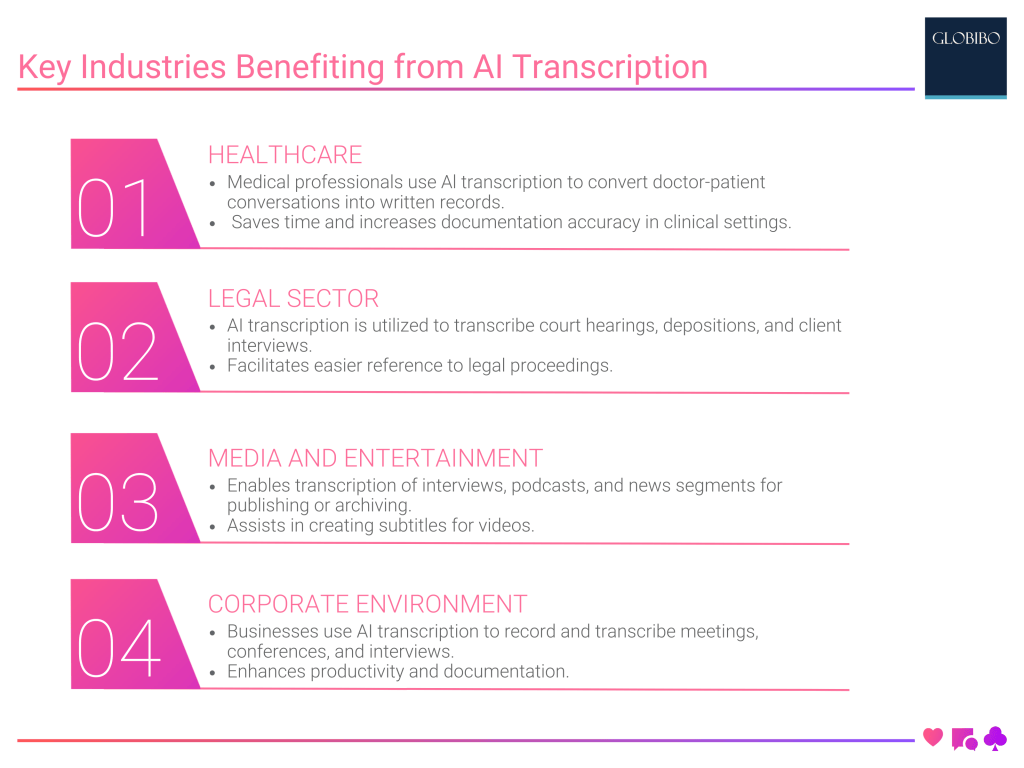
Key Industries Benefiting from AI Transcription
-
Healthcare:
- Medical professionals use AI transcription to convert doctor-patient conversations into written records.
- Saves time and increases documentation accuracy in clinical settings.
-
Legal Sector:
- AI transcription is utilized to transcribe court hearings, depositions, and client interviews.
- Facilitates easier reference to legal proceedings.
-
Media and Entertainment:
- Enables transcription of interviews, podcasts, and news segments for publishing or archiving.
- Assists in creating subtitles for videos.
-
Corporate Environment:
- Businesses use AI transcription to record and transcribe meetings, conferences, and interviews.
- Enhances productivity and documentation.
Challenges and Limitations of AI Transcription
Despite its significant advancements, AI transcription is not without its challenges. Several limitations persist, particularly in cases where complex audio or specialized vocabulary is involved.
1. Handling of Complex Audio
Background noise, overlapping conversations, or poor-quality recordings can negatively impact AI transcription accuracy. Although modern algorithms have improved in noise filtering, these conditions still pose challenges.
2. Specialized Jargon and Industry-Specific Terms
Certain industries, such as legal, healthcare, and academia, often use technical language that may not be well-represented in the datasets used to train AI transcription systems. Consequently, AI systems may struggle with terminology unless specifically trained on industry-specific data.
3. Ethical and Privacy Concerns
The use of AI transcription raises concerns about data privacy, particularly when sensitive conversations or confidential information are involved. Ensuring that AI transcription tools adhere to data protection regulations (such as GDPR and HIPAA) is critical.
4. Language and Cultural Nuances
While AI transcription has significantly improved its ability to understand different accents and dialects, capturing language nuances, idioms, and cultural references is still an ongoing challenge.
Challenges Facing AI Transcription
-
Audio Quality:
- Poor-quality audio with background noise can still degrade transcription accuracy.
-
Specialized Vocabulary:
- AI transcription systems may misinterpret technical terms if not trained on domain-specific data.
-
Privacy and Compliance:
- There are concerns about storing and processing sensitive conversations, especially in sectors like healthcare and law.
-
Ethical Use:
- AI transcription must be used responsibly, ensuring consent and safeguarding sensitive information.
Future Trends in AI Transcription
The field of AI transcription is expected to continue evolving, with several emerging trends likely to shape the future:
1. Increased Accuracy Through Domain-Specific AI
AI transcription systems will become more specialized, offering domain-specific models trained on industry jargon and language. This will improve accuracy in fields such as medicine, law, and technical industries.
2. Integration with Other AI Systems
AI transcription will be integrated with other AI-powered tools, such as sentiment analysis, automatic summarization, and real-time translation. This convergence will enable businesses to derive even more value from their transcription efforts.
3. Voice Biometrics and Authentication
Future AI transcription systems may incorporate voice biometrics to ensure speaker authentication, enhancing security and adding an additional layer of protection for sensitive information.
4. Enhanced Real-Time Transcription
The real-time capabilities of AI transcription will continue to improve, offering more accurate live transcriptions for events, customer service interactions, and legal proceedings.
Conclusion for AI Event Transcription
The evolution of AI transcription, particularly AI event transcription, from manual labor-intensive processes to highly automated, AI-driven systems, represents a significant leap forward in efficiency, accuracy, and scalability. As technology continues to advance, AI transcription will become an indispensable tool for a wide range of industries, offering real-time capabilities, cost savings, and greater access to multilingual and multi-accent transcription. Despite the challenges in handling complex audio and specialized vocabulary, AI transcription holds immense potential for further advancements, shaping the future of how we capture and process spoken language.
By embracing these innovations and addressing the limitations, AI transcription systems are poised to continue transforming how businesses, legal firms, healthcare providers, and media professionals operate, making transcription faster, more accessible, and more accurate than ever before.
Academic References for AI Event Transcription
- Automated generation of ‘good enough’transcripts as a first step to transcription of audio-recorded data
- [BOOK] Use of artificial intelligence (AI) in historical records transcription: Opportunities, challenges, and future directions
- [HTML] Semi-automated transcription and scoring of autobiographical memory narratives
- Comparison of voice-automated transcription and human transcription in generating pathology reports
- Preliminary Research on Computer-Assisted Transcription of Medieval Scripts in the Latin Alphabet using AI Computer Vision techniques and Machine Learning. A …
- Integrating automatic transcription into the language documentation workflow: Experiments with Na data and the Persephone toolkit
- Cody: An AI-based system to semi-automate coding for qualitative research
- [HTML] From voice to ink (Vink): development and assessment of an automated, free-of-charge transcription tool
- Speech-to-Text technology as a documentation tool for interpreters: A new approach to compiling an ad hoc corpus and extracting terminology from video-recorded …
- Transcribing as Research: “Manual” Transcription and Conversation Analysis

Rick Lee
Project Manager – Event Technology
With over 10 years of experience in event technology, Rick is an expert in integrating cutting-edge tech solutions for seamless event execution. His expertise includes audio-visual setups, interactive displays, and live-streaming technologies. Rick’s innovative approach ensures every event is technologically advanced and highly engaging.
YouTube Video for AI Event Transcription
Key Articles for AI Event Transcription
Contacts
Certification

Testimonials



Event Technology