How to Conduct a Live Test for Translation and Transcription
Live testing is a crucial phase in the validation of translation and transcription services. It ensures that these services perform accurately and effectively under real-world conditions. This comprehensive guide provides a detailed, step-by-step approach to conducting live tests for both translation and transcription services, emphasizing best practices, methodologies, and key considerations. The goal is to equip organizations with the knowledge to perform effective live tests, thereby enhancing service quality and reliability.
Understanding Live Testing
Live testing involves evaluating translation and transcription services in real-time to ensure they meet the desired standards of accuracy, efficiency, and functionality. This process is essential for identifying potential issues, verifying service performance, and making necessary adjustments before full-scale implementation.
Objectives of Live Testing
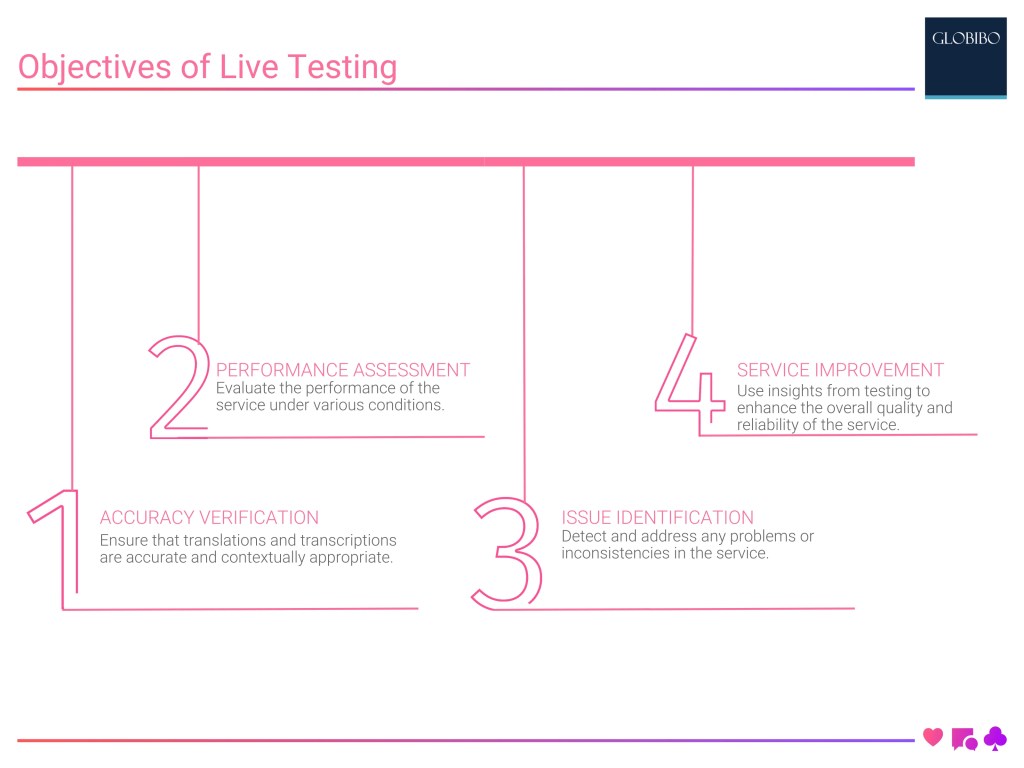
- Accuracy Verification: Ensure that translations and transcriptions are accurate and contextually appropriate.
- Performance Assessment: Evaluate the performance of the service under various conditions.
- Issue Identification: Detect and address any problems or inconsistencies in the service.
- Service Improvement: Use insights from testing to enhance the overall quality and reliability of the service.
Step-by-Step Guide to Conducting a Live Test
Define Testing Objectives
Objective Setting
- Determine Goals: Clearly define the goals of the live test, including what aspects of translation or transcription services need evaluation. Goals may include accuracy, speed, usability, or contextual appropriateness.
- Establish Criteria: Develop specific criteria for success. For example, accuracy might be measured as a percentage of correct translations or transcriptions.
Example:
- Translation Test Goals: Assess the accuracy of translated content and contextual relevance.
- Transcription Test Goals: Evaluate the accuracy of transcribed text and the service’s ability to handle various audio qualities.
Develop Test Scenarios
Scenario Creation
- Realistic Scenarios: Create scenarios that closely mimic real-world conditions. For translation, this could involve translating documents with diverse content. For transcription, it could include transcribing audio with different accents and background noises.
- Scenario Complexity: Ensure that scenarios vary in complexity to test the service’s capability across different conditions.
Example Scenarios:
- Translation: Translate a legal document, a marketing brochure, and an informal email.
- Transcription: Transcribe a clear interview, a conversation with background noise, and a lecture with technical terminology.
Set Up the Live Test Environment
Environment Preparation
- Controlled Setting: Set up a controlled environment that simulates real-world conditions. This includes preparing the necessary hardware, software, and network configurations.
- Participant Selection: Choose participants who represent the target audience or user base. For translation, this may include bilingual professionals; for transcription, it may include users familiar with the audio content.
Example Setup:
- Translation: Use translation management systems (TMS) and bilingual review teams.
- Transcription: Utilize transcription software and audio recording equipment with varying quality.
Execute the Live Test
Testing Execution
- Conduct Testing: Run the live test according to the developed scenarios. Ensure that all test cases are executed and data is collected systematically.
- Monitor Performance: Observe the performance of the translation or transcription service, noting any issues or anomalies.
Example Execution:
- Translation: Provide documents to translators and monitor their performance in real-time.
- Transcription: Record and transcribe audio while assessing the accuracy of the transcriptions.
Collect and Analyze Data
Data Collection
- Gather Results: Collect data on performance metrics, including accuracy rates, error frequencies, and user feedback. Ensure that data collection methods are standardized and comprehensive.
- Analyze Findings: Evaluate the collected data to identify trends, issues, and areas for improvement. Use statistical methods and analytical tools to assess service quality.
Example Data Points:
- Translation Accuracy: Percentage of correctly translated segments versus total segments.
- Transcription Accuracy: Error rate in transcribed text compared to the original audio.
Key Metrics for Live Testing
- Accuracy Metrics:
- Translation Accuracy: Percentage of correctly translated words or phrases.
- Transcription Accuracy: Percentage of correctly transcribed words or phrases.
- Performance Metrics:
- Speed: Time taken to complete translations or transcriptions.
- Error Rate: Frequency of errors or inconsistencies.
- User Feedback:
- Satisfaction Level: User satisfaction with the translation or transcription service.
- Usability Issues: Identified usability problems or challenges.

Address Issues and Implement Improvements
Issue Resolution
- Identify Issues: Based on the analysis, identify any issues or areas for improvement in the translation or transcription service.
- Implement Changes: Develop and implement corrective actions to address identified issues. This may involve adjusting workflows, refining algorithms, or improving user training.
Example Improvements:
- Translation: Adjust translation algorithms to improve accuracy in specialized domains.
- Transcription: Enhance speech recognition algorithms to better handle diverse audio inputs.
Common Issues and Solutions in Live Testing
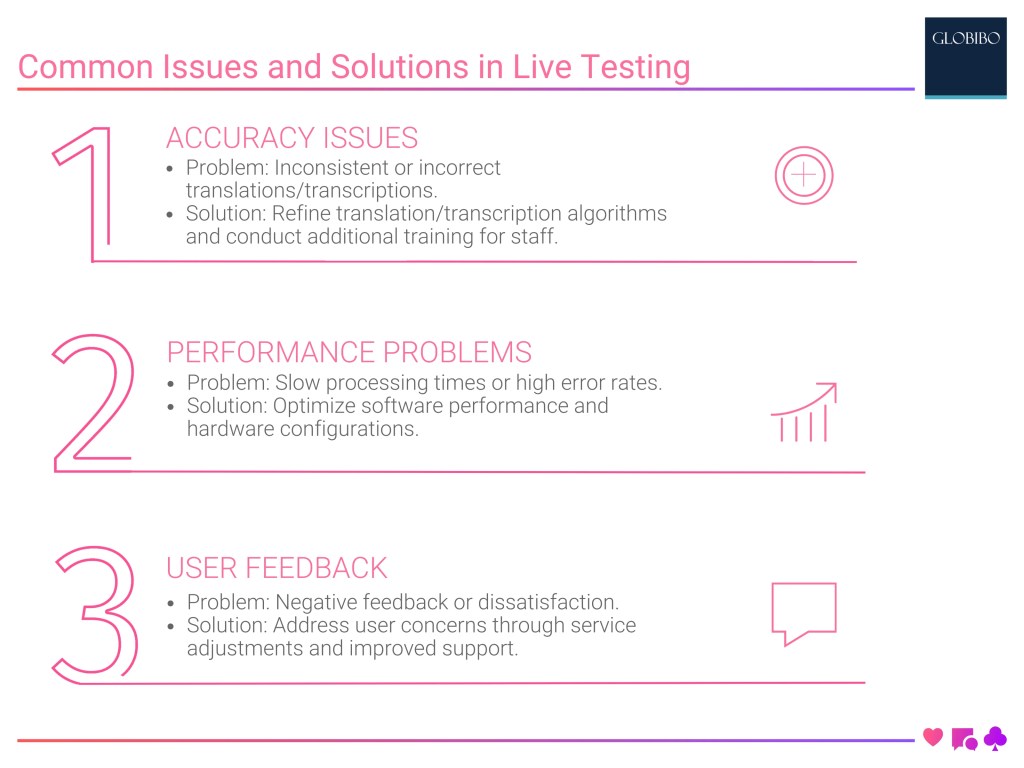
- Accuracy Issues:
- Problem: Inconsistent or incorrect translations/transcriptions.
- Solution: Refine translation/transcription algorithms and conduct additional training for staff.
- Performance Problems:
- Problem: Slow processing times or high error rates.
- Solution: Optimize software performance and hardware configurations.
- User Feedback:
- Problem: Negative feedback or dissatisfaction.
- Solution: Address user concerns through service adjustments and improved support.
Document and Report Findings
Documentation
- Report Results: Document the results of the live test, including key metrics, issues identified, and improvements made. Ensure that the report is detailed and provides actionable insights.
- Share Findings: Share the findings with relevant stakeholders, including management, technical teams, and end-users. Use the feedback to inform future testing and service enhancements.
Example Report Sections:
- Executive Summary: Overview of test objectives, methodology, and key findings.
- Detailed Analysis: In-depth analysis of performance metrics, issues, and improvements.
- Recommendations: Suggested actions based on test results.
Comparison of Live Testing for Translation vs. Transcription Services
| Aspect | Translation Services | Transcription Services |
| Test Scenarios | Document translations, context-specific texts | Audio recordings with various qualities |
| Accuracy Metrics | Translation correctness, contextual relevance | Transcription accuracy, error rates |
| Performance Metrics | Speed of translation, quality of output | Speed of transcription, handling of different audio types |
| User Feedback | Satisfaction with translation quality | Satisfaction with transcription accuracy and speed |
Conclusion for Live Test in Translation & Transcription
Conducting a live test for translation and transcription services is a crucial process to ensure that these services meet the highest standards of accuracy and performance. By following the step-by-step guide outlined in this article, organizations can effectively evaluate and enhance their translation and transcription services. This process not only helps in identifying and addressing potential issues but also contributes to the overall improvement of service quality.
Investing in rigorous live testing ensures that translation and transcription services are reliable, efficient, and capable of meeting the needs of diverse audiences. As global communication continues to evolve, the importance of effective live testing remains paramount in delivering high-quality, accurate, and contextually appropriate language services.
Academic References for Live Test in Translation & Transcription
- A transcription and translation protocol for sensitive cross-cultural team research
- [BOOK] Statistics translated: A step–by–step guide to analyzing and interpreting data
- Using software in qualitative research: A step–by–step guide
- [BOOK] Step by step: A course in contrastive linguistics and translation
- How to develop children as researchers: A step by step guide to teaching the research process
- [BOOK] Biomolecular kinetics: a step–by–step guide
- [BOOK] The copywriter’s handbook: a step–by–step guide to writing copy that sells
- The transcription of interpreting data
- [BOOK] Current protocols essential laboratory techniques
- [BOOK] Effective Methods for Software Testing, CafeScribe: Includes Complete Guidelines, Checklists, and Templates

Rick Lee
Project Manager – Event Technology
With over 10 years of experience in event technology, Rick is an expert in integrating cutting-edge tech solutions for seamless event execution. His expertise includes audio-visual setups, interactive displays, and live-streaming technologies. Rick’s innovative approach ensures every event is technologically advanced and highly engaging.
Youtube Video for Live Test in Translation and Transcription
Key Articles for Live Test in Translation and Transcription
- The Importance of Live Testing in Translation and Transcription Services
- How to Conduct a Live Test for Translation & Transcription: A Step-by-Step Guide
- Key Metrics to Measure During Live Translation & Transcription Tests
- Live Test Scenarios for Real-Time Translation Accuracy
- Live Translation in International Conferences: Key Considerations
- The Benefits of Live Translation for Virtual Events and Webinars
- Live Translation Services: How They Facilitate Cross-Cultural Communication
- How to Choose the Right Language Pair for Live Translation Services
Contacts
Certification

Testimonials


Event Technology