Comparing AI-Powered Live Captioning Services: What to Look For
AI-powered live captioning has become an indispensable tool for enhancing accessibility and engagement in a variety of settings, including live broadcasts, virtual meetings, and educational webinars. By converting spoken language into real-time text, these services make content accessible to a broader audience, including those with hearing impairments, non-native speakers, and individuals in noisy environments. With numerous providers offering AI-powered live captions solutions, choosing the right service involves evaluating several critical factors. This article provides a comprehensive comparison of leading AI-powered live captioning services, focusing on essential features, performance metrics, and integration capabilities.
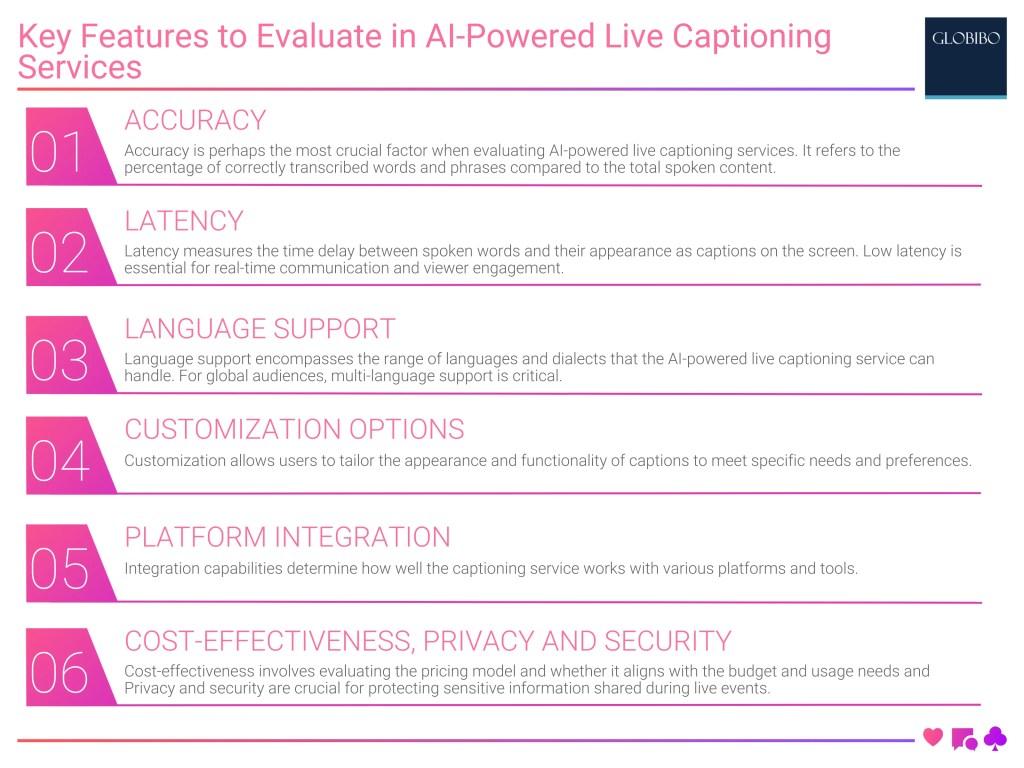
Key Features to Evaluate in AI-Powered Live Captioning Services
To select the best AI-powered live captioning service for your needs, it is crucial to understand and evaluate various features and performance metrics. Here are the primary aspects to consider:
Accuracy
Accuracy is perhaps the most crucial factor when evaluating AI-powered live captioning services. It refers to the percentage of correctly transcribed words and phrases compared to the total spoken content.
- Speech Recognition Quality: The accuracy of the Automatic Speech Recognition (ASR) technology used by the service. Advanced ASR models leverage deep learning and neural networks to improve recognition accuracy.
- Contextual Understanding: The capability of the Natural Language Processing (NLP) component to interpret and correct contextual errors, ensuring that the captions make sense in the given context.
Latency
Latency measures the time delay between spoken words and their appearance as captions on the screen. Low latency is essential for real-time communication and viewer engagement.
- Real-Time Processing: The ability of the AI system to process and display captions with minimal delay.
- Delay Tolerance: Acceptable latency thresholds, typically under 2 seconds for most live events.
Language Support
Language support encompasses the range of languages and dialects that the AI-powered live captioning service can handle. For global audiences, multi-language support is critical.
- Number of Supported Languages: The breadth of languages and dialects supported by the service.
- Accuracy Across Languages: The accuracy of captions in different languages, which can vary significantly depending on the language complexity and ASR model.
Customization Options
Customization allows users to tailor the appearance and functionality of captions to meet specific needs and preferences.
- Visual Customization: Options for adjusting font size, color, and caption positioning.
- Content Customization: The ability to customize terminology, add industry-specific vocabulary, or adjust caption formatting.
Platform Integration
Integration capabilities determine how well the captioning service works with various platforms and tools.
- Compatibility: Support for popular video conferencing platforms (e.g., Zoom, Microsoft Teams) and live streaming services (e.g., YouTube, Vimeo).
- API Integration: Availability of APIs for custom integrations with other applications and platforms.
Cost-Effectiveness
Cost-effectiveness involves evaluating the pricing model and whether it aligns with the budget and usage needs.
- Pricing Models: Different models such as subscription-based, pay-per-minute, or pay-per-event.
- Value for Money: The overall cost relative to the features and accuracy provided.
Privacy and Security
Privacy and security are crucial for protecting sensitive information shared during live events.
- Data Protection: Compliance with data protection regulations such as GDPR or HIPAA.
- Security Features: Measures to secure data transmission and storage.
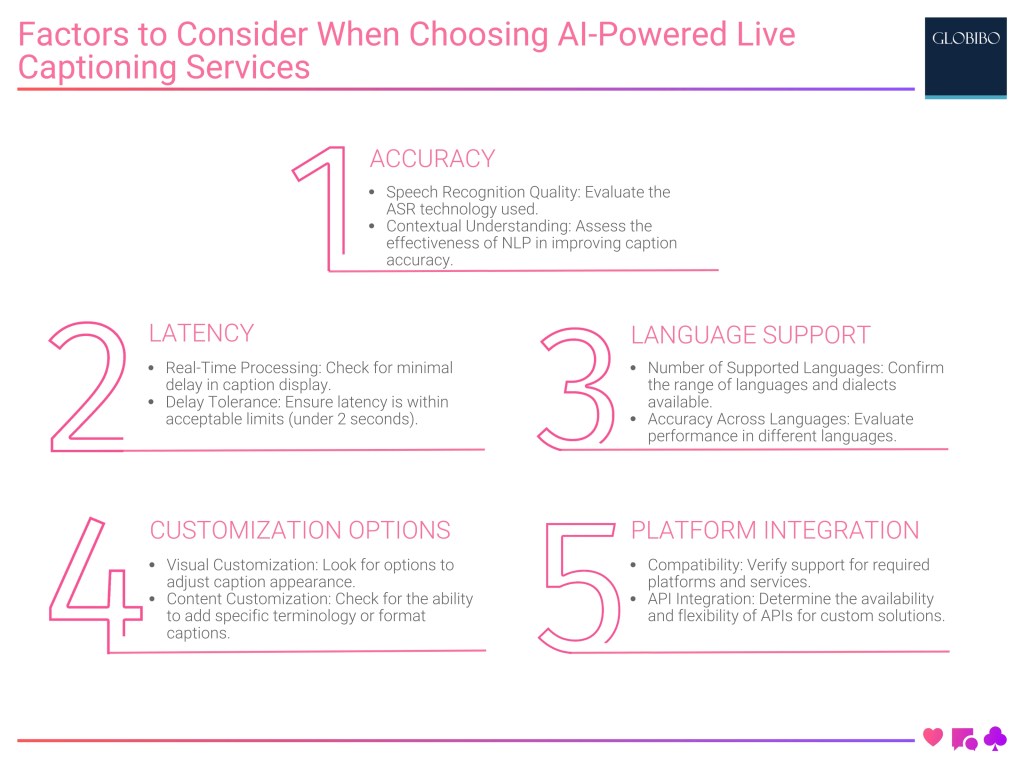
Factors to Consider When Choosing AI-Powered Live Captioning Services
- Accuracy
- Speech Recognition Quality: Evaluate the ASR technology used.
- Contextual Understanding: Assess the effectiveness of NLP in improving caption accuracy.
- Latency
- Real-Time Processing: Check for minimal delay in caption display.
- Delay Tolerance: Ensure latency is within acceptable limits (under 2 seconds).
- Language Support
- Number of Supported Languages: Confirm the range of languages and dialects available.
- Accuracy Across Languages: Evaluate performance in different languages.
- Customization Options
- Visual Customization: Look for options to adjust caption appearance.
- Content Customization: Check for the ability to add specific terminology or format captions.
- Platform Integration
- Compatibility: Verify support for required platforms and services.
- API Integration: Determine the availability and flexibility of APIs for custom solutions.
- Cost-Effectiveness
- Pricing Models: Compare different pricing structures.
- Value for Money: Assess the balance between cost and features.
- Privacy and Security
- Data Protection: Ensure compliance with relevant regulations.
- Security Features: Confirm robust security measures are in place.
Common Pitfalls to Avoid
Selecting an AI-powered live captioning service requires careful consideration to avoid common pitfalls. Here are some challenges to be aware of:
1. Overlooking Latency Issues
High latency can disrupt the flow of live events and reduce the effectiveness of captioning. Ensure that the service offers minimal delay and meets your real-time requirements.
2. Ignoring Multi-Language Capabilities
If your audience is international, verify that the service supports multiple languages and provides accurate captions in each language. Inadequate language support can hinder accessibility.
3. Neglecting Customization Needs
Failing to account for customization requirements can result in captions that do not align with your branding or accessibility needs. Ensure the service offers sufficient options for visual and content customization.
4. Disregarding Platform Compatibility
Not all AI-powered live captioning services integrate seamlessly with all platforms. Confirm that the service is compatible with the platforms and tools you use for live events.
5. Underestimating Privacy and Security
For events involving sensitive information, privacy and security should be a top priority. Ensure that the service complies with data protection regulations and offers robust security features.

Comparative Analysis of Major AI-Powered Live Captioning Services
To aid in your decision-making process, the following table summarizes key attributes of some leading AI-powered live captioning providers. This comparison focuses on accuracy, latency, language support, customization, integration, and cost-effectiveness.
Comparison of AI-Powered Live Captioning Providers
| Provider | Accuracy (%) | Supported Languages | Latency (Seconds) | Customization Options | Integration with Platforms | Cost Model | Privacy & Security |
| Google Live Caption | 90-95% | 40+ | 1-3 | Limited | Android, Chrome | Free | GDPR Compliance |
| Otter.ai | 85-90% | English only | 2-5 | Extensive | Zoom, Google Meet, Microsoft Teams | Subscription-based | GDPR Compliance |
| Rev AI | 92-96% | 31+ | 1-2 | Limited | Zoom, YouTube, Vimeo, API | Pay-per-minute | GDPR Compliance |
| Microsoft Azure Speech | 93-98% | 80+ | <1 | Extensive | Azure, Microsoft Teams, PowerPoint | Usage-based | GDPR, HIPAA Compliance |
| Descript | 88-92% | English, Spanish | 2-4 | Moderate | YouTube, Zoom, Google Meet | Subscription-based | GDPR Compliance |
| Verbit | 92-96% | 35+ | <1 | Extensive | Webinars, Virtual Classrooms, Custom APIs | Custom Pricing | GDPR, HIPAA Compliance |
Conclusion for AI-Powered Live Captions
When evaluating AI-powered live captioning services, it is essential to consider a range of factors including accuracy, latency, language support, customization options, platform integration, cost-effectiveness, and privacy. By understanding these key attributes and avoiding common pitfalls, you can select a service that meets your needs and enhances the accessibility and engagement of your live events. As technology continues to evolve, staying informed about advancements in AI-powered live captioning will help you make the most informed decision for your specific requirements.
Academic References for AI-Powered Live Captions
- Investigating Use Cases of AI–Powered Scene Description Applications for Blind and Low Vision People
- Investigating Use Cases of AI–Powered Scene Description Applications for Blind and Low Vision People
- The accuracy of automatic and human live captions in English
- How to Exploit China’s AI–powered Platforms for Korean-Chinese Translation/Interpreting Education
- GENERATIVE AI–POWERED FRAMEWORK
- Artificial intelligence fairness in the context of accessibility research on intelligent systems for people who are deaf or hard of hearing
- Image captioning system Using Artificial Intelligence
- [PDF] The Role of Artificial Intelligence in Enhancing Mobile App Accessibility
- Navigating the AI Landscape: A Comparative Study of Models, Applications, and Emerging Trends
- Can Commercially available AI services reduce costs within the media analysis industry?: A case study

Rick Lee
Project Manager – Event Technology
With over 10 years of experience in event technology, Rick is an expert in integrating cutting-edge tech solutions for seamless event execution. His expertise includes audio-visual setups, interactive displays, and live-streaming technologies. Rick’s innovative approach ensures every event is technologically advanced and highly engaging.
Youtube Video on AI-Powered Live Captions
Key Articles on AI-Powered Live Captions
Contacts
Certification

Testimonials


Event Technology